





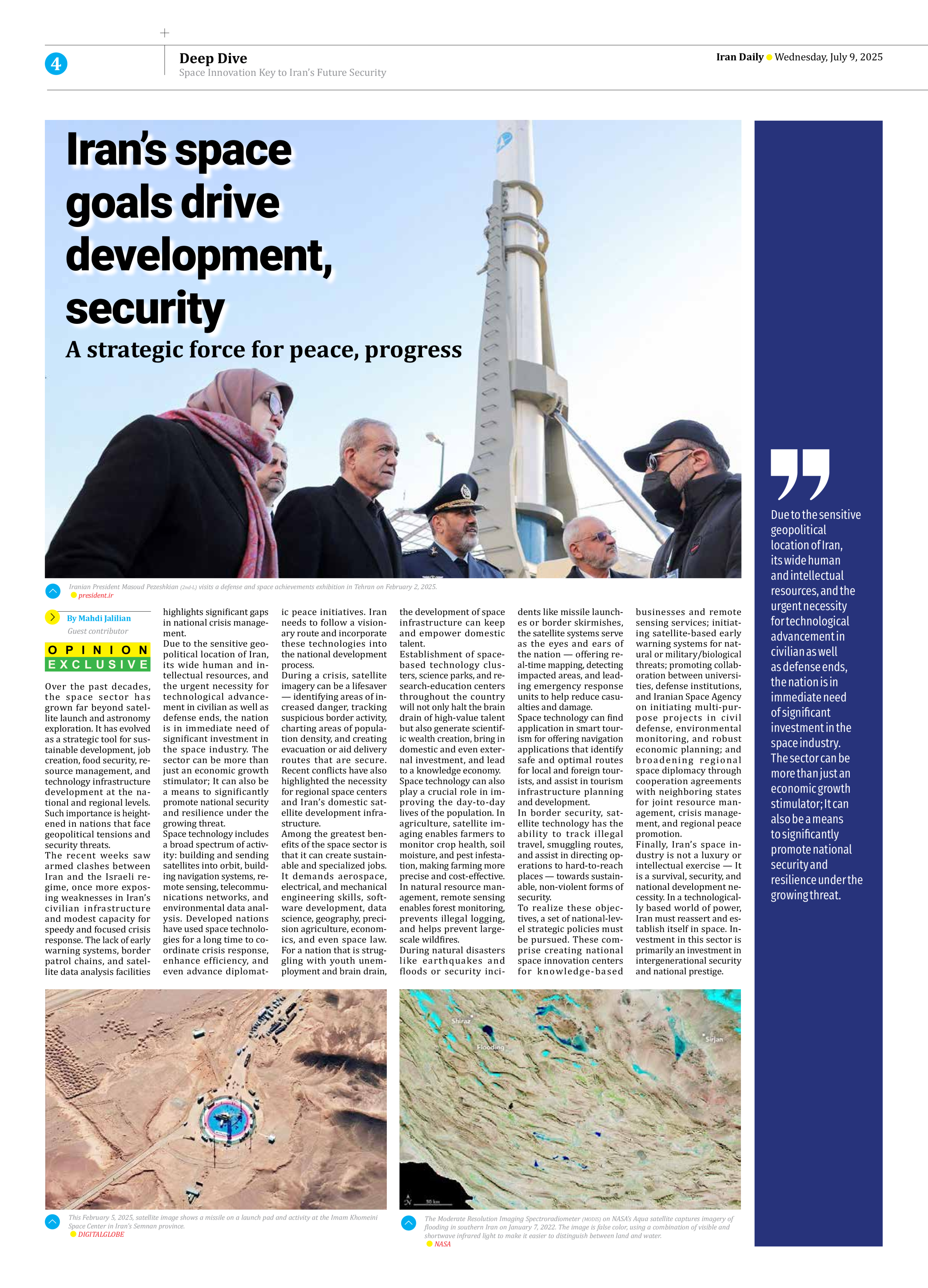


Iran’s space goals drive development, security
A strategic force for peace, progress
By Mahdi Jalilian
Guest contributor
Over the past decades, the space sector has grown far beyond satellite launch and astronomy exploration. It has evolved as a strategic tool for sustainable development, job creation, food security, resource management, and technology infrastructure development at the national and regional levels. Such importance is heightened in nations that face geopolitical tensions and security threats.
The recent weeks saw armed clashes between Iran and the Israeli regime, once more exposing weaknesses in Iran’s civilian infrastructure and modest capacity for speedy and focused crisis response. The lack of early warning systems, border patrol chains, and satellite data analysis facilities highlights significant gaps in national crisis management.
Due to the sensitive geopolitical location of Iran, its wide human and intellectual resources, and the urgent necessity for technological advancement in civilian as well as defense ends, the nation is in immediate need of significant investment in the space industry. The sector can be more than just an economic growth stimulator; It can also be a means to significantly promote national security and resilience under the growing threat.
Space technology includes a broad spectrum of activity: building and sending satellites into orbit, building navigation systems, remote sensing, telecommunications networks, and environmental data analysis. Developed nations have used space technologies for a long time to coordinate crisis response, enhance efficiency, and even advance diplomatic peace initiatives. Iran needs to follow a visionary route and incorporate these technologies into the national development process.
During a crisis, satellite imagery can be a lifesaver — identifying areas of increased danger, tracking suspicious border activity, charting areas of population density, and creating evacuation or aid delivery routes that are secure. Recent conflicts have also highlighted the necessity for regional space centers and Iran’s domestic satellite development infrastructure.
Among the greatest benefits of the space sector is that it can create sustainable and specialized jobs. It demands aerospace, electrical, and mechanical engineering skills, software development, data science, geography, precision agriculture, economics, and even space law. For a nation that is struggling with youth unemployment and brain drain, the development of space infrastructure can keep and empower domestic talent.
Establishment of space-based technology clusters, science parks, and research-education centers throughout the country will not only halt the brain drain of high-value talent but also generate scientific wealth creation, bring in domestic and even external investment, and lead to a knowledge economy.
Space technology can also play a crucial role in improving the day-to-day lives of the population. In agriculture, satellite imaging enables farmers to monitor crop health, soil moisture, and pest infestation, making farming more precise and cost-effective. In natural resource management, remote sensing enables forest monitoring, prevents illegal logging, and helps prevent large-scale wildfires.
During natural disasters like earthquakes and floods or security incidents like missile launches or border skirmishes, the satellite systems serve as the eyes and ears of the nation — offering real-time mapping, detecting impacted areas, and leading emergency response units to help reduce casualties and damage.
Space technology can find application in smart tourism for offering navigation applications that identify safe and optimal routes for local and foreign tourists, and assist in tourism infrastructure planning and development.
In border security, satellite technology has the ability to track illegal travel, smuggling routes, and assist in directing operations to hard-to-reach places — towards sustainable, non-violent forms of security.
To realize these objectives, a set of national-level strategic policies must be pursued. These comprise creating national space innovation centers for knowledge-based businesses and remote sensing services; initiating satellite-based early warning systems for natural or military/biological threats; promoting collaboration between universities, defense institutions, and Iranian Space Agency on initiating multi-purpose projects in civil defense, environmental monitoring, and robust economic planning; and broadening regional space diplomacy through cooperation agreements with neighboring states for joint resource management, crisis management, and regional peace promotion.
Finally, Iran’s space industry is not a luxury or intellectual exercise — It is a survival, security, and national development necessity. In a technologically based world of power, Iran must reassert and establish itself in space. Investment in this sector is primarily an investment in intergenerational security and national prestige.