





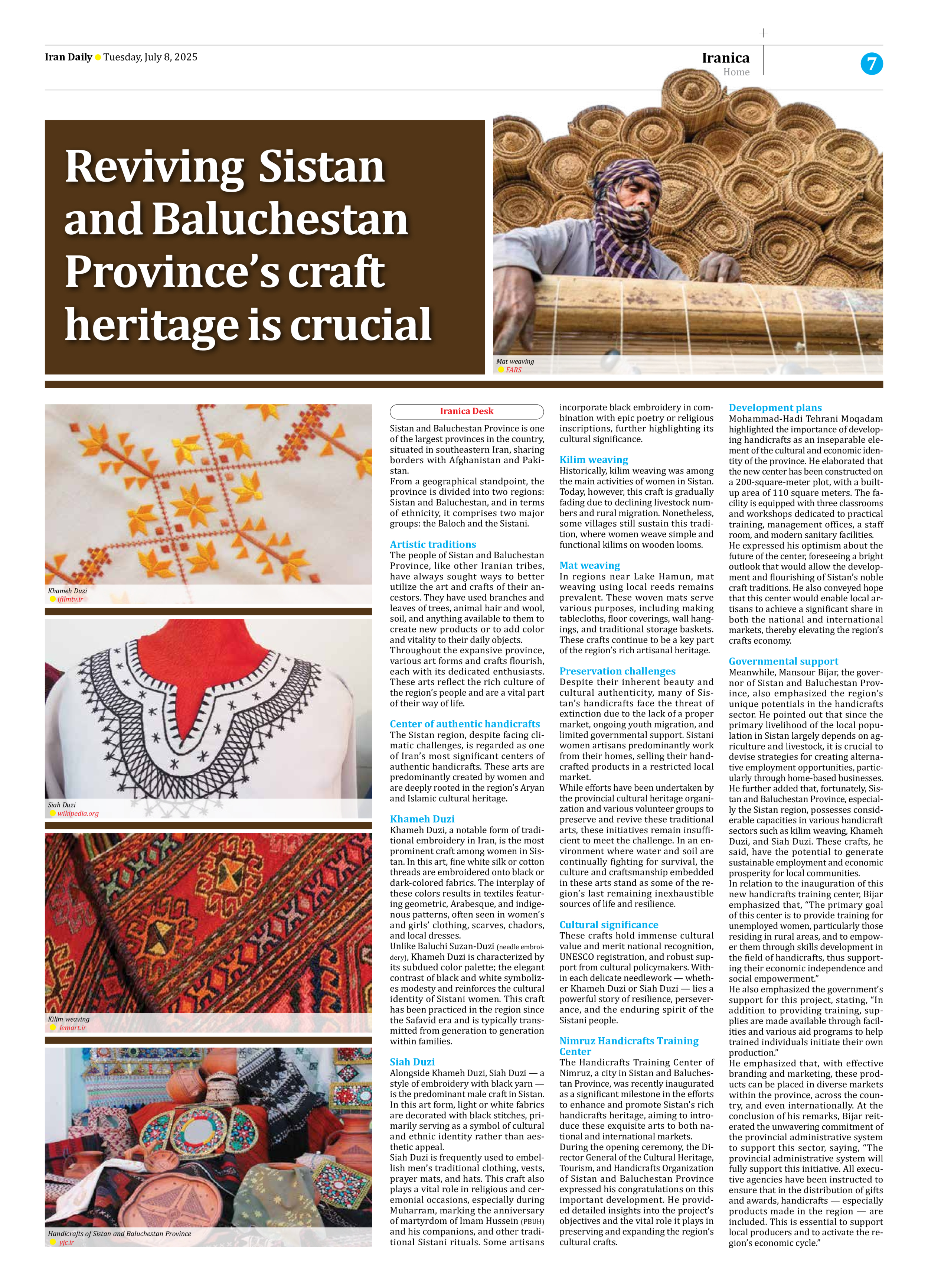


Reviving Sistan and Baluchestan Province’s craft heritage is crucial
Sistan and Baluchestan Province is one of the largest provinces in the country, situated in southeastern Iran, sharing borders with Afghanistan and Pakistan.
From a geographical standpoint, the province is divided into two regions: Sistan and Baluchestan, and in terms of ethnicity, it comprises two major groups: the Baloch and the Sistani.
Artistic traditions
The people of Sistan and Baluchestan Province, like other Iranian tribes, have always sought ways to better utilize the art and crafts of their ancestors. They have used branches and leaves of trees, animal hair and wool, soil, and anything available to them to create new products or to add color and vitality to their daily objects.
Throughout the expansive province, various art forms and crafts flourish, each with its dedicated enthusiasts. These arts reflect the rich culture of the region’s people and are a vital part of their way of life.
Center of authentic handicrafts
The Sistan region, despite facing climatic challenges, is regarded as one of Iran’s most significant centers of authentic handicrafts. These arts are predominantly created by women and are deeply rooted in the region’s Aryan and Islamic cultural heritage.
Khameh Duzi
Khameh Duzi, a notable form of traditional embroidery in Iran, is the most prominent craft among women in Sistan. In this art, fine white silk or cotton threads are embroidered onto black or dark-colored fabrics. The interplay of these colors results in textiles featuring geometric, Arabesque, and indigenous patterns, often seen in women’s and girls’ clothing, scarves, chadors, and local dresses.
Unlike Baluchi Suzan-Duzi (needle embroidery), Khameh Duzi is characterized by its subdued color palette; the elegant contrast of black and white symbolizes modesty and reinforces the cultural identity of Sistani women. This craft has been practiced in the region since the Safavid era and is typically transmitted from generation to generation within families.
Siah Duzi
Alongside Khameh Duzi, Siah Duzi — a style of embroidery with black yarn — is the predominant male craft in Sistan. In this art form, light or white fabrics are decorated with black stitches, primarily serving as a symbol of cultural and ethnic identity rather than aesthetic appeal.
Siah Duzi is frequently used to embellish men’s traditional clothing, vests, prayer mats, and hats. This craft also plays a vital role in religious and ceremonial occasions, especially during Muharram, marking the anniversary of martyrdom of Imam Hussein (PBUH) and his companions, and other traditional Sistani rituals. Some artisans incorporate black embroidery in combination with epic poetry or religious inscriptions, further highlighting its cultural significance.
Kilim weaving
Historically, kilim weaving was among the main activities of women in Sistan. Today, however, this craft is gradually fading due to declining livestock numbers and rural migration. Nonetheless, some villages still sustain this tradition, where women weave simple and functional kilims on wooden looms.
Mat weaving
In regions near Lake Hamun, mat weaving using local reeds remains prevalent. These woven mats serve various purposes, including making tablecloths, floor coverings, wall hangings, and traditional storage baskets. These crafts continue to be a key part of the region’s rich artisanal heritage.
Preservation challenges
Despite their inherent beauty and cultural authenticity, many of Sistan’s handicrafts face the threat of extinction due to the lack of a proper market, ongoing youth migration, and limited governmental support. Sistani women artisans predominantly work from their homes, selling their handcrafted products in a restricted local market.
While efforts have been undertaken by the provincial cultural heritage organization and various volunteer groups to preserve and revive these traditional arts, these initiatives remain insufficient to meet the challenge. In an environment where water and soil are continually fighting for survival, the culture and craftsmanship embedded in these arts stand as some of the region’s last remaining inexhaustible sources of life and resilience.
Cultural significance
These crafts hold immense cultural value and merit national recognition, UNESCO registration, and robust support from cultural policymakers. Within each delicate needlework — whether Khameh Duzi or Siah Duzi — lies a powerful story of resilience, perseverance, and the enduring spirit of the Sistani people.
Nimruz Handicrafts Training Center
The Handicrafts Training Center of Nimruz, a city in Sistan and Baluchestan Province, was recently inaugurated as a significant milestone in the efforts to enhance and promote Sistan’s rich handicrafts heritage, aiming to introduce these exquisite arts to both national and international markets.
During the opening ceremony, the Director General of the Cultural Heritage, Tourism, and Handicrafts Organization of Sistan and Baluchestan Province expressed his congratulations on this important development. He provided detailed insights into the project’s objectives and the vital role it plays in preserving and expanding the region’s cultural crafts.
Development plans
Mohammad-Hadi Tehrani Moqadam highlighted the importance of developing handicrafts as an inseparable element of the cultural and economic identity of the province. He elaborated that the new center has been constructed on a 200-square-meter plot, with a built-up area of 110 square meters. The facility is equipped with three classrooms and workshops dedicated to practical training, management offices, a staff room, and modern sanitary facilities.
He expressed his optimism about the future of the center, foreseeing a bright outlook that would allow the development and flourishing of Sistan’s noble craft traditions. He also conveyed hope that this center would enable local artisans to achieve a significant share in both the national and international markets, thereby elevating the region’s crafts economy.
Governmental support
Meanwhile, Mansour Bijar, the governor of Sistan and Baluchestan Province, also emphasized the region’s unique potentials in the handicrafts sector. He pointed out that since the primary livelihood of the local population in Sistan largely depends on agriculture and livestock, it is crucial to devise strategies for creating alternative employment opportunities, particularly through home-based businesses.
He further added that, fortunately, Sistan and Baluchestan Province, especially the Sistan region, possesses considerable capacities in various handicraft sectors such as kilim weaving, Khameh Duzi, and Siah Duzi. These crafts, he said, have the potential to generate sustainable employment and economic prosperity for local communities.
In relation to the inauguration of this new handicrafts training center, Bijar emphasized that, “The primary goal of this center is to provide training for unemployed women, particularly those residing in rural areas, and to empower them through skills development in the field of handicrafts, thus supporting their economic independence and social empowerment.”
He also emphasized the government’s support for this project, stating, “In addition to providing training, supplies are made available through facilities and various aid programs to help trained individuals initiate their own production.”
He emphasized that, with effective branding and marketing, these products can be placed in diverse markets within the province, across the country, and even internationally. At the conclusion of his remarks, Bijar reiterated the unwavering commitment of the provincial administrative system to support this sector, saying, “The provincial administrative system will fully support this initiative. All executive agencies have been instructed to ensure that in the distribution of gifts and awards, handicrafts — especially products made in the region — are included. This is essential to support local producers and to activate the region’s economic cycle.”