





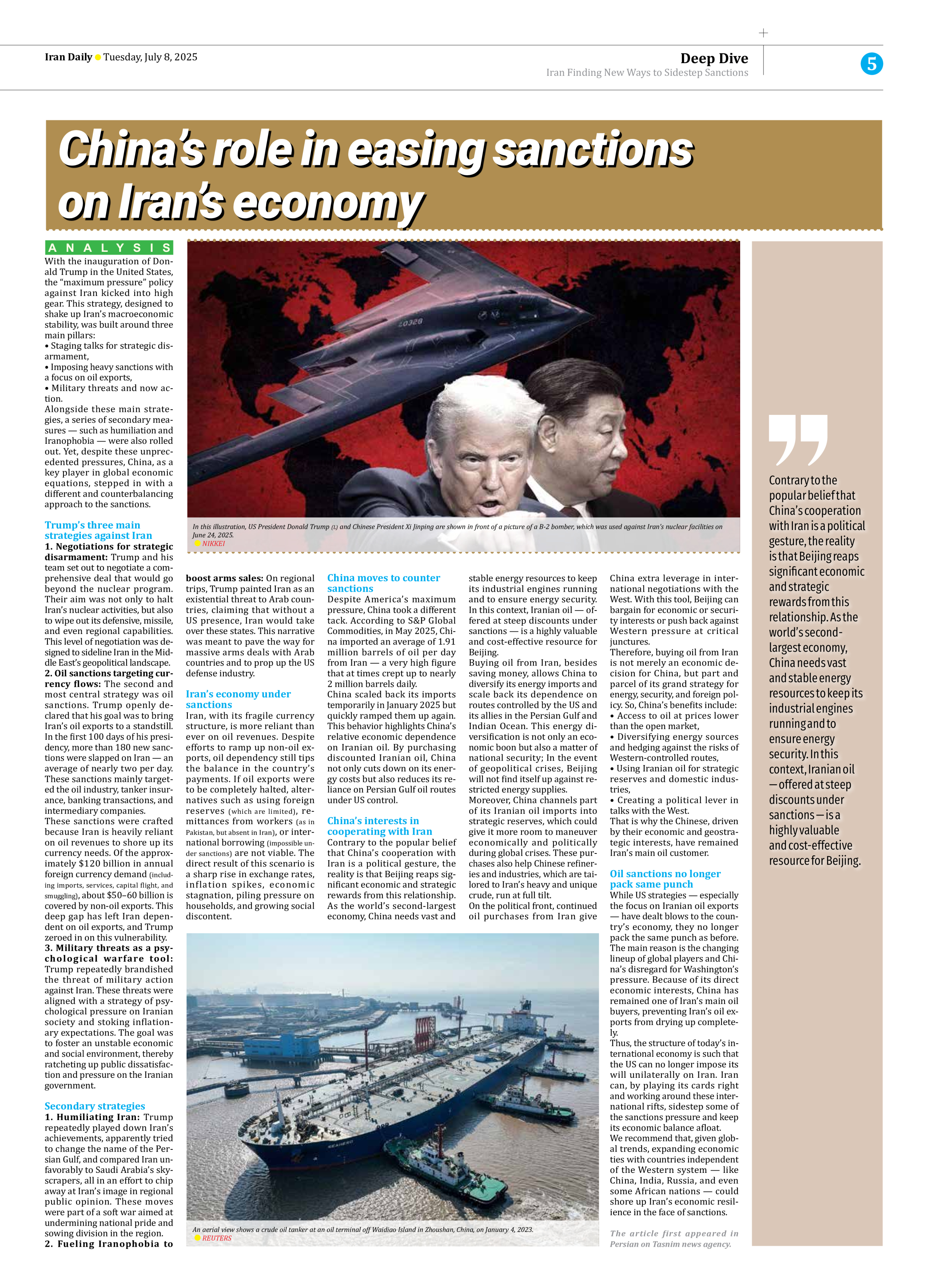


China’s role in easing sanctions on Iran’s economy
With the inauguration of Donald Trump in the United States, the “maximum pressure” policy against Iran kicked into high gear. This strategy, designed to shake up Iran’s macroeconomic stability, was built around three main pillars:
• Staging talks for strategic disarmament,
• Imposing heavy sanctions with a focus on oil exports,
• Military threats and now action.
Alongside these main strategies, a series of secondary measures — such as humiliation and Iranophobia — were also rolled out. Yet, despite these unprecedented pressures, China, as a key player in global economic equations, stepped in with a different and counterbalancing approach to the sanctions.
Trump’s three main strategies against Iran
1. Negotiations for strategic disarmament: Trump and his team set out to negotiate a comprehensive deal that would go beyond the nuclear program. Their aim was not only to halt Iran’s nuclear activities, but also to wipe out its defensive, missile, and even regional capabilities. This level of negotiation was designed to sideline Iran in the Middle East’s geopolitical landscape.
2. Oil sanctions targeting currency flows: The second and most central strategy was oil sanctions. Trump openly declared that his goal was to bring Iran’s oil exports to a standstill. In the first 100 days of his presidency, more than 180 new sanctions were slapped on Iran — an average of nearly two per day. These sanctions mainly targeted the oil industry, tanker insurance, banking transactions, and intermediary companies.
These sanctions were crafted because Iran is heavily reliant on oil revenues to shore up its currency needs. Of the approximately $120 billion in annual foreign currency demand (including imports, services, capital flight, and smuggling), about $50–60 billion is covered by non-oil exports. This deep gap has left Iran dependent on oil exports, and Trump zeroed in on this vulnerability.
3. Military threats as a psychological warfare tool: Trump repeatedly brandished the threat of military action against Iran. These threats were aligned with a strategy of psychological pressure on Iranian society and stoking inflationary expectations. The goal was to foster an unstable economic and social environment, thereby ratcheting up public dissatisfaction and pressure on the Iranian government.
Secondary strategies
1. Humiliating Iran: Trump repeatedly played down Iran’s achievements, apparently tried to change the name of the Persian Gulf, and compared Iran unfavorably to Saudi Arabia’s skyscrapers, all in an effort to chip away at Iran’s image in regional public opinion. These moves were part of a soft war aimed at undermining national pride and sowing division in the region.
2. Fueling Iranophobia to boost arms sales: On regional trips, Trump painted Iran as an existential threat to Arab countries, claiming that without a US presence, Iran would take over these states. This narrative was meant to pave the way for massive arms deals with Arab countries and to prop up the US defense industry.
Iran’s economy under sanctions
Iran, with its fragile currency structure, is more reliant than ever on oil revenues. Despite efforts to ramp up non-oil exports, oil dependency still tips the balance in the country’s payments. If oil exports were to be completely halted, alternatives such as using foreign reserves (which are limited), remittances from workers (as in Pakistan, but absent in Iran), or international borrowing (impossible under sanctions) are not viable. The direct result of this scenario is a sharp rise in exchange rates, inflation spikes, economic stagnation, piling pressure on households, and growing social discontent.
China moves to counter sanctions
Despite America’s maximum pressure, China took a different tack. According to S&P Global Commodities, in May 2025, China imported an average of 1.91 million barrels of oil per day from Iran — a very high figure that at times crept up to nearly 2 million barrels daily.
China scaled back its imports temporarily in January 2025 but quickly ramped them up again. This behavior highlights China’s relative economic dependence on Iranian oil. By purchasing discounted Iranian oil, China not only cuts down on its energy costs but also reduces its reliance on Persian Gulf oil routes under US control.
China’s interests in cooperating with Iran
Contrary to the popular belief that China’s cooperation with Iran is a political gesture, the reality is that Beijing reaps significant economic and strategic rewards from this relationship. As the world’s second-largest economy, China needs vast and stable energy resources to keep its industrial engines running and to ensure energy security. In this context, Iranian oil — offered at steep discounts under sanctions — is a highly valuable and cost-effective resource for Beijing.
Buying oil from Iran, besides saving money, allows China to diversify its energy imports and scale back its dependence on routes controlled by the US and its allies in the Persian Gulf and Indian Ocean. This energy diversification is not only an economic boon but also a matter of national security; In the event of geopolitical crises, Beijing will not find itself up against restricted energy supplies.
Moreover, China channels part of its Iranian oil imports into strategic reserves, which could give it more room to maneuver economically and politically during global crises. These purchases also help Chinese refineries and industries, which are tailored to Iran’s heavy and unique crude, run at full tilt.
On the political front, continued oil purchases from Iran give China extra leverage in international negotiations with the West. With this tool, Beijing can bargain for economic or security interests or push back against Western pressure at critical junctures.
Therefore, buying oil from Iran is not merely an economic decision for China, but part and parcel of its grand strategy for energy, security, and foreign policy. So, China’s benefits include:
• Access to oil at prices lower than the open market,
• Diversifying energy sources and hedging against the risks of Western-controlled routes,
• Using Iranian oil for strategic reserves and domestic industries,
• Creating a political lever in talks with the West.
That is why the Chinese, driven by their economic and geostrategic interests, have remained Iran’s main oil customer.
Oil sanctions no longer pack same punch
While US strategies — especially the focus on Iranian oil exports — have dealt blows to the country’s economy, they no longer pack the same punch as before. The main reason is the changing lineup of global players and China’s disregard for Washington’s pressure. Because of its direct economic interests, China has remained one of Iran’s main oil buyers, preventing Iran’s oil exports from drying up completely.
Thus, the structure of today’s international economy is such that the US can no longer impose its will unilaterally on Iran. Iran can, by playing its cards right and working around these international rifts, sidestep some of the sanctions pressure and keep its economic balance afloat.
We recommend that, given global trends, expanding economic ties with countries independent of the Western system — like China, India, Russia, and even some African nations — could shore up Iran’s economic resilience in the face of sanctions.
The article first appeared in
Persian on Tasnim news agency.