







Urartian royal inscription unearthed near lake Urmia
Iranian researchers uncovered the first hard evidence of King Rusa I of Urartu’s presence east of Lake Urmia, the Cultural Heritage and Tourism Research Institute confirmed.
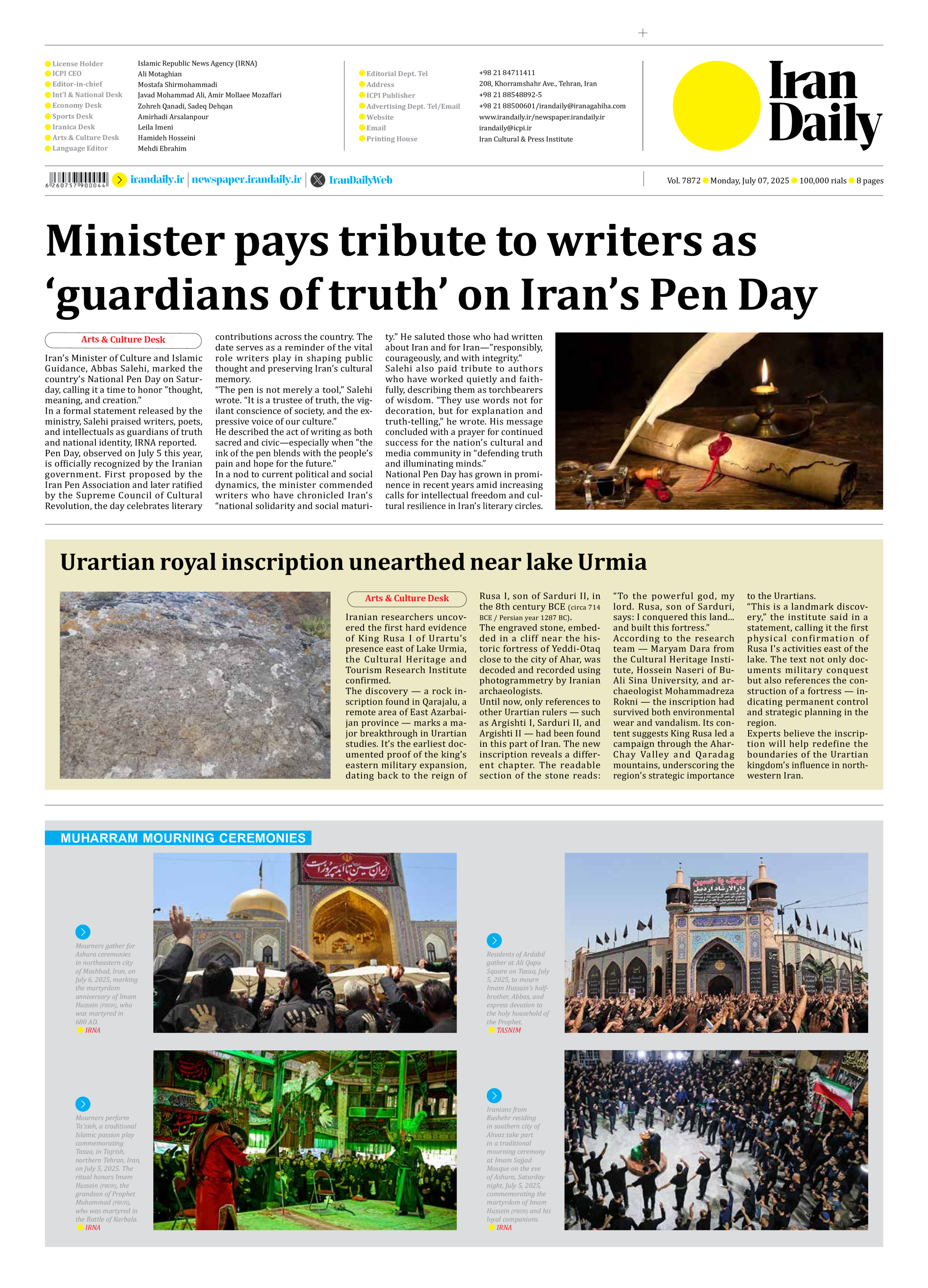
The discovery — a rock inscription found in Qarajalu, a remote area of East Azarbaijan province — marks a major breakthrough in Urartian studies. It’s the earliest documented proof of the king’s eastern military expansion, dating back to the reign of Rusa I, son of Sarduri II, in the 8th century BCE (circa 714 BCE / Persian year 1287 BC).
The engraved stone, embedded in a cliff near the historic fortress of Yeddi-Otaq close to the city of Ahar, was decoded and recorded using photogrammetry by Iranian archaeologists.
Until now, only references to other Urartian rulers — such as Argishti I, Sarduri II, and Argishti II — had been found in this part of Iran. The new inscription reveals a different chapter. The readable section of the stone reads: “To the powerful god, my lord. Rusa, son of Sarduri, says: I conquered this land... and built this fortress.”
According to the research team — Maryam Dara from the Cultural Heritage Institute, Hossein Naseri of Bu-Ali Sina University, and archaeologist Mohammadreza Rokni — the inscription had survived both environmental wear and vandalism. Its content suggests King Rusa led a campaign through the Ahar-Chay Valley and Qaradag mountains, underscoring the region’s strategic importance to the Urartians.
“This is a landmark discovery,” the institute said in a statement, calling it the first physical confirmation of Rusa I's activities east of the lake. The text not only documents military conquest but also references the construction of a fortress — indicating permanent control and strategic planning in the region.
Experts believe the inscription will help redefine the boundaries of the Urartian kingdom’s influence in northwestern Iran.