





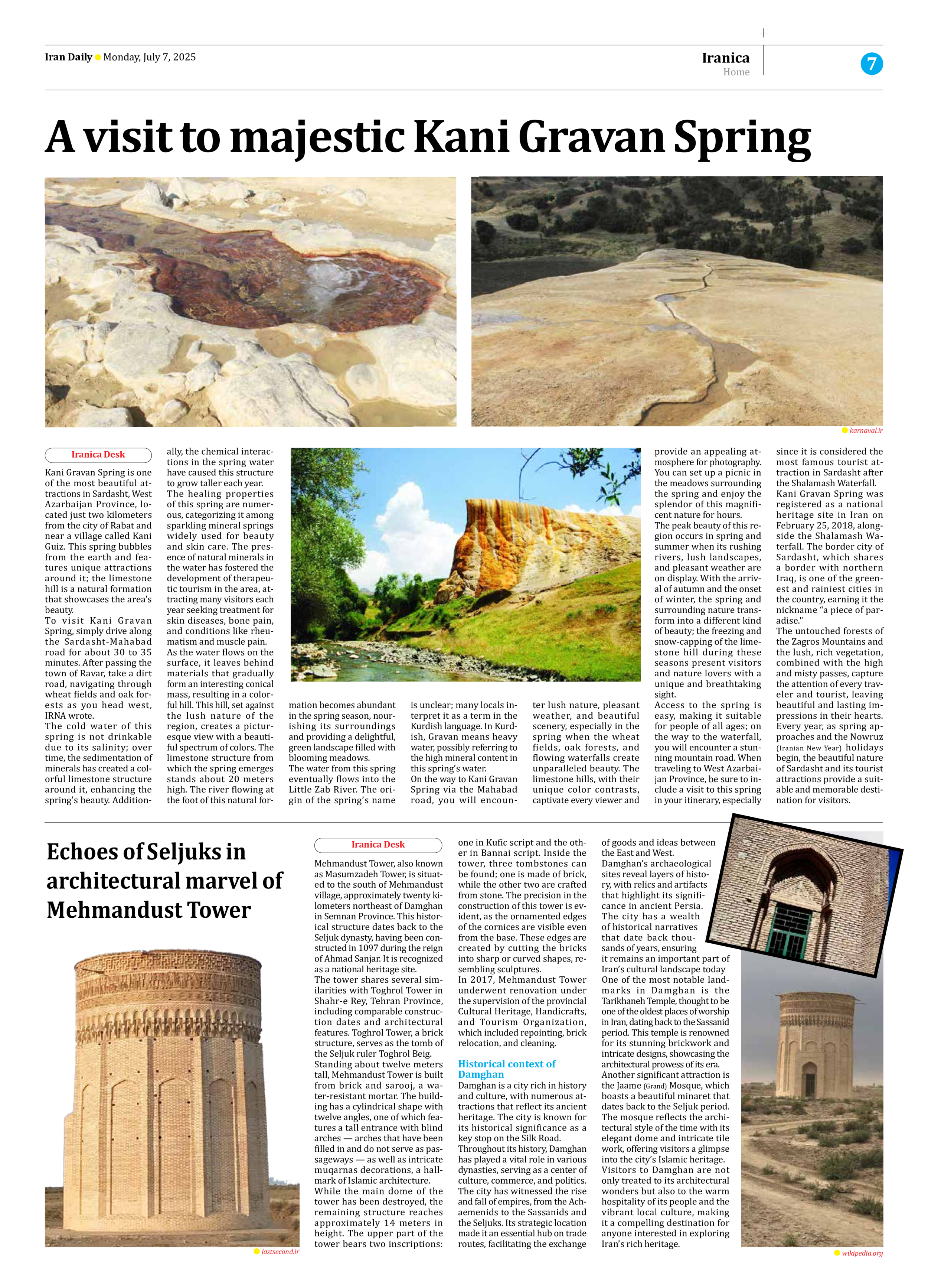


Echoes of Seljuks in architectural marvel of Mehmandust Tower
Mehmandust Tower, also known as Masumzadeh Tower, is situated to the south of Mehmandust village, approximately twenty kilometers northeast of Damghan in Semnan Province. This historical structure dates back to the Seljuk dynasty, having been constructed in 1097 during the reign of Ahmad Sanjar. It is recognized as a national heritage site.
The tower shares several similarities with Toghrol Tower in Shahr-e Rey, Tehran Province, including comparable construction dates and architectural features. Toghrol Tower, a brick structure, serves as the tomb of the Seljuk ruler Toghrol Beig.
Standing about twelve meters tall, Mehmandust Tower is built from brick and sarooj, a water-resistant mortar. The building has a cylindrical shape with twelve angles, one of which features a tall entrance with blind arches — arches that have been filled in and do not serve as passageways — as well as intricate muqarnas decorations, a hallmark of Islamic architecture.
While the main dome of the tower has been destroyed, the remaining structure reaches approximately 14 meters in height. The upper part of the tower bears two inscriptions: one in Kufic script and the other in Bannai script. Inside the tower, three tombstones can be found; one is made of brick, while the other two are crafted from stone. The precision in the construction of this tower is evident, as the ornamented edges of the cornices are visible even from the base. These edges are created by cutting the bricks into sharp or curved shapes, resembling sculptures.
In 2017, Mehmandust Tower underwent renovation under the supervision of the provincial Cultural Heritage, Handicrafts, and Tourism Organization, which included repointing, brick relocation, and cleaning.
Historical context of Damghan
Damghan is a city rich in history and culture, with numerous attractions that reflect its ancient heritage. The city is known for its historical significance as a key stop on the Silk Road.
Throughout its history, Damghan has played a vital role in various dynasties, serving as a center of culture, commerce, and politics. The city has witnessed the rise and fall of empires, from the Achaemenids to the Sassanids and the Seljuks. Its strategic location made it an essential hub on trade routes, facilitating the exchange of goods and ideas between the East and West.
Damghan’s archaeological sites reveal layers of history, with relics and artifacts that highlight its significance in ancient Persia. The city has a wealth of historical narratives that date back thousands of years, ensuring it remains an important part of Iran’s cultural landscape today
One of the most notable landmarks in Damghan is the Tarikhaneh Temple, thought to be one of the oldest places of worship in Iran, dating back to the Sassanid period. This temple is renowned for its stunning brickwork and intricate designs, showcasing the architectural prowess of its era.
Another significant attraction is the Jaame (Grand) Mosque, which boasts a beautiful minaret that dates back to the Seljuk period. The mosque reflects the architectural style of the time with its elegant dome and intricate tile work, offering visitors a glimpse into the city’s Islamic heritage.
Visitors to Damghan are not only treated to its architectural wonders but also to the warm hospitality of its people and the vibrant local culture, making it a compelling destination for anyone interested in exploring Iran’s rich heritage.