







Red Crescent aid workers’ deaths heartbreaking: ICRC official
Upholding ‘humanity’ in war imperative
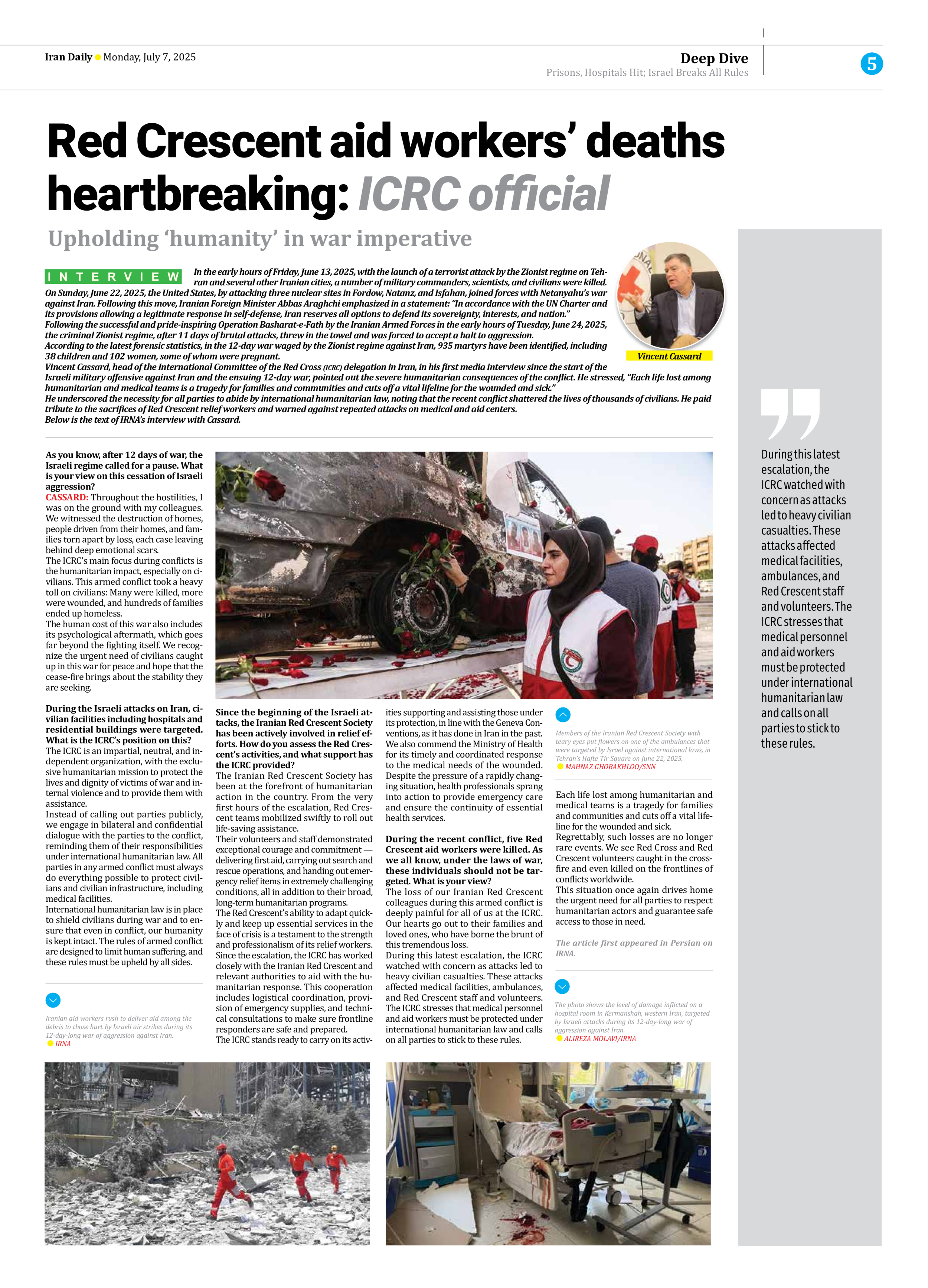
In the early hours of Friday, June 13, 2025, with the launch of a terrorist attack by the Zionist regime on Tehran and several other Iranian cities, a number of military commanders, scientists, and civilians were killed. On Sunday, June 22, 2025, the United States, by attacking three nuclear sites in Fordow, Natanz, and Isfahan, joined forces with Netanyahu’s war against Iran. Following this move, Iranian Foreign Minister Abbas Araghchi emphasized in a statement: “In accordance with the UN Charter and its provisions allowing a legitimate response in self-defense, Iran reserves all options to defend its sovereignty, interests, and nation.” Following the successful and pride-inspiring Operation Basharat-e-Fath by the Iranian Armed Forces in the early hours of Tuesday, June 24, 2025, the criminal Zionist regime, after 11 days of brutal attacks, threw in the towel and was forced to accept a halt to aggression. According to the latest forensic statistics, in the 12-day war waged by the Zionist regime against Iran, 935 martyrs have been identified, including 38 children and 102 women, some of whom were pregnant. Vincent Cassard, head of the International Committee of the Red Cross (ICRC) delegation in Iran, in his first media interview since the start of the Israeli military offensive against Iran and the ensuing 12-day war, pointed out the severe humanitarian consequences of the conflict. He stressed, “Each life lost among humanitarian and medical teams is a tragedy for families and communities and cuts off a vital lifeline for the wounded and sick.” He underscored the necessity for all parties to abide by international humanitarian law, noting that the recent conflict shattered the lives of thousands of civilians. He paid tribute to the sacrifices of Red Crescent relief workers and warned against repeated attacks on medical and aid centers. Below is the text of IRNA’s interview with Cassard.
Vincent Cassard
As you know, after 12 days of war, the Israeli regime called for a pause. What is your view on this cessation of Israeli aggression?
CASSARD: Throughout the hostilities, I was on the ground with my colleagues. We witnessed the destruction of homes, people driven from their homes, and families torn apart by loss, each case leaving behind deep emotional scars.
The ICRC’s main focus during conflicts is the humanitarian impact, especially on civilians. This armed conflict took a heavy toll on civilians: Many were killed, more were wounded, and hundreds of families ended up homeless.
The human cost of this war also includes its psychological aftermath, which goes far beyond the fighting itself. We recognize the urgent need of civilians caught up in this war for peace and hope that the cease-fire brings about the stability they are seeking.
During the Israeli attacks on Iran, civilian facilities including hospitals and residential buildings were targeted. What is the ICRC’s position on this?
The ICRC is an impartial, neutral, and independent organization, with the exclusive humanitarian mission to protect the lives and dignity of victims of war and internal violence and to provide them with assistance.
Instead of calling out parties publicly, we engage in bilateral and confidential dialogue with the parties to the conflict, reminding them of their responsibilities under international humanitarian law. All parties in any armed conflict must always do everything possible to protect civilians and civilian infrastructure, including medical facilities.
International humanitarian law is in place to shield civilians during war and to ensure that even in conflict, our humanity is kept intact. The rules of armed conflict are designed to limit human suffering, and these rules must be upheld by all sides.
Since the beginning of the Israeli attacks, the Iranian Red Crescent Society has been actively involved in relief efforts. How do you assess the Red Crescent’s activities, and what support has the ICRC provided?
The Iranian Red Crescent Society has been at the forefront of humanitarian action in the country. From the very first hours of the escalation, Red Crescent teams mobilized swiftly to roll out life-saving assistance.
Their volunteers and staff demonstrated exceptional courage and commitment — delivering first aid, carrying out search and rescue operations, and handing out emergency relief items in extremely challenging conditions, all in addition to their broad, long-term humanitarian programs.
The Red Crescent’s ability to adapt quickly and keep up essential services in the face of crisis is a testament to the strength and professionalism of its relief workers.
Since the escalation, the ICRC has worked closely with the Iranian Red Crescent and relevant authorities to aid with the humanitarian response. This cooperation includes logistical coordination, provision of emergency supplies, and technical consultations to make sure frontline responders are safe and prepared.
The ICRC stands ready to carry on its activities supporting and assisting those under its protection, in line with the Geneva Conventions, as it has done in Iran in the past.
We also commend the Ministry of Health for its timely and coordinated response to the medical needs of the wounded. Despite the pressure of a rapidly changing situation, health professionals sprang into action to provide emergency care and ensure the continuity of essential health services.
During the recent conflict, five Red Crescent aid workers were killed. As we all know, under the laws of war, these individuals should not be targeted. What is your view?
The loss of our Iranian Red Crescent colleagues during this armed conflict is deeply painful for all of us at the ICRC. Our hearts go out to their families and loved ones, who have borne the brunt of this tremendous loss.
During this latest escalation, the ICRC watched with concern as attacks led to heavy civilian casualties. These attacks affected medical facilities, ambulances, and Red Crescent staff and volunteers. The ICRC stresses that medical personnel and aid workers must be protected under international humanitarian law and calls on all parties to stick to these rules.
Each life lost among humanitarian and medical teams is a tragedy for families and communities and cuts off a vital lifeline for the wounded and sick.
Regrettably, such losses are no longer rare events. We see Red Cross and Red Crescent volunteers caught in the crossfire and even killed on the frontlines of conflicts worldwide.
This situation once again drives home the urgent need for all parties to respect humanitarian actors and guarantee safe access to those in need.
The article first appeared in Persian on IRNA.