





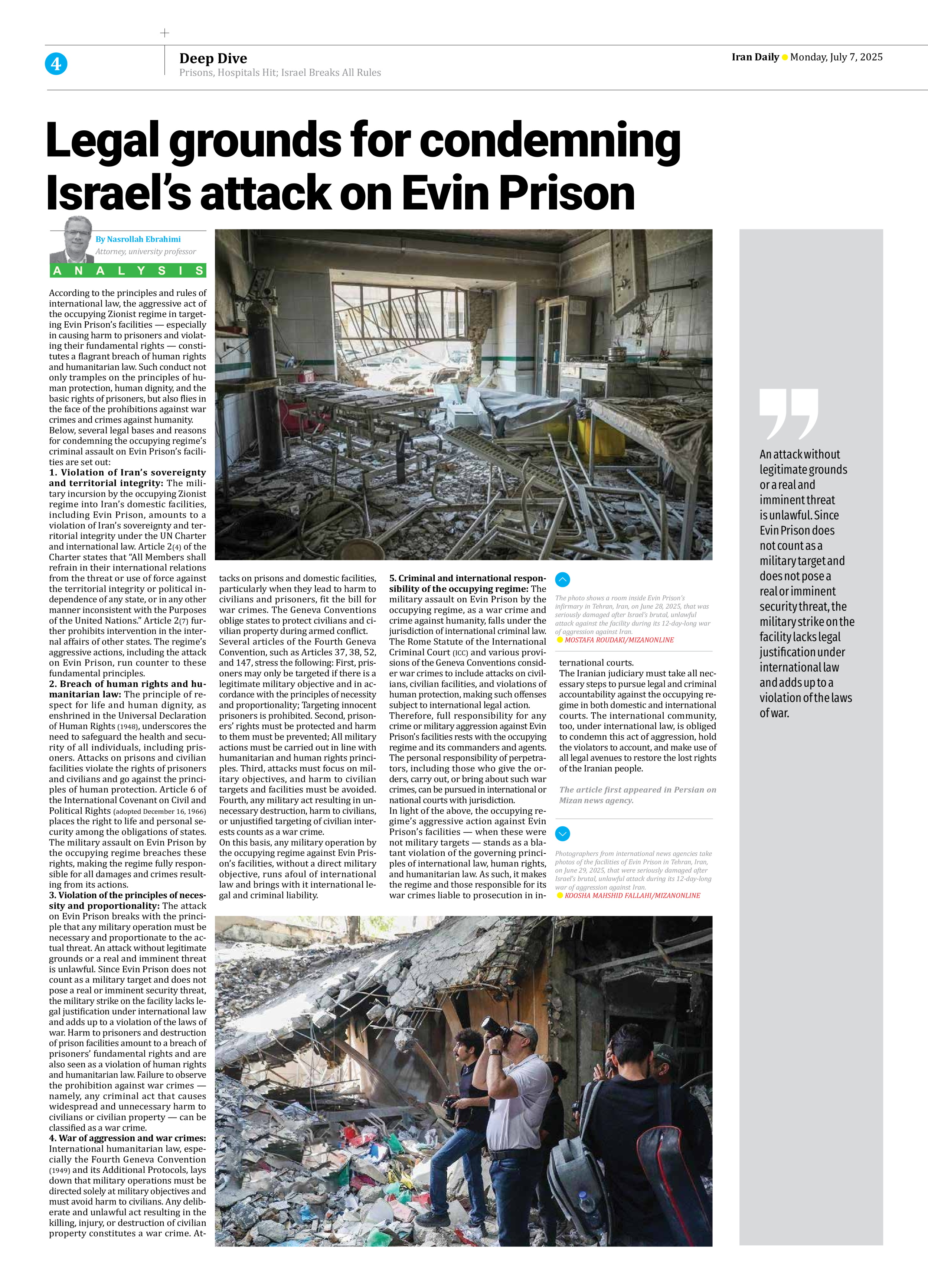


Legal grounds for condemning Israel’s attack on Evin Prison
By Nasrollah Ebrahimi
Attorney, university professor
According to the principles and rules of international law, the aggressive act of the occupying Zionist regime in targeting Evin Prison’s facilities — especially in causing harm to prisoners and violating their fundamental rights — constitutes a flagrant breach of human rights and humanitarian law. Such conduct not only tramples on the principles of human protection, human dignity, and the basic rights of prisoners, but also flies in the face of the prohibitions against war crimes and crimes against humanity.
Below, several legal bases and reasons for condemning the occupying regime’s criminal assault on Evin Prison’s facilities are set out:
1. Violation of Iran’s sovereignty and territorial integrity: The military incursion by the occupying Zionist regime into Iran’s domestic facilities, including Evin Prison, amounts to a violation of Iran’s sovereignty and territorial integrity under the UN Charter and international law. Article 2(4) of the Charter states that “All Members shall refrain in their international relations from the threat or use of force against the territorial integrity or political independence of any state, or in any other manner inconsistent with the Purposes of the United Nations.” Article 2(7) further prohibits intervention in the internal affairs of other states. The regime’s aggressive actions, including the attack on Evin Prison, run counter to these fundamental principles.
2. Breach of human rights and humanitarian law: The principle of respect for life and human dignity, as enshrined in the Universal Declaration of Human Rights (1948), underscores the need to safeguard the health and security of all individuals, including prisoners. Attacks on prisons and civilian facilities violate the rights of prisoners and civilians and go against the principles of human protection. Article 6 of the International Covenant on Civil and Political Rights (adopted December 16, 1966) places the right to life and personal security among the obligations of states. The military assault on Evin Prison by the occupying regime breaches these rights, making the regime fully responsible for all damages and crimes resulting from its actions.
3. Violation of the principles of necessity and proportionality: The attack on Evin Prison breaks with the principle that any military operation must be necessary and proportionate to the actual threat. An attack without legitimate grounds or a real and imminent threat is unlawful. Since Evin Prison does not count as a military target and does not pose a real or imminent security threat, the military strike on the facility lacks legal justification under international law and adds up to a violation of the laws of war. Harm to prisoners and destruction of prison facilities amount to a breach of prisoners’ fundamental rights and are also seen as a violation of human rights and humanitarian law. Failure to observe the prohibition against war crimes — namely, any criminal act that causes widespread and unnecessary harm to civilians or civilian property — can be classified as a war crime.
4. War of aggression and war crimes: International humanitarian law, especially the Fourth Geneva Convention (1949) and its Additional Protocols, lays down that military operations must be directed solely at military objectives and must avoid harm to civilians. Any deliberate and unlawful act resulting in the killing, injury, or destruction of civilian property constitutes a war crime. Attacks on prisons and domestic facilities, particularly when they lead to harm to civilians and prisoners, fit the bill for war crimes. The Geneva Conventions oblige states to protect civilians and civilian property during armed conflict.
Several articles of the Fourth Geneva Convention, such as Articles 37, 38, 52, and 147, stress the following: First, prisoners may only be targeted if there is a legitimate military objective and in accordance with the principles of necessity and proportionality; Targeting innocent prisoners is prohibited. Second, prisoners’ rights must be protected and harm to them must be prevented; All military actions must be carried out in line with humanitarian and human rights principles. Third, attacks must focus on military objectives, and harm to civilian targets and facilities must be avoided. Fourth, any military act resulting in unnecessary destruction, harm to civilians, or unjustified targeting of civilian interests counts as a war crime.
On this basis, any military operation by the occupying regime against Evin Prison’s facilities, without a direct military objective, runs afoul of international law and brings with it international legal and criminal liability.
5. Criminal and international responsibility of the occupying regime: The military assault on Evin Prison by the occupying regime, as a war crime and crime against humanity, falls under the jurisdiction of international criminal law. The Rome Statute of the International Criminal Court (ICC) and various provisions of the Geneva Conventions consider war crimes to include attacks on civilians, civilian facilities, and violations of human protection, making such offenses subject to international legal action.
Therefore, full responsibility for any crime or military aggression against Evin Prison’s facilities rests with the occupying regime and its commanders and agents. The personal responsibility of perpetrators, including those who give the orders, carry out, or bring about such war crimes, can be pursued in international or national courts with jurisdiction.
In light of the above, the occupying regime’s aggressive action against Evin Prison’s facilities — when these were not military targets — stands as a blatant violation of the governing principles of international law, human rights, and humanitarian law. As such, it makes the regime and those responsible for its war crimes liable to prosecution in international courts.
The Iranian judiciary must take all necessary steps to pursue legal and criminal accountability against the occupying regime in both domestic and international courts. The international community, too, under international law, is obliged to condemn this act of aggression, hold the violators to account, and make use of all legal avenues to restore the lost rights of the Iranian people.
The article first appeared in Persian on Mizan news agency.