





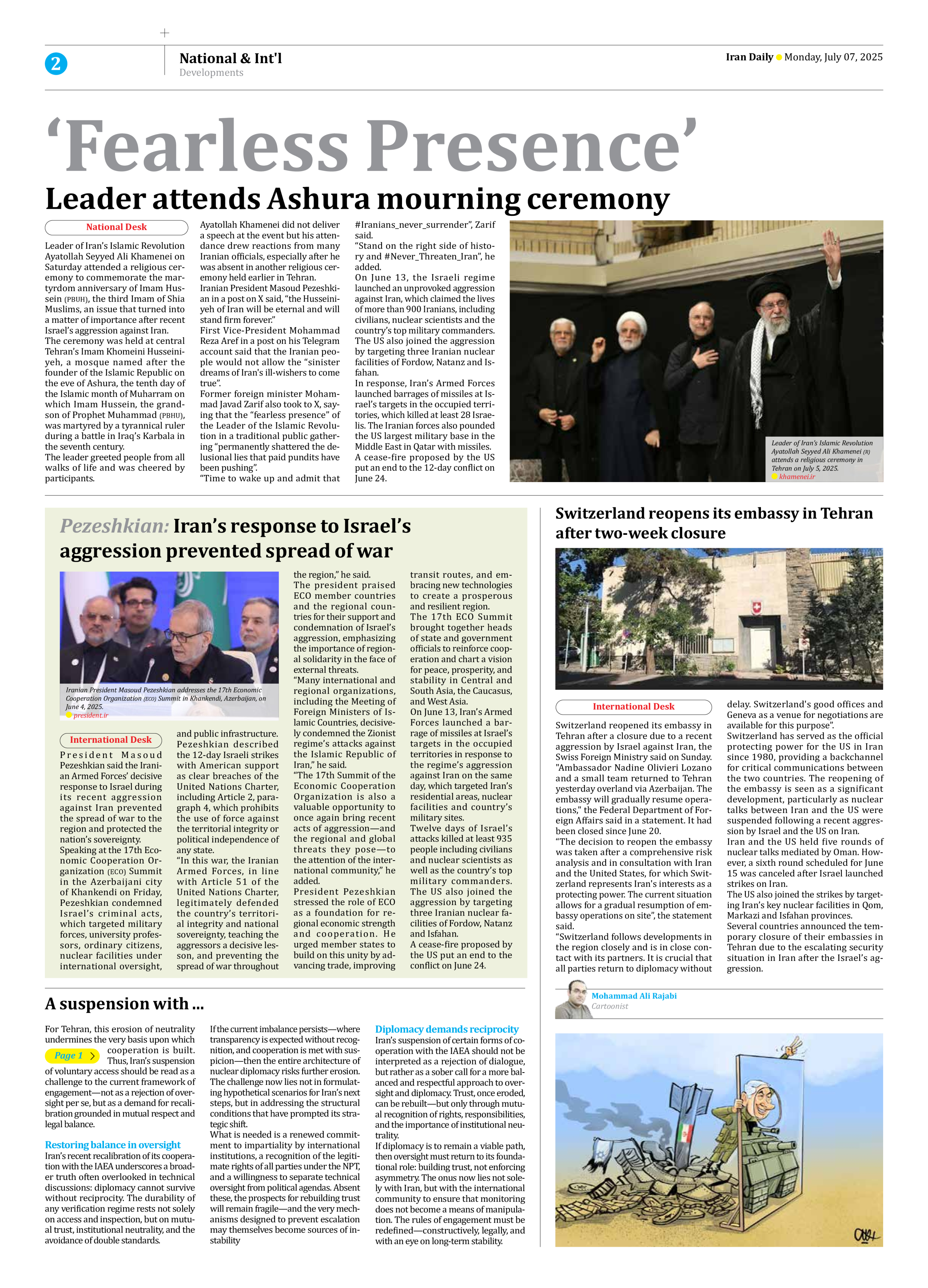


A suspension with ...
Page 1
For Tehran, this erosion of neutrality undermines the very basis upon which cooperation is built. Thus, Iran’s suspension of voluntary access should be read as a challenge to the current framework of engagement—not as a rejection of oversight per se, but as a demand for recalibration grounded in mutual respect and legal balance.
Restoring balance in oversight
Iran’s recent recalibration of its cooperation with the IAEA underscores a broader truth often overlooked in technical discussions: diplomacy cannot survive without reciprocity. The durability of any verification regime rests not solely on access and inspection, but on mutual trust, institutional neutrality, and the avoidance of double standards.
If the current imbalance persists—where transparency is expected without recognition, and cooperation is met with suspicion—then the entire architecture of nuclear diplomacy risks further erosion. The challenge now lies not in formulating hypothetical scenarios for Iran’s next steps, but in addressing the structural conditions that have prompted its strategic shift.
What is needed is a renewed commitment to impartiality by international institutions, a recognition of the legitimate rights of all parties under the NPT, and a willingness to separate technical oversight from political agendas. Absent these, the prospects for rebuilding trust will remain fragile—and the very mechanisms designed to prevent escalation may themselves become sources of instability
Diplomacy demands reciprocity
Iran’s suspension of certain forms of cooperation with the IAEA should not be interpreted as a rejection of dialogue, but rather as a sober call for a more balanced and respectful approach to oversight and diplomacy. Trust, once eroded, can be rebuilt—but only through mutual recognition of rights, responsibilities, and the importance of institutional neutrality.
If diplomacy is to remain a viable path, then oversight must return to its foundational role: building trust, not enforcing asymmetry. The onus now lies not solely with Iran, but with the international community to ensure that monitoring does not become a means of manipulation. The rules of engagement must be redefined—constructively, legally, and with an eye on long-term stability.