







European Troika, Trump’s instrumental doctrine
Why did Europe choose disruptive role?
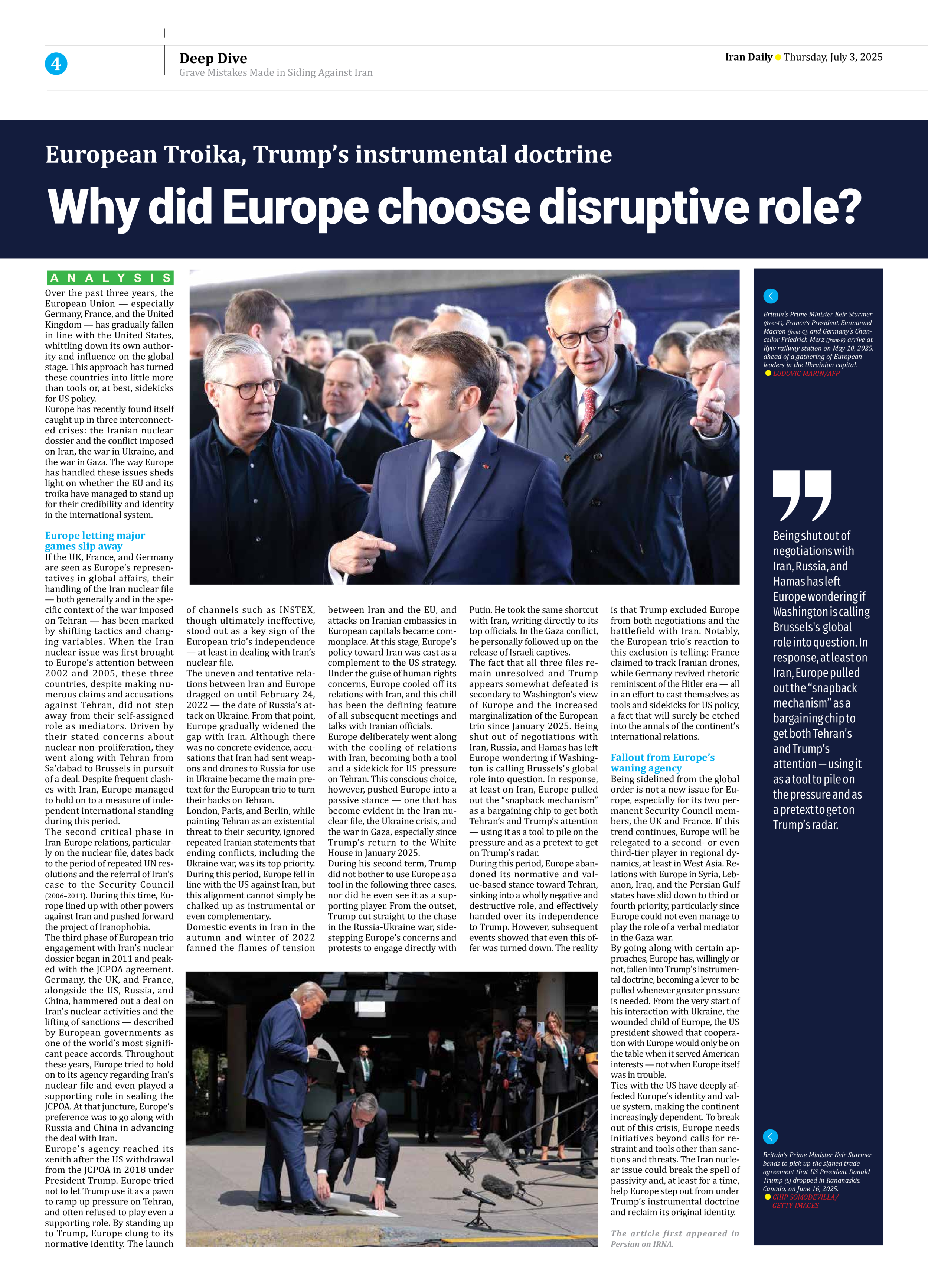
Over the past three years, the European Union — especially Germany, France, and the United Kingdom — has gradually fallen in line with the United States, whittling down its own authority and influence on the global stage. This approach has turned these countries into little more than tools or, at best, sidekicks for US policy.
Europe has recently found itself caught up in three interconnected crises: the Iranian nuclear dossier and the conflict imposed on Iran, the war in Ukraine, and the war in Gaza. The way Europe has handled these issues sheds light on whether the EU and its troika have managed to stand up for their credibility and identity in the international system.
Europe letting major games slip away
If the UK, France, and Germany are seen as Europe’s representatives in global affairs, their handling of the Iran nuclear file — both generally and in the specific context of the war imposed on Tehran — has been marked by shifting tactics and changing variables. When the Iran nuclear issue was first brought to Europe’s attention between 2002 and 2005, these three countries, despite making numerous claims and accusations against Tehran, did not step away from their self-assigned role as mediators. Driven by their stated concerns about nuclear non-proliferation, they went along with Tehran from Sa’dabad to Brussels in pursuit of a deal. Despite frequent clashes with Iran, Europe managed to hold on to a measure of independent international standing during this period.
The second critical phase in Iran-Europe relations, particularly on the nuclear file, dates back to the period of repeated UN resolutions and the referral of Iran’s case to the Security Council (2006–2011). During this time, Europe lined up with other powers against Iran and pushed forward the project of Iranophobia.
The third phase of European trio engagement with Iran’s nuclear dossier began in 2011 and peaked with the JCPOA agreement. Germany, the UK, and France, alongside the US, Russia, and China, hammered out a deal on Iran’s nuclear activities and the lifting of sanctions — described by European governments as one of the world’s most significant peace accords. Throughout these years, Europe tried to hold on to its agency regarding Iran’s nuclear file and even played a supporting role in sealing the JCPOA. At that juncture, Europe’s preference was to go along with Russia and China in advancing the deal with Iran.
Europe’s agency reached its zenith after the US withdrawal from the JCPOA in 2018 under President Trump. Europe tried not to let Trump use it as a pawn to ramp up pressure on Tehran, and often refused to play even a supporting role. By standing up to Trump, Europe clung to its normative identity. The launch of channels such as INSTEX, though ultimately ineffective, stood out as a key sign of the European trio’s independence — at least in dealing with Iran’s nuclear file.
The uneven and tentative relations between Iran and Europe dragged on until February 24, 2022 — the date of Russia’s attack on Ukraine. From that point, Europe gradually widened the gap with Iran. Although there was no concrete evidence, accusations that Iran had sent weapons and drones to Russia for use in Ukraine became the main pretext for the European trio to turn their backs on Tehran.
London, Paris, and Berlin, while painting Tehran as an existential threat to their security, ignored repeated Iranian statements that ending conflicts, including the Ukraine war, was its top priority. During this period, Europe fell in line with the US against Iran, but this alignment cannot simply be chalked up as instrumental or even complementary.
Domestic events in Iran in the autumn and winter of 2022 fanned the flames of tension between Iran and the EU, and attacks on Iranian embassies in European capitals became commonplace. At this stage, Europe’s policy toward Iran was cast as a complement to the US strategy. Under the guise of human rights concerns, Europe cooled off its relations with Iran, and this chill has been the defining feature of all subsequent meetings and talks with Iranian officials.
Europe deliberately went along with the cooling of relations with Iran, becoming both a tool and a sidekick for US pressure on Tehran. This conscious choice, however, pushed Europe into a passive stance — one that has become evident in the Iran nuclear file, the Ukraine crisis, and the war in Gaza, especially since Trump’s return to the White House in January 2025.
During his second term, Trump did not bother to use Europe as a tool in the following three cases, nor did he even see it as a supporting player. From the outset, Trump cut straight to the chase in the Russia-Ukraine war, sidestepping Europe’s concerns and protests to engage directly with Putin. He took the same shortcut with Iran, writing directly to its top officials. In the Gaza conflict, he personally followed up on the release of Israeli captives.
The fact that all three files remain unresolved and Trump appears somewhat defeated is secondary to Washington’s view of Europe and the increased marginalization of the European trio since January 2025. Being shut out of negotiations with Iran, Russia, and Hamas has left Europe wondering if Washington is calling Brussels's global role into question. In response, at least on Iran, Europe pulled out the “snapback mechanism” as a bargaining chip to get both Tehran’s and Trump’s attention — using it as a tool to pile on the pressure and as a pretext to get on Trump’s radar.
During this period, Europe abandoned its normative and value-based stance toward Tehran, sinking into a wholly negative and destructive role, and effectively handed over its independence to Trump. However, subsequent events showed that even this offer was turned down. The reality is that Trump excluded Europe from both negotiations and the battlefield with Iran. Notably, the European trio’s reaction to this exclusion is telling: France claimed to track Iranian drones, while Germany revived rhetoric reminiscent of the Hitler era — all in an effort to cast themselves as tools and sidekicks for US policy, a fact that will surely be etched into the annals of the continent’s international relations.
Fallout from Europe’s waning agency
Being sidelined from the global order is not a new issue for Europe, especially for its two permanent Security Council members, the UK and France. If this trend continues, Europe will be relegated to a second- or even third-tier player in regional dynamics, at least in West Asia. Relations with Europe in Syria, Lebanon, Iraq, and the Persian Gulf states have slid down to third or fourth priority, particularly since Europe could not even manage to play the role of a verbal mediator in the Gaza war.
By going along with certain approaches, Europe has, willingly or not, fallen into Trump’s instrumental doctrine, becoming a lever to be pulled whenever greater pressure is needed. From the very start of his interaction with Ukraine, the wounded child of Europe, the US president showed that cooperation with Europe would only be on the table when it served American interests — not when Europe itself was in trouble.
Ties with the US have deeply affected Europe’s identity and value system, making the continent increasingly dependent. To break out of this crisis, Europe needs initiatives beyond calls for restraint and tools other than sanctions and threats. The Iran nuclear issue could break the spell of passivity and, at least for a time, help Europe step out from under Trump’s instrumental doctrine and reclaim its original identity.
The article first appeared in Persian on IRNA.