





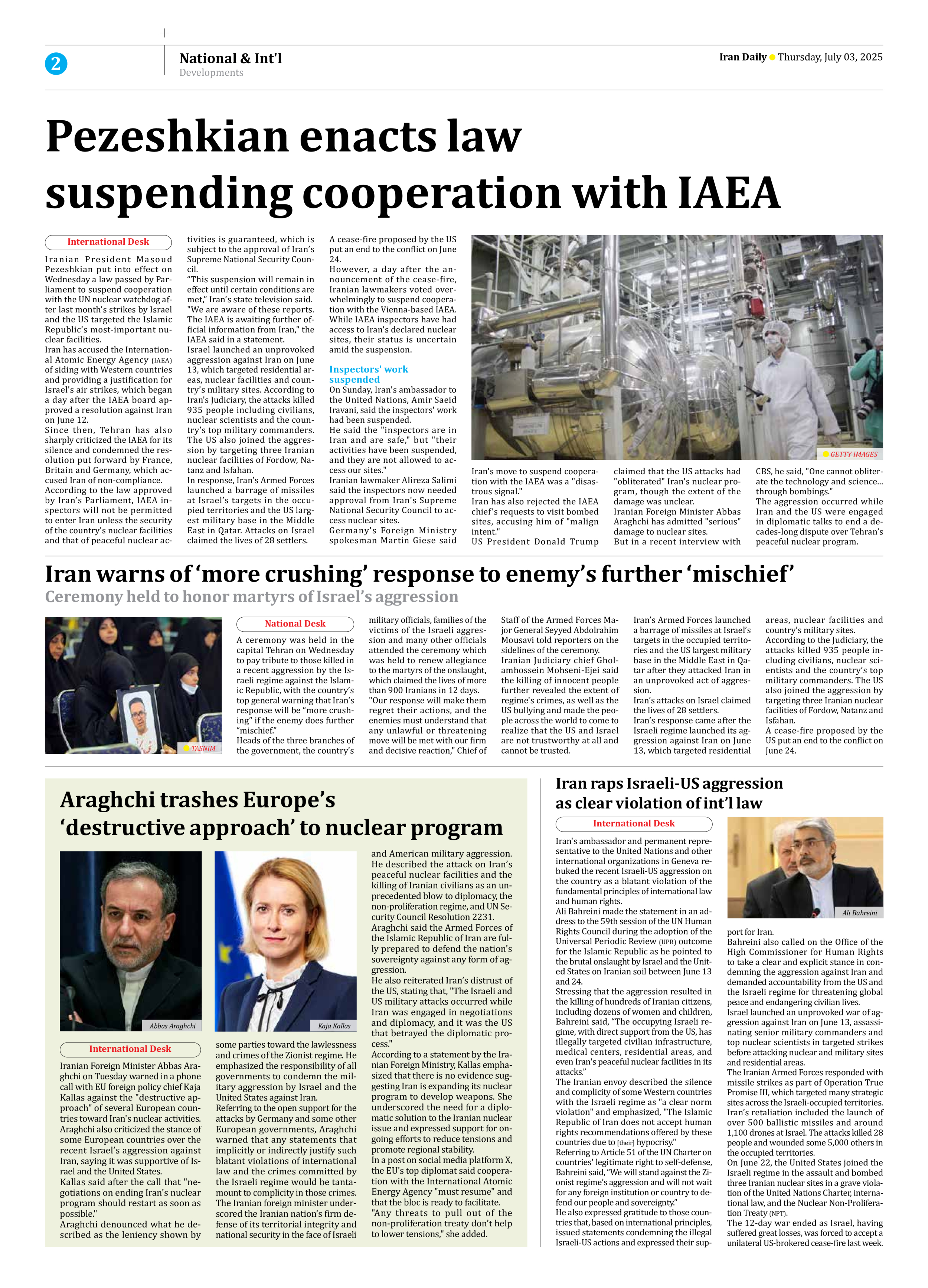


Pezeshkian enacts law suspending cooperation with IAEA
Iranian President Masoud Pezeshkian put into effect on Wednesday a law passed by Parliament to suspend cooperation with the UN nuclear watchdog after last month’s strikes by Israel and the US targeted the Islamic Republic’s most-important nuclear facilities.
Iran has accused the International Atomic Energy Agency (IAEA) of siding with Western countries and providing a justification for Israel's air strikes, which began a day after the IAEA board approved a resolution against Iran on June 12.
Since then, Tehran has also sharply criticized the IAEA for its silence and condemned the resolution put forward by France, Britain and Germany, which accused Iran of non-compliance.
According to the law approved by Iran’s Parliament, IAEA inspectors will not be permitted to enter Iran unless the security of the country's nuclear facilities and that of peaceful nuclear activities is guaranteed, which is subject to the approval of Iran’s Supreme National Security Council.
“This suspension will remain in effect until certain conditions are met,” Iran’s state television said.
"We are aware of these reports. The IAEA is awaiting further official information from Iran," the IAEA said in a statement.
Israel launched an unprovoked aggression against Iran on June 13, which targeted residential areas, nuclear facilities and country’s military sites. According to Iran’s Judiciary, the attacks killed 935 people including civilians, nuclear scientists and the country’s top military commanders. The US also joined the aggression by targeting three Iranian nuclear facilities of Fordow, Natanz and Isfahan.
In response, Iran’s Armed Forces launched a barrage of missiles at Israel’s targets in the occupied territories and the US largest military base in the Middle East in Qatar. Attacks on Israel claimed the lives of 28 settlers.
A cease-fire proposed by the US put an end to the conflict on June 24.
However, a day after the announcement of the cease-fire, Iranian lawmakers voted overwhelmingly to suspend cooperation with the Vienna-based IAEA.
While IAEA inspectors have had access to Iran's declared nuclear sites, their status is uncertain amid the suspension.
Inspectors' work suspended
On Sunday, Iran's ambassador to the United Nations, Amir Saeid Iravani, said the inspectors' work had been suspended.
He said the "inspectors are in Iran and are safe," but "their activities have been suspended, and they are not allowed to access our sites."
Iranian lawmaker Alireza Salimi said the inspectors now needed approval from Iran's Supreme National Security Council to access nuclear sites.
Germany's Foreign Ministry spokesman Martin Giese said Iran's move to suspend cooperation with the IAEA was a "disastrous signal."
Iran has also rejected the IAEA chief’s requests to visit bombed sites, accusing him of "malign intent."
US President Donald Trump claimed that the US attacks had "obliterated" Iran's nuclear program, though the extent of the damage was unclear.
Iranian Foreign Minister Abbas Araghchi has admitted "serious" damage to nuclear sites.
But in a recent interview with CBS, he said, "One cannot obliterate the technology and science... through bombings."
The aggression occurred while Iran and the US were engaged in diplomatic talks to end a decades-long dispute over Tehran’s peaceful nuclear program.