







A life through the lens
Iran’s top camera collector dreams of int’l photography museum in Tehran
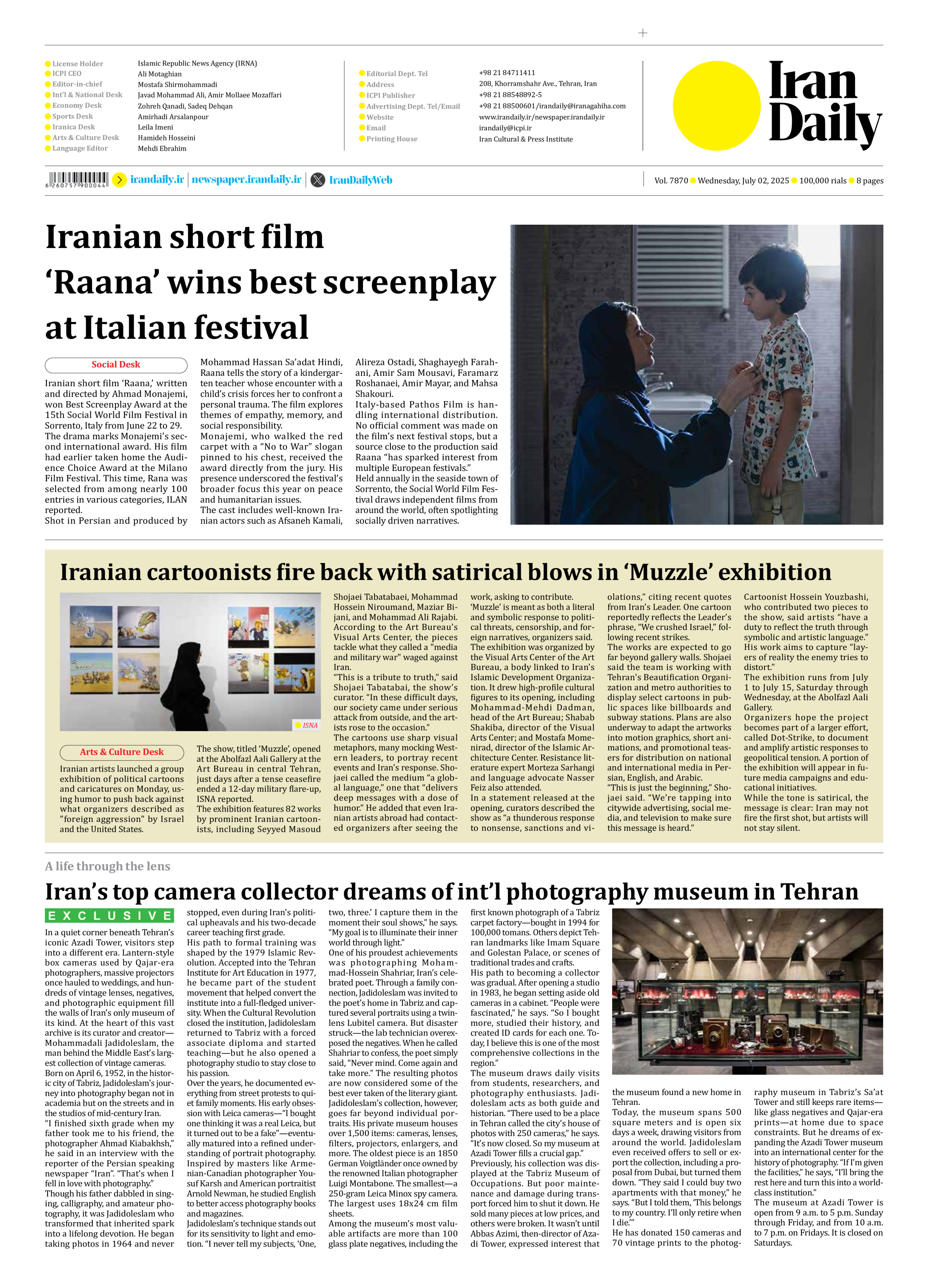
In a quiet corner beneath Tehran’s iconic Azadi Tower, visitors step into a different era. Lantern-style box cameras used by Qajar-era photographers, massive projectors once hauled to weddings, and hundreds of vintage lenses, negatives, and photographic equipment fill the walls of Iran’s only museum of its kind. At the heart of this vast archive is its curator and creator— Mohammadali Jadidoleslam, the man behind the Middle East’s largest collection of vintage cameras.
Born on April 6, 1952, in the historic city of Tabriz, Jadidoleslam’s journey into photography began not in academia but on the streets and in the studios of mid-century Iran.
“I finished sixth grade when my father took me to his friend, the photographer Ahmad Kiabakhsh,” he said in an interview with the reporter of the Persian speaking newspaper “Iran”. “That’s when I fell in love with photography.”
Though his father dabbled in singing, calligraphy, and amateur photography, it was Jadidoleslam who transformed that inherited spark into a lifelong devotion. He began taking photos in 1964 and never stopped, even during Iran’s political upheavals and his two-decade career teaching first grade.
His path to formal training was shaped by the 1979 Islamic Revolution. Accepted into the Tehran Institute for Art Education in 1977, he became part of the student movement that helped convert the institute into a full-fledged university. When the Cultural Revolution closed the institution, Jadidoleslam returned to Tabriz with a forced associate diploma and started teaching—but he also opened a photography studio to stay close to his passion.
Over the years, he documented everything from street protests to quiet family moments. His early obsession with Leica cameras—“I bought one thinking it was a real Leica, but it turned out to be a fake”—eventually matured into a refined understanding of portrait photography. Inspired by masters like Armenian-Canadian photographer Yousuf Karsh and American portraitist Arnold Newman, he studied English to better access photography books and magazines.
Jadidoleslam’s technique stands out for its sensitivity to light and emotion. “I never tell my subjects, ‘One, two, three.’ I capture them in the moment their soul shows,” he says. “My goal is to illuminate their inner world through light.”
One of his proudest achievements was photographing Mohammad-Hossein Shahriar, Iran’s celebrated poet. Through a family connection, Jadidoleslam was invited to the poet’s home in Tabriz and captured several portraits using a twin-lens Lubitel camera. But disaster struck—the lab technician overexposed the negatives. When he called Shahriar to confess, the poet simply said, “Never mind. Come again and take more.” The resulting photos are now considered some of the best ever taken of the literary giant.
Jadidoleslam’s collection, however, goes far beyond individual portraits. His private museum houses over 1,500 items: cameras, lenses, filters, projectors, enlargers, and more. The oldest piece is an 1850 German Voigtländer once owned by the renowned Italian photographer Luigi Montabone. The smallest—a 250-gram Leica Minox spy camera. The largest uses 18x24 cm film sheets.
Among the museum’s most valuable artifacts are more than 100 glass plate negatives, including the first known photograph of a Tabriz carpet factory—bought in 1994 for 100,000 tomans. Others depict Tehran landmarks like Imam Square and Golestan Palace, or scenes of traditional trades and crafts.
His path to becoming a collector was gradual. After opening a studio in 1983, he began setting aside old cameras in a cabinet. “People were fascinated,” he says. “So I bought more, studied their history, and created ID cards for each one. Today, I believe this is one of the most comprehensive collections in the region.”
The museum draws daily visits from students, researchers, and photography enthusiasts. Jadidoleslam acts as both guide and historian. “There used to be a place in Tehran called the city’s house of photos with 250 cameras,” he says. “It’s now closed. So my museum at Azadi Tower fills a crucial gap.”
Previously, his collection was displayed at the Tabriz Museum of Occupations. But poor maintenance and damage during transport forced him to shut it down. He sold many pieces at low prices, and others were broken. It wasn’t until Abbas Azimi, then-director of Azadi Tower, expressed interest that the museum found a new home in Tehran.
Today, the museum spans 500 square meters and is open six days a week, drawing visitors from around the world. Jadidoleslam even received offers to sell or export the collection, including a proposal from Dubai, but turned them down. “They said I could buy two apartments with that money,” he says. “But I told them, ‘This belongs to my country. I’ll only retire when I die.’”
He has donated 150 cameras and 70 vintage prints to the photography museum in Tabriz’s Sa’at Tower and still keeps rare items—like glass negatives and Qajar-era prints—at home due to space constraints. But he dreams of expanding the Azadi Tower museum into an international center for the history of photography. “If I’m given the facilities,” he says, “I’ll bring the rest here and turn this into a world-class institution.”
The museum at Azadi Tower is open from 9 a.m. to 5 p.m. Sunday through Friday, and from 10 a.m. to 7 p.m. on Fridays. It is closed on Saturdays.