







Iran’s prospects in Europe’s evolving energy security equation
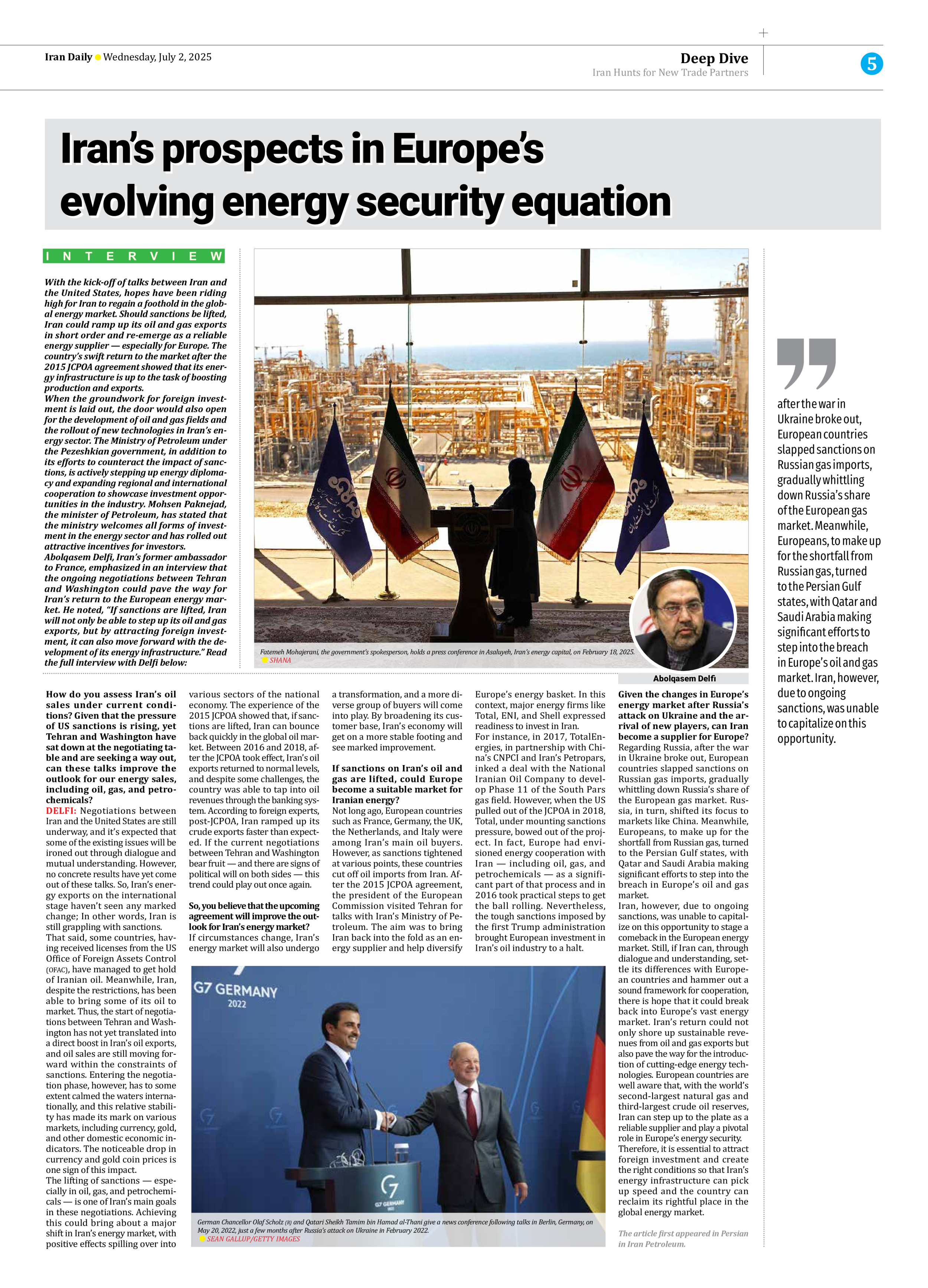
With the kick-off of talks between Iran and the United States, hopes have been riding high for Iran to regain a foothold in the global energy market. Should sanctions be lifted, Iran could ramp up its oil and gas exports in short order and re-emerge as a reliable energy supplier — especially for Europe. The country’s swift return to the market after the 2015 JCPOA agreement showed that its energy infrastructure is up to the task of boosting production and exports. When the groundwork for foreign investment is laid out, the door would also open for the development of oil and gas fields and the rollout of new technologies in Iran’s energy sector. The Ministry of Petroleum under the Pezeshkian government, in addition to its efforts to counteract the impact of sanctions, is actively stepping up energy diplomacy and expanding regional and international cooperation to showcase investment opportunities in the industry. Mohsen Paknejad, the minister of Petroleum, has stated that the ministry welcomes all forms of investment in the energy sector and has rolled out attractive incentives for investors. Abolqasem Delfi, Iran’s former ambassador to France, emphasized in an interview that the ongoing negotiations between Tehran and Washington could pave the way for Iran’s return to the European energy market. He noted, “If sanctions are lifted, Iran will not only be able to step up its oil and gas exports, but by attracting foreign investment, it can also move forward with the development of its energy infrastructure.” Read the full interview with Delfi below:
How do you assess Iran’s oil sales under current conditions? Given that the pressure of US sanctions is rising, yet Tehran and Washington have sat down at the negotiating table and are seeking a way out, can these talks improve the outlook for our energy sales, including oil, gas, and petrochemicals?
DELFI: Negotiations between Iran and the United States are still underway, and it’s expected that some of the existing issues will be ironed out through dialogue and mutual understanding. However, no concrete results have yet come out of these talks. So, Iran’s energy exports on the international stage haven’t seen any marked change; In other words, Iran is still grappling with sanctions.
That said, some countries, having received licenses from the US Office of Foreign Assets Control (OFAC), have managed to get hold of Iranian oil. Meanwhile, Iran, despite the restrictions, has been able to bring some of its oil to market. Thus, the start of negotiations between Tehran and Washington has not yet translated into a direct boost in Iran’s oil exports, and oil sales are still moving forward within the constraints of sanctions. Entering the negotiation phase, however, has to some extent calmed the waters internationally, and this relative stability has made its mark on various markets, including currency, gold, and other domestic economic indicators. The noticeable drop in currency and gold coin prices is one sign of this impact.
The lifting of sanctions — especially in oil, gas, and petrochemicals — is one of Iran’s main goals in these negotiations. Achieving this could bring about a major shift in Iran’s energy market, with positive effects spilling over into various sectors of the national economy. The experience of the 2015 JCPOA showed that, if sanctions are lifted, Iran can bounce back quickly in the global oil market. Between 2016 and 2018, after the JCPOA took effect, Iran’s oil exports returned to normal levels, and despite some challenges, the country was able to tap into oil revenues through the banking system. According to foreign experts, post-JCPOA, Iran ramped up its crude exports faster than expected. If the current negotiations between Tehran and Washington bear fruit — and there are signs of political will on both sides — this trend could play out once again.
So, you believe that the upcoming agreement will improve the outlook for Iran’s energy market?
If circumstances change, Iran’s energy market will also undergo a transformation, and a more diverse group of buyers will come into play. By broadening its customer base, Iran’s economy will get on a more stable footing and see marked improvement.
If sanctions on Iran’s oil and gas are lifted, could Europe become a suitable market for Iranian energy?
Not long ago, European countries such as France, Germany, the UK, the Netherlands, and Italy were among Iran’s main oil buyers. However, as sanctions tightened at various points, these countries cut off oil imports from Iran. After the 2015 JCPOA agreement, the president of the European Commission visited Tehran for talks with Iran’s Ministry of Petroleum. The aim was to bring Iran back into the fold as an energy supplier and help diversify Europe’s energy basket. In this context, major energy firms like Total, ENI, and Shell expressed readiness to invest in Iran.
For instance, in 2017, TotalEnergies, in partnership with China’s CNPCI and Iran’s Petropars, inked a deal with the National Iranian Oil Company to develop Phase 11 of the South Pars gas field. However, when the US pulled out of the JCPOA in 2018, Total, under mounting sanctions pressure, bowed out of the project. In fact, Europe had envisioned energy cooperation with Iran — including oil, gas, and petrochemicals — as a significant part of that process and in 2016 took practical steps to get the ball rolling. Nevertheless, the tough sanctions imposed by the first Trump administration brought European investment in Iran’s oil industry to a halt.
Given the changes in Europe’s energy market after Russia’s attack on Ukraine and the arrival of new players, can Iran become a supplier for Europe?
Regarding Russia, after the war in Ukraine broke out, European countries slapped sanctions on Russian gas imports, gradually whittling down Russia’s share of the European gas market. Russia, in turn, shifted its focus to markets like China. Meanwhile, Europeans, to make up for the shortfall from Russian gas, turned to the Persian Gulf states, with Qatar and Saudi Arabia making significant efforts to step into the breach in Europe’s oil and gas market.
Iran, however, due to ongoing sanctions, was unable to capitalize on this opportunity to stage a comeback in the European energy market. Still, if Iran can, through dialogue and understanding, settle its differences with European countries and hammer out a sound framework for cooperation, there is hope that it could break back into Europe’s vast energy market. Iran’s return could not only shore up sustainable revenues from oil and gas exports but also pave the way for the introduction of cutting-edge energy technologies. European countries are well aware that, with the world’s second-largest natural gas and third-largest crude oil reserves, Iran can step up to the plate as a reliable supplier and play a pivotal role in Europe’s energy security.
Therefore, it is essential to attract foreign investment and create the right conditions so that Iran’s energy infrastructure can pick up speed and the country can reclaim its rightful place in the global energy market.
The article first appeared in Persian in Iran Petroleum.