





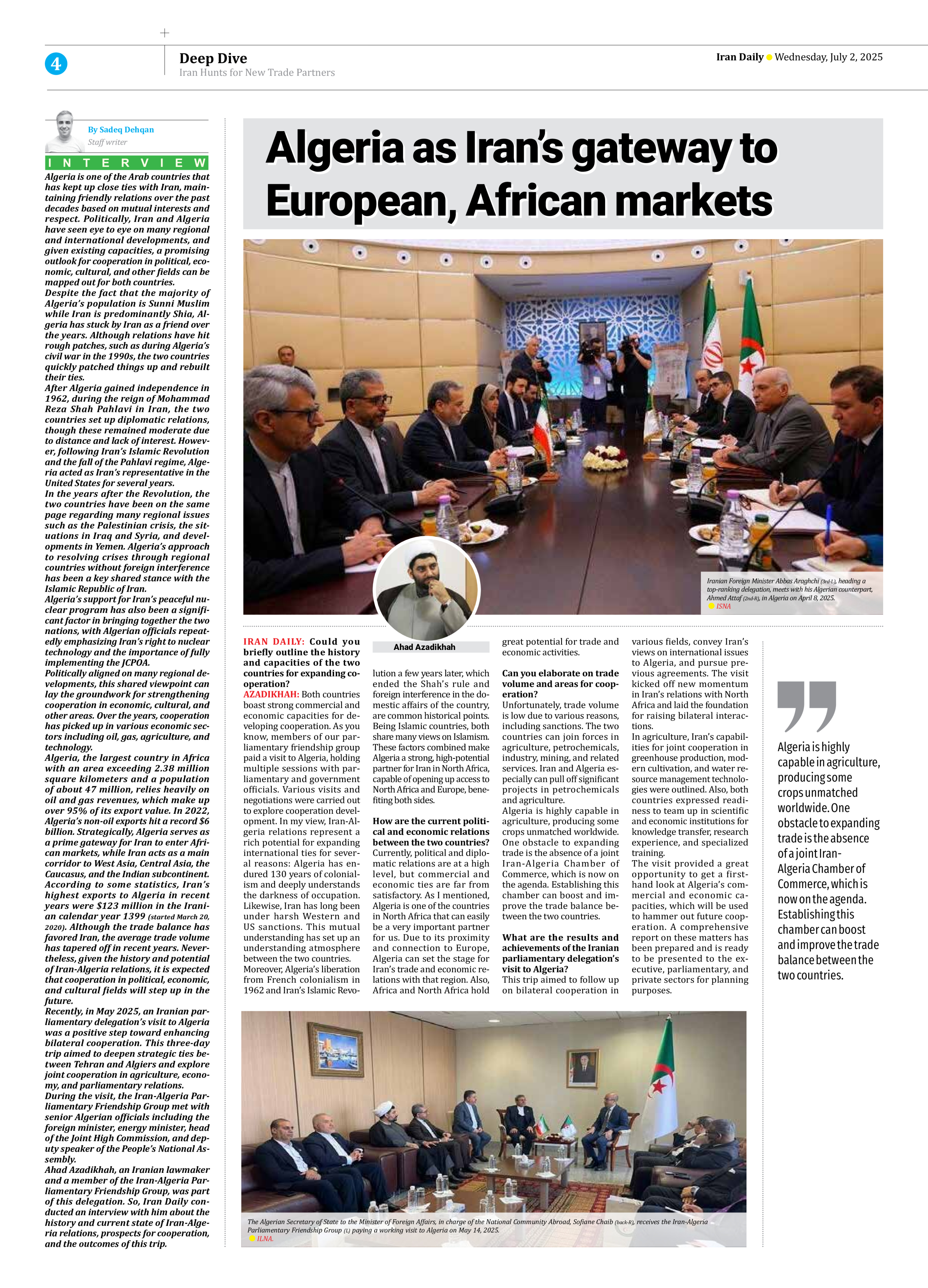


Algeria as Iran’s gateway to European, African markets
Algeria is one of the Arab countries that has kept up close ties with Iran, maintaining friendly relations over the past decades based on mutual interests and respect. Politically, Iran and Algeria have seen eye to eye on many regional and international developments, and given existing capacities, a promising outlook for cooperation in political, economic, cultural, and other fields can be mapped out for both countries. Despite the fact that the majority of Algeria’s population is Sunni Muslim while Iran is predominantly Shia, Algeria has stuck by Iran as a friend over the years. Although relations have hit rough patches, such as during Algeria’s civil war in the 1990s, the two countries quickly patched things up and rebuilt their ties. After Algeria gained independence in 1962, during the reign of Mohammad Reza Shah Pahlavi in Iran, the two countries set up diplomatic relations, though these remained moderate due to distance and lack of interest. However, following Iran’s Islamic Revolution and the fall of the Pahlavi regime, Algeria acted as Iran’s representative in the United States for several years. In the years after the Revolution, the two countries have been on the same page regarding many regional issues such as the Palestinian crisis, the situations in Iraq and Syria, and developments in Yemen. Algeria’s approach to resolving crises through regional countries without foreign interference has been a key shared stance with the Islamic Republic of Iran. Algeria’s support for Iran’s peaceful nuclear program has also been a significant factor in bringing together the two nations, with Algerian officials repeatedly emphasizing Iran’s right to nuclear technology and the importance of fully implementing the JCPOA. Politically aligned on many regional developments, this shared viewpoint can lay the groundwork for strengthening cooperation in economic, cultural, and other areas. Over the years, cooperation has picked up in various economic sectors including oil, gas, agriculture, and technology. Algeria, the largest country in Africa with an area exceeding 2.38 million square kilometers and a population of about 47 million, relies heavily on oil and gas revenues, which make up over 95% of its export value. In 2022, Algeria’s non-oil exports hit a record $6 billion. Strategically, Algeria serves as a prime gateway for Iran to enter African markets, while Iran acts as a main corridor to West Asia, Central Asia, the Caucasus, and the Indian subcontinent. According to some statistics, Iran’s highest exports to Algeria in recent years were $123 million in the Iranian calendar year 1399 (started March 20, 2020). Although the trade balance has favored Iran, the average trade volume has tapered off in recent years. Nevertheless, given the history and potential of Iran-Algeria relations, it is expected that cooperation in political, economic, and cultural fields will step up in the future. Recently, in May 2025, an Iranian parliamentary delegation’s visit to Algeria was a positive step toward enhancing bilateral cooperation. This three-day trip aimed to deepen strategic ties between Tehran and Algiers and explore joint cooperation in agriculture, economy, and parliamentary relations. During the visit, the Iran-Algeria Parliamentary Friendship Group met with senior Algerian officials including the foreign minister, energy minister, head of the Joint High Commission, and deputy speaker of the People’s National Assembly. Ahad Azadikhah, an Iranian lawmaker and a member of the Iran-Algeria Parliamentary Friendship Group, was part of this delegation. So, Iran Daily conducted an interview with him about the history and current state of Iran-Algeria relations, prospects for cooperation, and the outcomes of this trip.
By Sadeq Dehqan
Staff writer
IRAN DAILY: Could you briefly outline the history and capacities of the two countries for expanding cooperation?
AZADIKHAH: Both countries boast strong commercial and economic capacities for developing cooperation. As you know, members of our parliamentary friendship group paid a visit to Algeria, holding multiple sessions with parliamentary and government officials. Various visits and negotiations were carried out to explore cooperation development. In my view, Iran-Algeria relations represent a rich potential for expanding international ties for several reasons: Algeria has endured 130 years of colonialism and deeply understands the darkness of occupation. Likewise, Iran has long been under harsh Western and US sanctions. This mutual understanding has set up an understanding atmosphere between the two countries.
Moreover, Algeria’s liberation from French colonialism in 1962 and Iran’s Islamic Revolution a few years later, which ended the Shah’s rule and foreign interference in the domestic affairs of the country, are common historical points. Being Islamic countries, both share many views on Islamism. These factors combined make Algeria a strong, high-potential partner for Iran in North Africa, capable of opening up access to North Africa and Europe, benefiting both sides.
How are the current political and economic relations between the two countries?
Currently, political and diplomatic relations are at a high level, but commercial and economic ties are far from satisfactory. As I mentioned, Algeria is one of the countries in North Africa that can easily be a very important partner for us. Due to its proximity and connection to Europe, Algeria can set the stage for Iran’s trade and economic relations with that region. Also, Africa and North Africa hold great potential for trade and economic activities.
Can you elaborate on trade volume and areas for cooperation?
Unfortunately, trade volume is low due to various reasons, including sanctions. The two countries can join forces in agriculture, petrochemicals, industry, mining, and related services. Iran and Algeria especially can pull off significant projects in petrochemicals and agriculture.
Algeria is highly capable in agriculture, producing some crops unmatched worldwide. One obstacle to expanding trade is the absence of a joint Iran-Algeria Chamber of Commerce, which is now on the agenda. Establishing this chamber can boost and improve the trade balance between the two countries.
What are the results and achievements of the Iranian parliamentary delegation’s visit to Algeria?
This trip aimed to follow up on bilateral cooperation in various fields, convey Iran’s views on international issues to Algeria, and pursue previous agreements. The visit kicked off new momentum in Iran’s relations with North Africa and laid the foundation for raising bilateral interactions.
In agriculture, Iran’s capabilities for joint cooperation in greenhouse production, modern cultivation, and water resource management technologies were outlined. Also, both countries expressed readiness to team up in scientific and economic institutions for knowledge transfer, research experience, and specialized training.
The visit provided a great opportunity to get a firsthand look at Algeria’s commercial and economic capacities, which will be used to hammer out future cooperation. A comprehensive report on these matters has been prepared and is ready to be presented to the executive, parliamentary, and private sectors for planning purposes.