





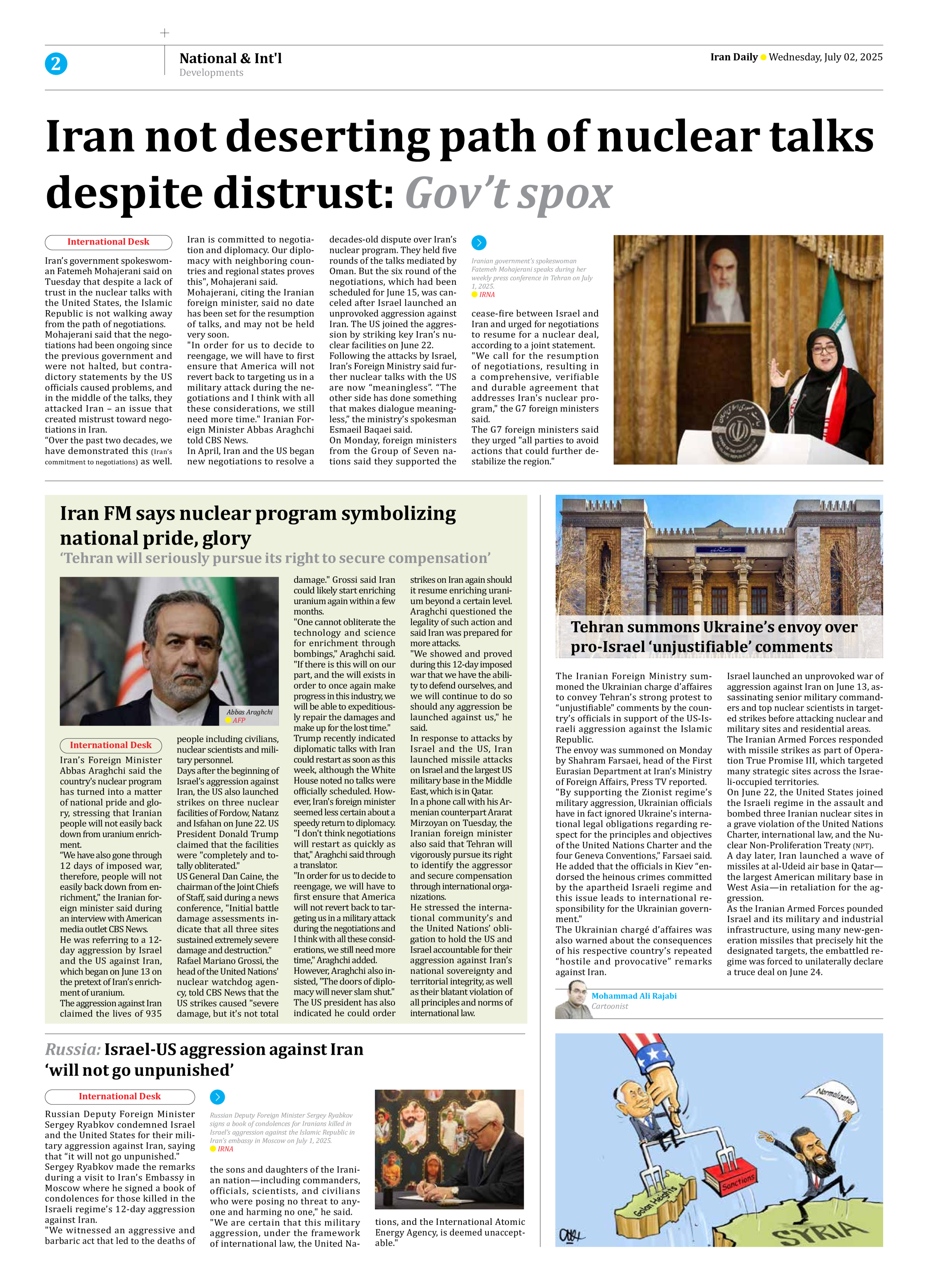


Iran FM says nuclear program symbolizing national pride, glory
‘Tehran will seriously pursue its right to secure compensation’
Iran’s Foreign Minister Abbas Araghchi said the country's nuclear program has turned into a matter of national pride and glory, stressing that Iranian people will not easily back down from uranium enrichment.
“We have also gone through 12 days of imposed war, therefore, people will not easily back down from enrichment," the Iranian foreign minister said during an interview with American media outlet CBS News.
He was referring to a 12-day aggression by Israel and the US against Iran, which began on June 13 on the pretext of Iran’s enrichment of uranium.
The aggression against Iran claimed the lives of 935 people including civilians, nuclear scientists and military personnel.
Days after the beginning of Israel’s aggression against Iran, the US also launched strikes on three nuclear facilities of Fordow, Natanz and Isfahan on June 22. US President Donald Trump claimed that the facilities were "completely and totally obliterated."
US General Dan Caine, the chairman of the Joint Chiefs of Staff, said during a news conference, "Initial battle damage assessments indicate that all three sites sustained extremely severe damage and destruction."
Rafael Mariano Grossi, the head of the United Nations' nuclear watchdog agency, told CBS News that the US strikes caused "severe damage, but it's not total damage." Grossi said Iran could likely start enriching uranium again within a few months.
"One cannot obliterate the technology and science for enrichment through bombings," Araghchi said. "If there is this will on our part, and the will exists in order to once again make progress in this industry, we will be able to expeditiously repair the damages and make up for the lost time."
Trump recently indicated diplomatic talks with Iran could restart as soon as this week, although the White House noted no talks were officially scheduled. However, Iran's foreign minister seemed less certain about a speedy return to diplomacy.
"I don't think negotiations will restart as quickly as that," Araghchi said through a translator.
"In order for us to decide to reengage, we will have to first ensure that America will not revert back to targeting us in a military attack during the negotiations and I think with all these considerations, we still need more time," Araghchi added.
However, Araghchi also insisted, "The doors of diplomacy will never slam shut."
The US president has also indicated he could order strikes on Iran again should it resume enriching uranium beyond a certain level. Araghchi questioned the legality of such action and said Iran was prepared for more attacks.
"We showed and proved during this 12-day imposed war that we have the ability to defend ourselves, and we will continue to do so should any aggression be launched against us," he said.
In response to attacks by Israel and the US, Iran launched missile attacks on Israel and the largest US military base in the Middle East, which is in Qatar.
In a phone call with his Armenian counterpart Ararat Mirzoyan on Tuesday, the Iranian foreign minister also said that Tehran will vigorously pursue its right to identify the aggressor and secure compensation through international organizations.
He stressed the international community’s and the United Nations’ obligation to hold the US and Israel accountable for their aggression against Iran’s national sovereignty and territorial integrity, as well as their blatant violation of all principles and norms of international law.