







Zanjan Province; a major center for handmade carpets
Handwoven carpet, as a suitable and soft flooring, have been a fundamental component of every Iranian home, holding a unique and irreplaceable position within Iranian culture. This flooring not only imparts a sense of tranquility and warmth to households but has also been cherished for its beauty, artistic value, economic significance, and cultural importance for centuries. Its esteemed status extends beyond borders, where it is often exchanged as a valuable gift — an act of great respect and admiration.
Artistic, cultural value
Among these, hand-woven carpets made from natural materials such as wool, cotton, silk, and other fibers are particularly significant from multiple perspectives. Their importance is amplified due to their deep connection to art, creativity, and craftsmanship, making their value grow exponentially. These carpets, woven with intricate, rhythmic patterns akin to harmonious poetry, symbolize Iranian art and culture. Renowned worldwide, they are rich with history and stories that reflect centuries of tradition, IRNA wrote.
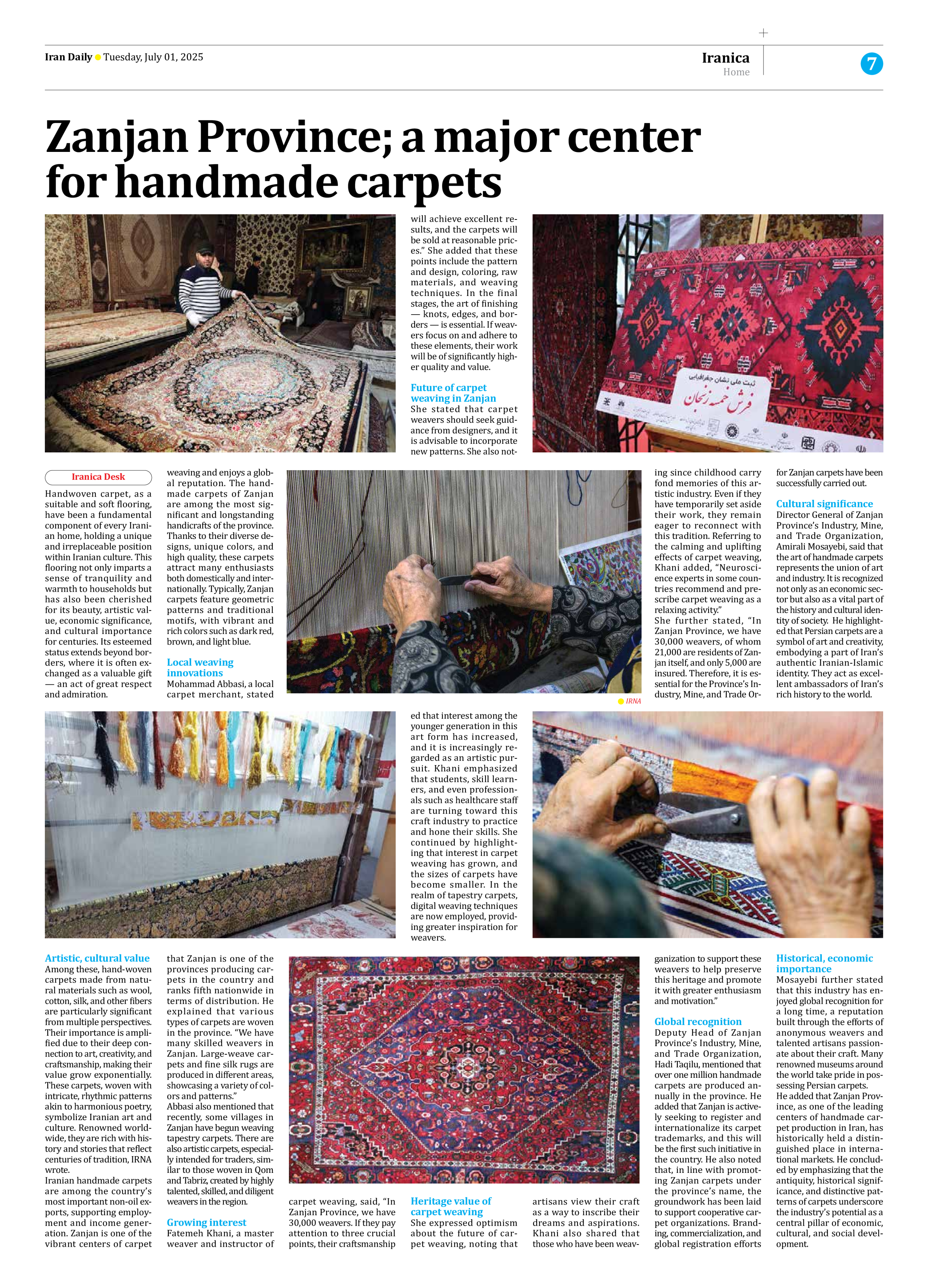
Iranian handmade carpets are among the country’s most important non-oil exports, supporting employment and income generation. Zanjan is one of the vibrant centers of carpet weaving and enjoys a global reputation. The handmade carpets of Zanjan are among the most significant and longstanding handicrafts of the province. Thanks to their diverse designs, unique colors, and high quality, these carpets attract many enthusiasts both domestically and internationally. Typically, Zanjan carpets feature geometric patterns and traditional motifs, with vibrant and rich colors such as dark red, brown, and light blue.
Local weaving innovations
Mohammad Abbasi, a local carpet merchant, stated that Zanjan is one of the provinces producing carpets in the country and ranks fifth nationwide in terms of distribution. He explained that various types of carpets are woven in the province. “We have many skilled weavers in Zanjan. Large-weave carpets and fine silk rugs are produced in different areas, showcasing a variety of colors and patterns.”
Abbasi also mentioned that recently, some villages in Zanjan have begun weaving tapestry carpets. There are also artistic carpets, especially intended for traders, similar to those woven in Qom and Tabriz, created by highly talented, skilled, and diligent weavers in the region.
Growing interest
Fatemeh Khani, a master weaver and instructor of carpet weaving, said, “In Zanjan Province, we have 30,000 weavers. If they pay attention to three crucial points, their craftsmanship will achieve excellent results, and the carpets will be sold at reasonable prices.” She added that these points include the pattern and design, coloring, raw materials, and weaving techniques. In the final stages, the art of finishing — knots, edges, and borders — is essential. If weavers focus on and adhere to these elements, their work will be of significantly higher quality and value.
Future of carpet weaving in Zanjan
She stated that carpet weavers should seek guidance from designers, and it is advisable to incorporate new patterns. She also noted that interest among the younger generation in this art form has increased, and it is increasingly regarded as an artistic pursuit. Khani emphasized that students, skill learners, and even professionals such as healthcare staff are turning toward this craft industry to practice and hone their skills. She continued by highlighting that interest in carpet weaving has grown, and the sizes of carpets have become smaller. In the realm of tapestry carpets, digital weaving techniques are now employed, providing greater inspiration for weavers.
Heritage value of carpet weaving
She expressed optimism about the future of carpet weaving, noting that artisans view their craft as a way to inscribe their dreams and aspirations. Khani also shared that those who have been weaving since childhood carry fond memories of this artistic industry. Even if they have temporarily set aside their work, they remain eager to reconnect with this tradition. Referring to the calming and uplifting effects of carpet weaving, Khani added, “Neuroscience experts in some countries recommend and prescribe carpet weaving as a relaxing activity.”
She further stated, “In Zanjan Province, we have 30,000 weavers, of whom 21,000 are residents of Zanjan itself, and only 5,000 are insured. Therefore, it is essential for the Province’s Industry, Mine, and Trade Organization to support these weavers to help preserve this heritage and promote it with greater enthusiasm and motivation.”
Global recognition
Deputy Head of Zanjan Province’s Industry, Mine, and Trade Organization, Hadi Taqilu, mentioned that over one million handmade carpets are produced annually in the province. He added that Zanjan is actively seeking to register and internationalize its carpet trademarks, and this will be the first such initiative in the country. He also noted that, in line with promoting Zanjan carpets under the province’s name, the groundwork has been laid to support cooperative carpet organizations. Branding, commercialization, and global registration efforts for Zanjan carpets have been successfully carried out.
Cultural significance
Director General of Zanjan Province’s Industry, Mine, and Trade Organization, Amirali Mosayebi, said that the art of handmade carpets represents the union of art and industry. It is recognized not only as an economic sector but also as a vital part of the history and cultural identity of society. He highlighted that Persian carpets are a symbol of art and creativity, embodying a part of Iran’s authentic Iranian-Islamic identity. They act as excellent ambassadors of Iran’s rich history to the world.
Historical, economic importance
Mosayebi further stated that this industry has enjoyed global recognition for a long time, a reputation built through the efforts of anonymous weavers and talented artisans passionate about their craft. Many renowned museums around the world take pride in possessing Persian carpets.
He added that Zanjan Province, as one of the leading centers of handmade carpet production in Iran, has historically held a distinguished place in international markets. He concluded by emphasizing that the antiquity, historical significance, and distinctive patterns of carpets underscore the industry’s potential as a central pillar of economic, cultural, and social development.