







Iranian Parliament moves to suspend cooperation with IAEA
Reviewing Agency’s strategic missteps
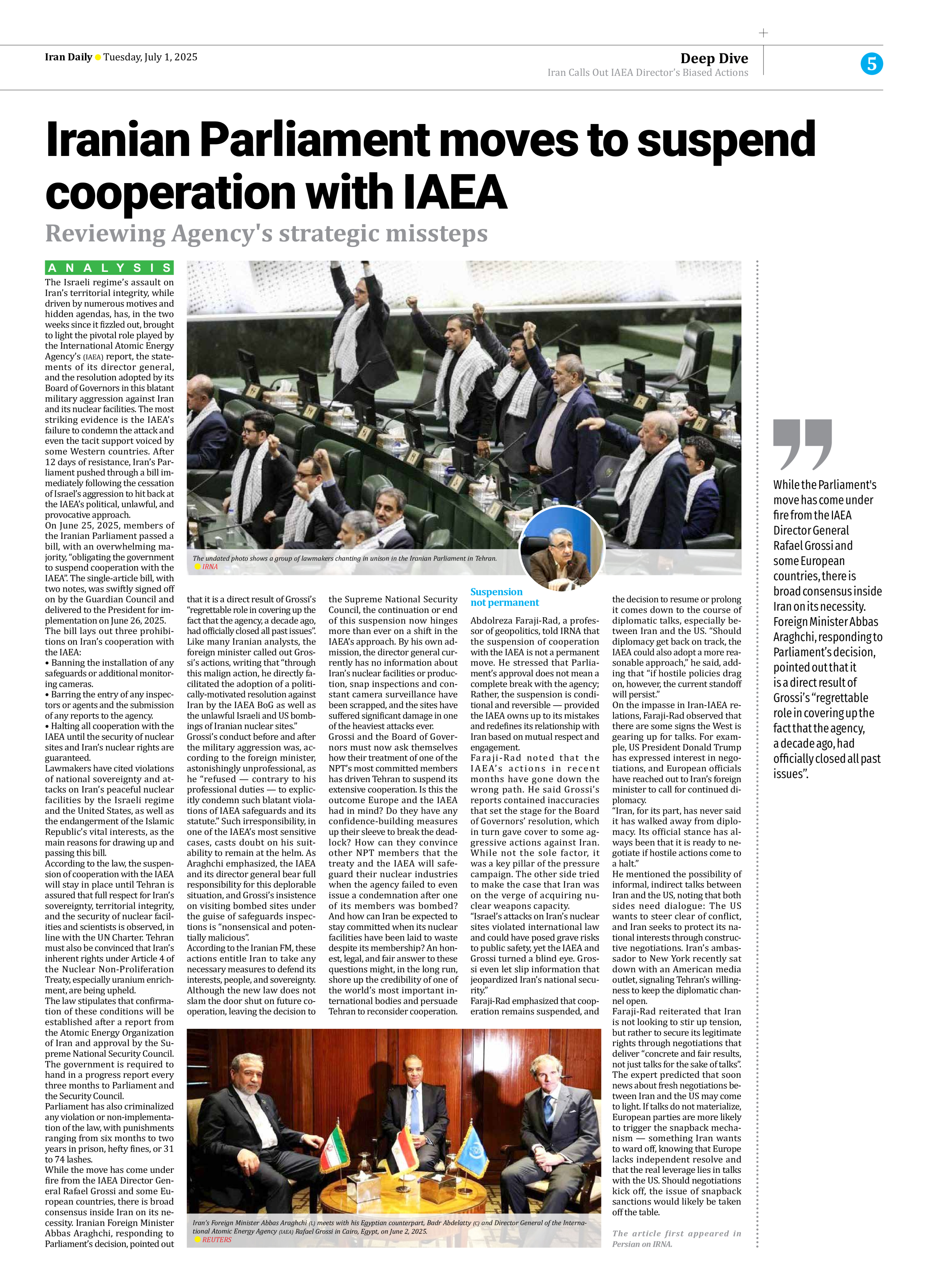
The Israeli regime’s assault on Iran’s territorial integrity, while driven by numerous motives and hidden agendas, has, in the two weeks since it fizzled out, brought to light the pivotal role played by the International Atomic Energy Agency’s (IAEA) report, the statements of its director general, and the resolution adopted by its Board of Governors in this blatant military aggression against Iran and its nuclear facilities. The most striking evidence is the IAEA’s failure to condemn the attack and even the tacit support voiced by some Western countries. After 12 days of resistance, Iran’s Parliament pushed through a bill immediately following the cessation of Israel’s aggression to hit back at the IAEA’s political, unlawful, and provocative approach.
On June 25, 2025, members of the Iranian Parliament passed a bill, with an overwhelming majority, “obligating the government to suspend cooperation with the IAEA”. The single-article bill, with two notes, was swiftly signed off on by the Guardian Council and delivered to the President for implementation on June 26, 2025.
The bill lays out three prohibitions on Iran’s cooperation with the IAEA:
• Banning the installation of any safeguards or additional monitoring cameras.
• Barring the entry of any inspectors or agents and the submission of any reports to the agency.
• Halting all cooperation with the IAEA until the security of nuclear sites and Iran’s nuclear rights are guaranteed.
Lawmakers have cited violations of national sovereignty and attacks on Iran’s peaceful nuclear facilities by the Israeli regime and the United States, as well as the endangerment of the Islamic Republic’s vital interests, as the main reasons for drawing up and passing this bill.
According to the law, the suspension of cooperation with the IAEA will stay in place until Tehran is assured that full respect for Iran’s sovereignty, territorial integrity, and the security of nuclear facilities and scientists is observed, in line with the UN Charter. Tehran must also be convinced that Iran’s inherent rights under Article 4 of the Nuclear Non-Proliferation Treaty, especially uranium enrichment, are being upheld.
The law stipulates that confirmation of these conditions will be established after a report from the Atomic Energy Organization of Iran and approval by the Supreme National Security Council. The government is required to hand in a progress report every three months to Parliament and the Security Council.
Parliament has also criminalized any violation or non-implementation of the law, with punishments ranging from six months to two years in prison, hefty fines, or 31 to 74 lashes.
While the move has come under fire from the IAEA Director General Rafael Grossi and some European countries, there is broad consensus inside Iran on its necessity. Iranian Foreign Minister Abbas Araghchi, responding to Parliament’s decision, pointed out that it is a direct result of Grossi’s “regrettable role in covering up the fact that the agency, a decade ago, had officially closed all past issues”.
Like many Iranian analysts, the foreign minister called out Grossi’s actions, writing that “through this malign action, he directly facilitated the adoption of a politically-motivated resolution against Iran by the IAEA BoG as well as the unlawful Israeli and US bombings of Iranian nuclear sites.”
Grossi’s conduct before and after the military aggression was, according to the foreign minister, astonishingly unprofessional, as he “refused — contrary to his professional duties — to explicitly condemn such blatant violations of IAEA safeguards and its statute.” Such irresponsibility, in one of the IAEA’s most sensitive cases, casts doubt on his suitability to remain at the helm. As Araghchi emphasized, the IAEA and its director general bear full responsibility for this deplorable situation, and Grossi’s insistence on visiting bombed sites under the guise of safeguards inspections is “nonsensical and potentially malicious”.
According to the Iranian FM, these actions entitle Iran to take any necessary measures to defend its interests, people, and sovereignty.
Although the new law does not slam the door shut on future cooperation, leaving the decision to the Supreme National Security Council, the continuation or end of this suspension now hinges more than ever on a shift in the IAEA’s approach. By his own admission, the director general currently has no information about Iran’s nuclear facilities or production, snap inspections and constant camera surveillance have been scrapped, and the sites have suffered significant damage in one of the heaviest attacks ever.
Grossi and the Board of Governors must now ask themselves how their treatment of one of the NPT’s most committed members has driven Tehran to suspend its extensive cooperation. Is this the outcome Europe and the IAEA had in mind? Do they have any confidence-building measures up their sleeve to break the deadlock? How can they convince other NPT members that the treaty and the IAEA will safeguard their nuclear industries when the agency failed to even issue a condemnation after one of its members was bombed? And how can Iran be expected to stay committed when its nuclear facilities have been laid to waste despite its membership? An honest, legal, and fair answer to these questions might, in the long run, shore up the credibility of one of the world’s most important international bodies and persuade Tehran to reconsider cooperation.
Suspension not permanent
Abdolreza Faraji-Rad, a professor of geopolitics, told IRNA that the suspension of cooperation with the IAEA is not a permanent move. He stressed that Parliament’s approval does not mean a complete break with the agency; Rather, the suspension is conditional and reversible — provided the IAEA owns up to its mistakes and redefines its relationship with Iran based on mutual respect and engagement.
Faraji-Rad noted that the IAEA’s actions in recent months have gone down the wrong path. He said Grossi’s reports contained inaccuracies that set the stage for the Board of Governors’ resolution, which in turn gave cover to some aggressive actions against Iran. While not the sole factor, it was a key pillar of the pressure campaign. The other side tried to make the case that Iran was on the verge of acquiring nuclear weapons capacity.
“Israel’s attacks on Iran’s nuclear sites violated international law and could have posed grave risks to public safety, yet the IAEA and Grossi turned a blind eye. Grossi even let slip information that jeopardized Iran’s national security.”
Faraji-Rad emphasized that cooperation remains suspended, and the decision to resume or prolong it comes down to the course of diplomatic talks, especially between Iran and the US. “Should diplomacy get back on track, the IAEA could also adopt a more reasonable approach,” he said, adding that “if hostile policies drag on, however, the current standoff will persist.”
On the impasse in Iran-IAEA relations, Faraji-Rad observed that there are some signs the West is gearing up for talks. For example, US President Donald Trump has expressed interest in negotiations, and European officials have reached out to Iran’s foreign minister to call for continued diplomacy.
“Iran, for its part, has never said it has walked away from diplomacy. Its official stance has always been that it is ready to negotiate if hostile actions come to a halt.”
He mentioned the possibility of informal, indirect talks between Iran and the US, noting that both sides need dialogue: The US wants to steer clear of conflict, and Iran seeks to protect its national interests through constructive negotiations. Iran’s ambassador to New York recently sat down with an American media outlet, signaling Tehran’s willingness to keep the diplomatic channel open.
Faraji-Rad reiterated that Iran is not looking to stir up tension, but rather to secure its legitimate rights through negotiations that deliver “concrete and fair results, not just talks for the sake of talks”.
The expert predicted that soon news about fresh negotiations between Iran and the US may come to light. If talks do not materialize, European parties are more likely to trigger the snapback mechanism — something Iran wants to ward off, knowing that Europe lacks independent resolve and that the real leverage lies in talks with the US. Should negotiations kick off, the issue of snapback sanctions would likely be taken off the table.
The article first appeared in
Persian on IRNA.