







Amidst eroding credibility of UN watchdog
Tehran has to take firm action against IAEA chief
By Nosratollah Tajik
Former Iranian ambassador to Jordan
For humanity, peace has always been sweeter than war. Yet staying alert in times of peace is no less important than vigilance during conflict. One of the key players in bringing the region to the brink of a potentially global confrontation was the International Atomic Energy Agency (IAEA). Until the agency comes out and condemns the US and Israeli attacks on Iran’s nuclear facilities, Iran must stick to all necessary security, intelligence, protective, political, and other required protocols. In other words, Iran’s cooperation with the agency, both before and after these 12 days (June 13–24, 2025), should be handled differently.
Beyond the West’s aim to turn up the heat on Iran’s nuclear program — a move in which the agency and its current Director General Mr. Rafael Grossi have played a significant role — the core of the West’s dispute with Iran centers on enrichment. The West’s actions, including its failure to deliver nuclear fuel paid for by Iran before the 1979 Islamic Revolution, have sown the seeds of mistrust and convinced Iran not to bank on Western commitments, prompting it to go down its own path. Now, Trump, acting on behalf of the West, is trying to pick up where Ernest Moniz, John Kerry, and Obama “said they couldn’t,” seeking to take apart Iran’s nuclear industry by force, aiming both for national hero status and a Nobel Prize.
From Iran’s perspective, the “body” of enrichment is technological, while its “spirit” is geopolitical, underpinned by national will and authority to secure its interests. Although Iran is enriching uranium under the rights granted by the JCPOA and as an NPT member, given the West’s repeated breaches of trust — even before the Islamic Republic’s founding — who can guarantee that halting enrichment would be the end of Western demands?
In a region where everyone is waiting for Iran to fall apart, Iran’s nuclear program has not only become a way for the US, Europe, and the agency to settle their political debts, but the US attack on Iran’s nuclear facilities amounts to an international crime. Given the legal foundations of Iran’s nuclear program, this can be taken up in international courts. While this may not have an immediate impact in today’s unjust international system and the flawed structure of the UN, even casting doubt on America’s legitimacy could tip the scales in the global balance of power — a point that requires cooperation with other nations.
Looking at the main actors — Iran, the US, Europe, the agency, and Mr. Grossi — and their various agendas, we are faced with a complex equation with multiple scenarios. Iran sees nuclear energy as a pillar of its national strength and seeks to resolve its issues with the West and the agency without harming this industry. The US is maximalist and pushes for zero enrichment, which is neither legally justified nor acceptable to Iran. Although an agreement could have been a major breakthrough, Trump is all over the map — it’s unclear whether his goal is to wipe out Iran’s nuclear industry or to bring about regime change. The US attack on Iran’s nuclear facilities has brought negotiations to a standstill and pushed diplomacy to the sidelines.
Europe, sidelined by the US, has tried to make the most of the situation by ramping up pressure on Iran to secure its own role in the nuclear program and shore up its regional and global standing.
The IAEA, meanwhile, has operated on two levels. First, Director General Grossi waded into a complex political game, playing a destructive role driven by personal ambition. He sought to boost his own standing by cozying up to the US, turning Iran’s nuclear dossier into a tool for his own advancement. Second, the agency itself strayed from impartial oversight, becoming a tool for political pressure and bargaining. Instead of focusing on technical oversight, the agency has turned into a political actor in the ongoing horse-trading.
Although the three main players — the US, Europe, and the agency — have different goals, they have all taken advantage of the current situation to turn up the pressure on Iran and pave the way for US and Israeli attacks.
Rather than sticking to his professional and technical duties, Rafael Grossi has gone in for political, media, and PR activities — actions outside the agency’s mandate, aimed solely at polishing his own image and currying favor with the West in hopes of a future UN secretary-general bid.
Meanwhile, inside Iran, there is little positive sentiment toward him or his approach. Many experts believe he should be seen as nothing more than a technical staffer at the agency’s secretariat, not as a political figure.
Engagement with the director general should have remained strictly technical. The lack of Iran-Europe relations should not have opened the door for Grossi to step into the spotlight. His interviews, especially from a security and information protection standpoint, were troubling. In my view, Iran should have spoken out clearly and firmly against his actions.
Fortunately, in an explanatory note distributed by Iran’s IAEA mission, the country called out Grossi’s report and his lack of professionalism, but this matter should now be taken up a notch and a formal complaint lodged against him. The note pointed out that some of the information he released was sensitive and its public disclosure could be dangerous.
Overall, Mr. Grossi’s conduct departed from professional norms, turning Iran’s nuclear program into a tool for his personal ambitions. Iran’s mission in Vienna and the Foreign Ministry must write to the UN secretary-general, both to object to the director general’s methods and to the agency’s overall performance, which has become blatantly biased and politicized.
According to Iran’s mission, the agency has pulled out all the stops to monitor Iran’s nuclear program, conducting more inspections there than anywhere else in the world. Yet, these efforts are neither reflected in the agency’s reports nor in its technical assessments, which are colored by politics.
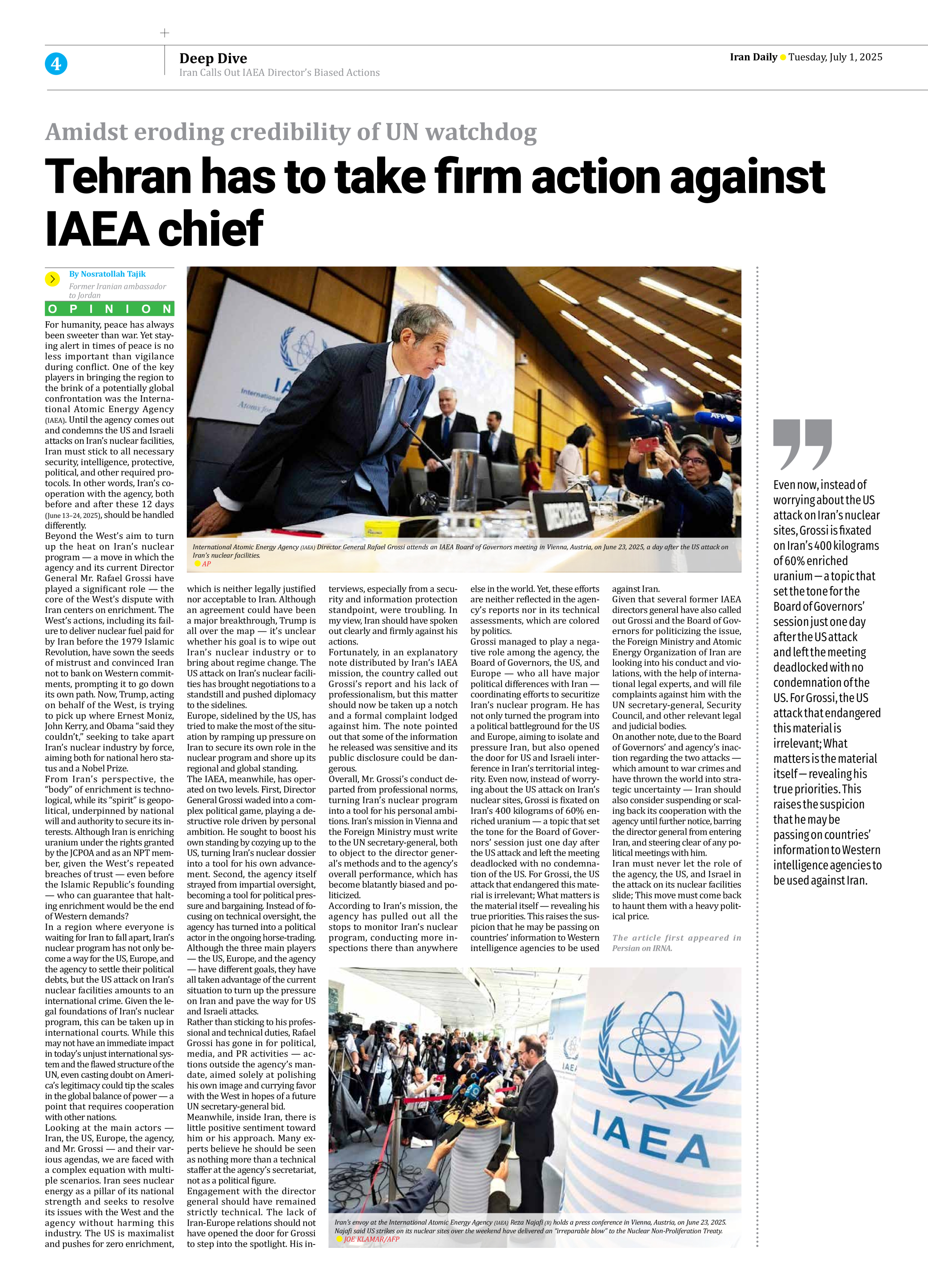
Grossi managed to play a negative role among the agency, the Board of Governors, the US, and Europe — who all have major political differences with Iran — coordinating efforts to securitize Iran’s nuclear program. He has not only turned the program into a political battleground for the US and Europe, aiming to isolate and pressure Iran, but also opened the door for US and Israeli interference in Iran’s territorial integrity. Even now, instead of worrying about the US attack on Iran’s nuclear sites, Grossi is fixated on Iran’s 400 kilograms of 60% enriched uranium — a topic that set the tone for the Board of Governors’ session just one day after the US attack and left the meeting deadlocked with no condemnation of the US. For Grossi, the US attack that endangered this material is irrelevant; What matters is the material itself — revealing his true priorities. This raises the suspicion that he may be passing on countries’ information to Western intelligence agencies to be used against Iran.
Given that several former IAEA directors general have also called out Grossi and the Board of Governors for politicizing the issue, the Foreign Ministry and Atomic Energy Organization of Iran are looking into his conduct and violations, with the help of international legal experts, and will file complaints against him with the UN secretary-general, Security Council, and other relevant legal and judicial bodies.
On another note, due to the Board of Governors’ and agency’s inaction regarding the two attacks — which amount to war crimes and have thrown the world into strategic uncertainty — Iran should also consider suspending or scaling back its cooperation with the agency until further notice, barring the director general from entering Iran, and steering clear of any political meetings with him.
Iran must never let the role of the agency, the US, and Israel in the attack on its nuclear facilities slide; This move must come back to haunt them with a heavy political price.
The article first appeared in
Persian on IRNA.