





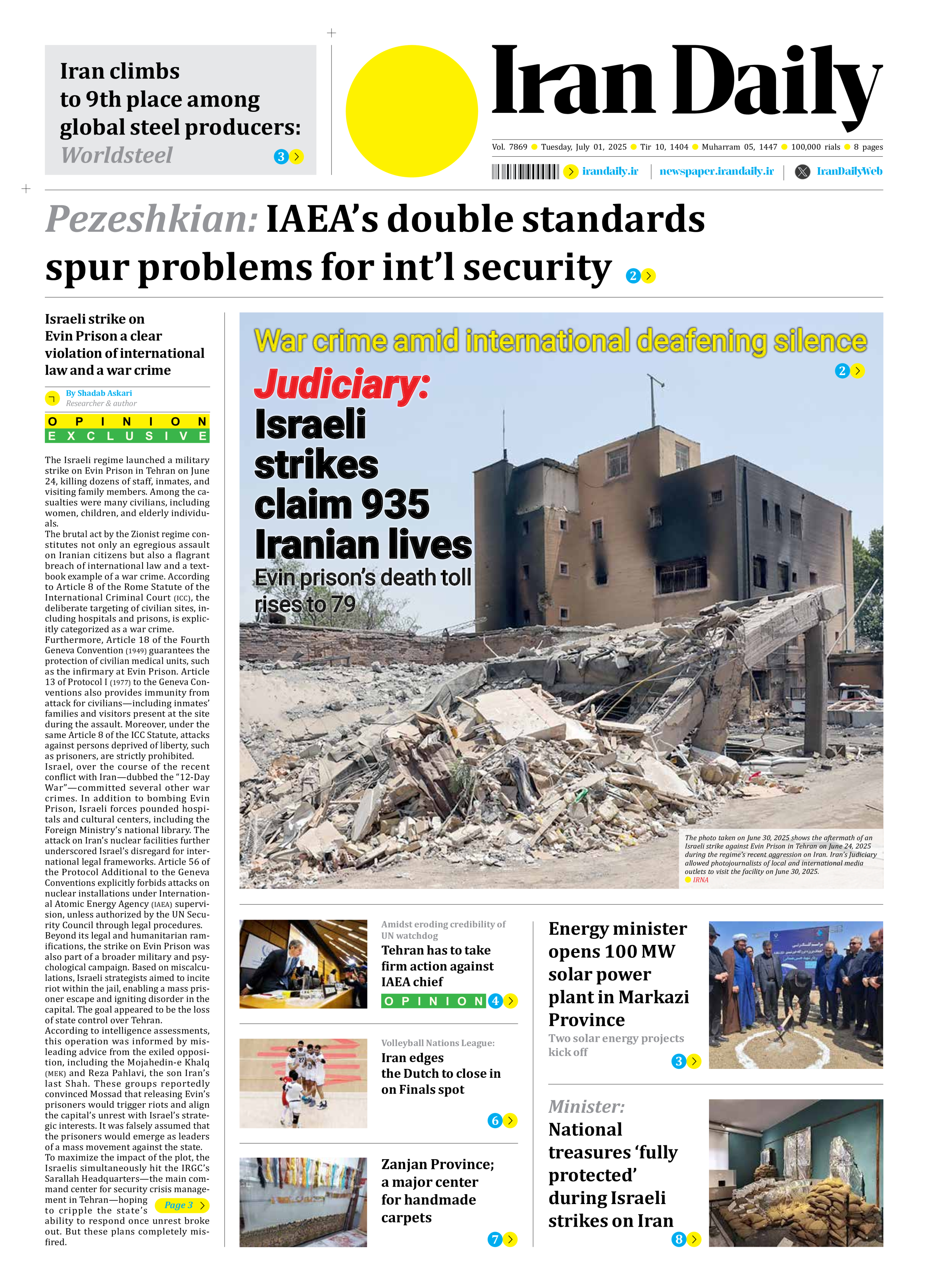


Israeli strike on Evin Prison a clear violation of international law and a war crime
By Shadab Askari
Researcher & author
The Israeli regime launched a military strike on Evin Prison in Tehran on June 24, killing dozens of staff, inmates, and visiting family members. Among the casualties were many civilians, including women, children, and elderly individuals.
The brutal act by the Zionist regime constitutes not only an egregious assault on Iranian citizens but also a flagrant breach of international law and a textbook example of a war crime. According to Article 8 of the Rome Statute of the International Criminal Court (ICC), the deliberate targeting of civilian sites, including hospitals and prisons, is explicitly categorized as a war crime.
Furthermore, Article 18 of the Fourth Geneva Convention (1949) guarantees the protection of civilian medical units, such as the infirmary at Evin Prison. Article 13 of Protocol I (1977) to the Geneva Conventions also provides immunity from attack for civilians—including inmates’ families and visitors present at the site during the assault. Moreover, under the same Article 8 of the ICC Statute, attacks against persons deprived of liberty, such as prisoners, are strictly prohibited.
Israel, over the course of the recent conflict with Iran—dubbed the “12-Day War”—committed several other war crimes. In addition to bombing Evin Prison, Israeli forces pounded hospitals and cultural centers, including the Foreign Ministry’s national library. The attack on Iran’s nuclear facilities further underscored Israel’s disregard for international legal frameworks. Article 56 of the Protocol Additional to the Geneva Conventions explicitly forbids attacks on nuclear installations under International Atomic Energy Agency (IAEA) supervision, unless authorized by the UN Security Council through legal procedures.
Beyond its legal and humanitarian ramifications, the strike on Evin Prison was also part of a broader military and psychological campaign. Based on miscalculations, Israeli strategists aimed to incite riot within the jail, enabling a mass prisoner escape and igniting disorder in the capital. The goal appeared to be the loss of state control over Tehran.
According to intelligence assessments, this operation was informed by misleading advice from the exiled opposition, including the Mojahedin-e Khalq (MEK) and Reza Pahlavi, the son Iran’s last Shah. These groups reportedly convinced Mossad that releasing Evin’s prisoners would trigger riots and align the capital’s unrest with Israel’s strategic interests. It was falsely assumed that the prisoners would emerge as leaders of a mass movement against the state.
To maximize the impact of the plot, the Israelis simultaneously hit the IRGC’s Sarallah Headquarters—the main command center for security crisis management in Tehran—hoping to cripple the state’s ability to respond once unrest broke out. But these plans completely misfired.
Page 3