





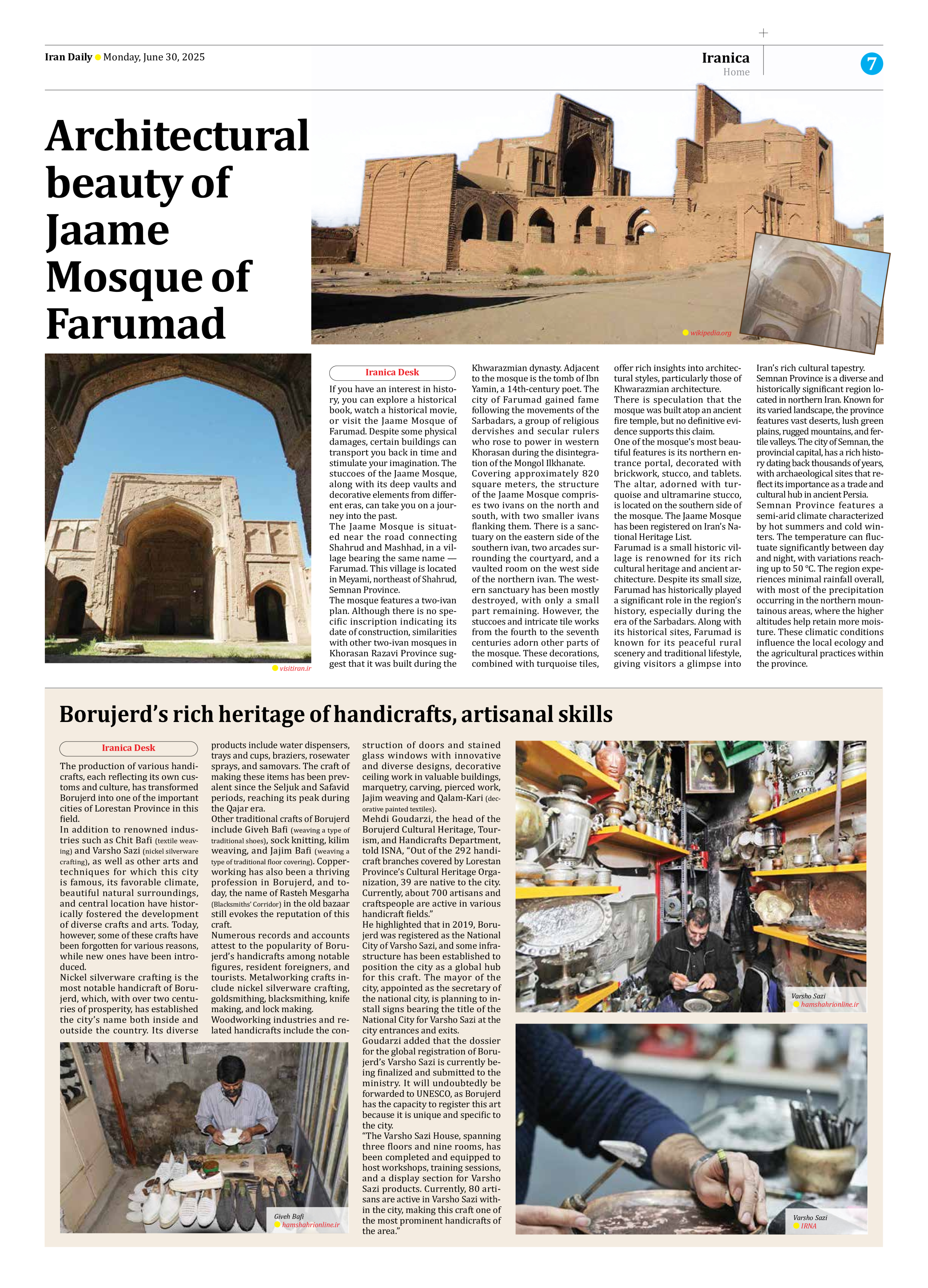


Architectural beauty of Jaame Mosque of Farumad
If you have an interest in history, you can explore a historical book, watch a historical movie, or visit the Jaame Mosque of Farumad. Despite some physical damages, certain buildings can transport you back in time and stimulate your imagination. The stuccoes of the Jaame Mosque, along with its deep vaults and decorative elements from different eras, can take you on a journey into the past.
The Jaame Mosque is situated near the road connecting Shahrud and Mashhad, in a village bearing the same name — Farumad. This village is located in Meyami, northeast of Shahrud, Semnan Province.
The mosque features a two-ivan plan. Although there is no specific inscription indicating its date of construction, similarities with other two-ivan mosques in Khorasan Razavi Province suggest that it was built during the Khwarazmian dynasty. Adjacent to the mosque is the tomb of Ibn Yamin, a 14th-century poet. The city of Farumad gained fame following the movements of the Sarbadars, a group of religious dervishes and secular rulers who rose to power in western Khorasan during the disintegration of the Mongol Ilkhanate.
Covering approximately 820 square meters, the structure of the Jaame Mosque comprises two ivans on the north and south, with two smaller ivans flanking them. There is a sanctuary on the eastern side of the southern ivan, two arcades surrounding the courtyard, and a vaulted room on the west side of the northern ivan. The western sanctuary has been mostly destroyed, with only a small part remaining. However, the stuccoes and intricate tile works from the fourth to the seventh centuries adorn other parts of the mosque. These decorations, combined with turquoise tiles, offer rich insights into architectural styles, particularly those of Khwarazmian architecture.
There is speculation that the mosque was built atop an ancient fire temple, but no definitive evidence supports this claim.
One of the mosque’s most beautiful features is its northern entrance portal, decorated with brickwork, stucco, and tablets. The altar, adorned with turquoise and ultramarine stucco, is located on the southern side of the mosque. The Jaame Mosque has been registered on Iran’s National Heritage List.
Farumad is a small historic village is renowned for its rich cultural heritage and ancient architecture. Despite its small size, Farumad has historically played a significant role in the region’s history, especially during the era of the Sarbadars. Along with its historical sites, Farumad is known for its peaceful rural scenery and traditional lifestyle, giving visitors a glimpse into Iran’s rich cultural tapestry.
Semnan Province is a diverse and historically significant region located in northern Iran. Known for its varied landscape, the province features vast deserts, lush green plains, rugged mountains, and fertile valleys. The city of Semnan, the provincial capital, has a rich history dating back thousands of years, with archaeological sites that reflect its importance as a trade and cultural hub in ancient Persia.
Semnan Province features a semi-arid climate characterized by hot summers and cold winters. The temperature can fluctuate significantly between day and night, with variations reaching up to 50 °C. The region experiences minimal rainfall overall, with most of the precipitation occurring in the northern mountainous areas, where the higher altitudes help retain more moisture. These climatic conditions influence the local ecology and the agricultural practices within the province.