







Iranian nation ‘backbone’ of Islamic Establishment: Professor
Diplomacy, military prowess align perfectly
From the early hours of Friday, June 13, 2025, to the morning of Tuesday, June 24, 2025, one of the most significant chapters in the book of Iran’s history was turned. Over these 12 days of military aggression by the Zionist regime and the United States against Iran’s borders, we witnessed a resounding defense by both the government and the people. This blatant act of aggression against Iran, which took place in the midst of negotiations with the United States and under the pretext of a political report from the International Atomic Energy Agency (IAEA), not only dealt a blow to diplomacy but also called into question the credibility of many international institutions and advocates of established norms.
The Israeli regime’s military aggression against the Islamic Republic of Iran was recently brought to a halt. Regardless of whether this unilateral cease-fire will hold, did the Israeli cabinet achieve the objectives it had in mind?
DEHGHANI FIROOZABADI: First and foremost, I would like to extend my heartfelt gratitude to the brave armed forces and the resilient people of Iran, and to pay tribute to the noble and dignified Iranian nation and our courageous fighters. Perhaps Israel, and especially its criminal prime minister, did not openly spell out their true objectives. Nevertheless, both Israel and the United States have repeatedly stated their intention to wipe out Iran’s nuclear capabilities. At times, they have also spoken of reining in Iran’s missile power. Yet, as previously anticipated and raised by some, three major operational goals can be identified: first, to eliminate Iran’s nuclear capabilities; second, to restrict or destroy Iran’s missile power; and third, to reduce or eliminate Iran’s regional presence.
However, there were also broader political aims at play. In his first interview after the conflict broke out, Netanyahu addressed the Iranian people, declaring that Israel is not at war with Iranians and just wants to set them free. Such statements and slogans speak volumes about their underlying intention: regime change in the Islamic Republic of Iran. How did they hope to achieve this? By stirring up chaos, unrest, and disorder. Their analysis was that the Iranian people were dissatisfied and weary, and that the Islamic Republic had lost its popular support. They believed that if an air strike took place, the ground forces would rise up from within the people themselves. I can say with confidence that their most important goal — beyond damaging Iran’s nuclear, missile, and regional capabilities — was to undermine the Islamic Republic’s defensive strength. But their main political objective, regime change, was found to be out of reach. They did not even fully achieve their other declared goals.
In my view, Iran’s nuclear capabilities have not been destroyed either. Even now, there is debate within the United States as to whether this military strike on nuclear facilities actually wiped out Iran’s nuclear potential. Physical equipment and facilities may have been damaged, but the indigenous knowledge, technology, and expertise are still there and, in my opinion, have not been lost. So, it can be said that the Zionist regime’s attacks on Iran, while inflicting losses — especially with the martyrdom of our beloved compatriots and the damage caused — fell short of their main objectives. I say this not just as an Iranian, but as an outside observer: They did not even achieve their minimum goals, apart from the aforementioned harm they inflicted on the country.
America’s entry into the conflict and the bombing of Fordow can be analyzed from two perspectives. Some believe it was simply to appease Netanyahu, while others argue that the US entered the war with the clear aim of wiping out Iran’s nuclear industry. What is your take on the White House’s involvement?
These two views are not necessarily at odds with each other. In other words, Trump and the United States want to win, both the war and the peace. This means there was an overarching plan in place, undoubtedly drawn up before the Muscat negotiations began, and the US was in the loop. In my opinion, without US logistical, military, equipment, and weapons support, Israel simply would not have had the capacity to carry out offensive operations or mount an effective defense. We saw Trump repeatedly boast that they have the best weapons and that the Israelis certainly use them efficiently. In recent days, Trump has also frequently used the pronoun “we” in his remarks, making it clear he saw himself as a partner in these operations — which, in my view, he truly was.
In fact, the entire Western world and NATO got drawn into this affair. One could say we have just experienced a second sacred defense against the world. The Iranian nation showed, just as during Saddam Hussein’s attack — when all the powers of East and West threw their weight behind the enemy — that today, too, NATO and Western European countries stand squarely behind Israel. Could it be any clearer than when the German Chancellor says, “This is the dirty work Israel is doing for all of us”? That says it all.
Therefore, it can be concluded that the Americans were indirectly involved from the outset. When they sensed they could score some points from this military aggression, they jumped in directly. Whether this analysis is accurate, or whether there is precise information to back it up, I cannot say; However, some believe that what America did was more a show of force than a strategically significant move as nothing decisive was actually accomplished — especially given the lingering doubts about whether the Fordow facility was truly destroyed.
Was the US able to achieve its stated goal of destroying Iran’s nuclear facilities?
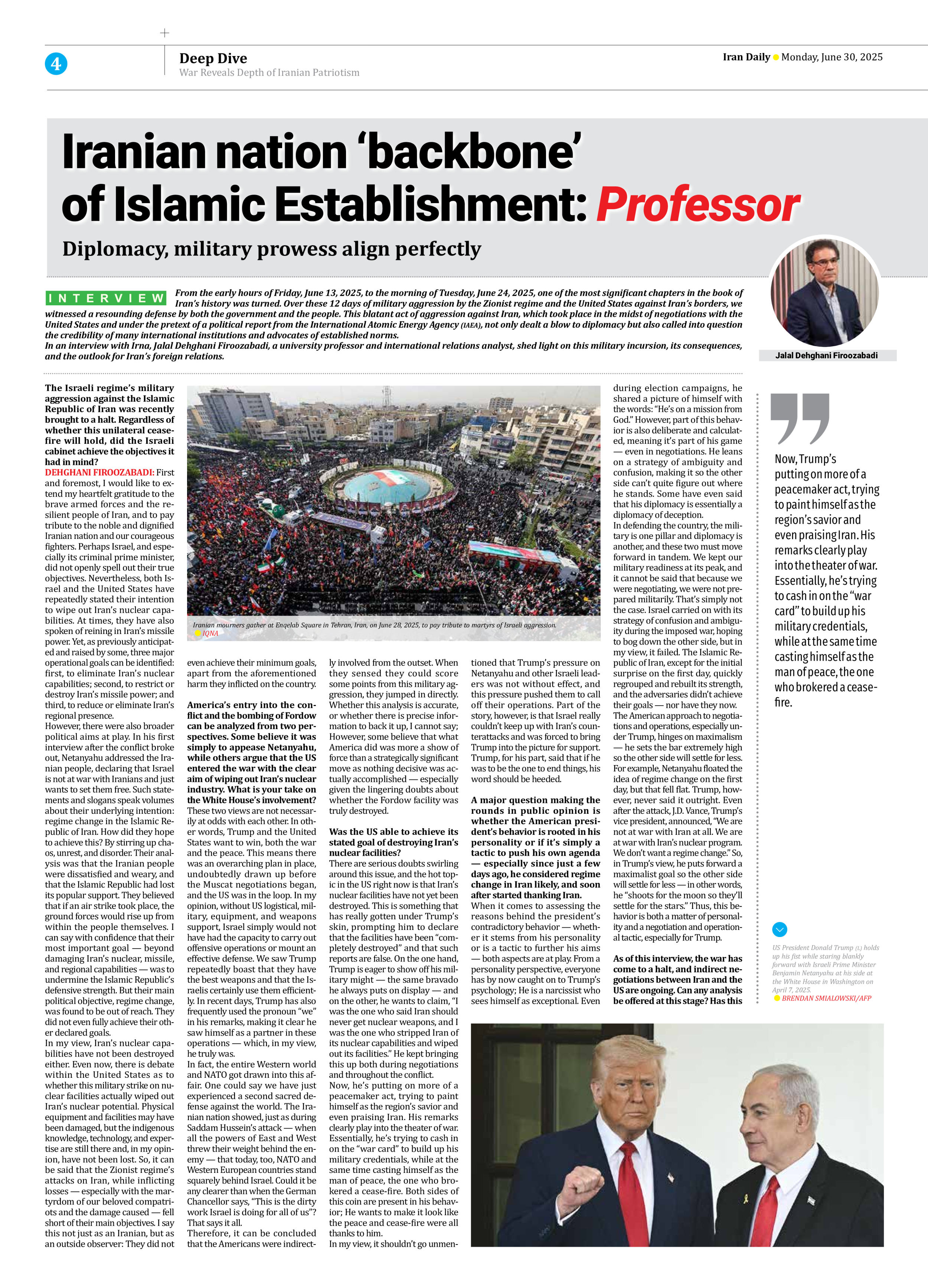
There are serious doubts swirling around this issue, and the hot topic in the US right now is that Iran’s nuclear facilities have not yet been destroyed. This is something that has really gotten under Trump’s skin, prompting him to declare that the facilities have been “completely destroyed” and that such reports are false. On the one hand, Trump is eager to show off his military might — the same bravado he always puts on display — and on the other, he wants to claim, “I was the one who said Iran should never get nuclear weapons, and I was the one who stripped Iran of its nuclear capabilities and wiped out its facilities.” He kept bringing this up both during negotiations and throughout the conflict.
Now, he’s putting on more of a peacemaker act, trying to paint himself as the region’s savior and even praising Iran. His remarks clearly play into the theater of war. Essentially, he’s trying to cash in on the “war card” to build up his military credentials, while at the same time casting himself as the man of peace, the one who brokered a cease-fire. Both sides of this coin are present in his behavior; He wants to make it look like the peace and cease-fire were all thanks to him.
In my view, it shouldn’t go unmentioned that Trump’s pressure on Netanyahu and other Israeli leaders was not without effect, and this pressure pushed them to call off their operations. Part of the story, however, is that Israel really couldn’t keep up with Iran’s counterattacks and was forced to bring Trump into the picture for support. Trump, for his part, said that if he was to be the one to end things, his word should be heeded.
A major question making the rounds in public opinion is whether the American president’s behavior is rooted in his personality or if it’s simply a tactic to push his own agenda — especially since just a few days ago, he considered regime change in Iran likely, and soon after started thanking Iran.
When it comes to assessing the reasons behind the president’s contradictory behavior — whether it stems from his personality or is a tactic to further his aims — both aspects are at play. From a personality perspective, everyone has by now caught on to Trump’s psychology; He is a narcissist who sees himself as exceptional. Even during election campaigns, he shared a picture of himself with the words: “He’s on a mission from God.” However, part of this behavior is also deliberate and calculated, meaning it’s part of his game — even in negotiations. He leans on a strategy of ambiguity and confusion, making it so the other side can’t quite figure out where he stands. Some have even said that his diplomacy is essentially a diplomacy of deception.
In defending the country, the military is one pillar and diplomacy is another, and these two must move forward in tandem. We kept our military readiness at its peak, and it cannot be said that because we were negotiating, we were not prepared militarily. That’s simply not the case. Israel carried on with its strategy of confusion and ambiguity during the imposed war, hoping to bog down the other side, but in my view, it failed. The Islamic Republic of Iran, except for the initial surprise on the first day, quickly regrouped and rebuilt its strength, and the adversaries didn’t achieve their goals — nor have they now.
The American approach to negotiations and operations, especially under Trump, hinges on maximalism — he sets the bar extremely high so the other side will settle for less. For example, Netanyahu floated the idea of regime change on the first day, but that fell flat. Trump, however, never said it outright. Even after the attack, J.D. Vance, Trump’s vice president, announced, “We are not at war with Iran at all. We are at war with Iran’s nuclear program. We don’t want a regime change.” So, in Trump’s view, he puts forward a maximalist goal so the other side will settle for less — in other words, he “shoots for the moon so they’ll settle for the stars.” Thus, this behavior is both a matter of personality and a negotiation and operational tactic, especially for Trump.
As of this interview, the war has come to a halt, and indirect negotiations between Iran and the US are ongoing. Can any analysis be offered at this stage? Has this round of diplomacy fallen into the war trap? Was the whole negotiation process just a smokescreen for war?
In the foreign policy toolbox, there are various instruments: military, security, defense, political, economic, commercial, and cultural. Foreign policy is not a box with only one tool inside. Depending on the issue, circumstances, and the country’s situation, one tool may be used more, or all may be brought into play at the same time. Using diplomacy alongside military power is both logical and necessary. I have previously said that foreign policy can be likened to a twin-engine aircraft. You can’t say the left engine is more important than the right; the two complement each other. These two paths — diplomacy and military — are like two parallel rails that intersect at the station of national interests and security. Sometimes we board the diplomacy train, sometimes the military train, and sometimes both carry us more quickly to our destination. In any case, our destination is the station of national interests and security.
Diplomacy never shuts down during wartime; Rather, it moves at different speeds depending on the circumstances. In times of peace, it’s only natural for diplomacy to take the driver’s seat. Now that we have used our military tools to their limits, diplomacy will, by nature, step up and play a greater role. During the war, diplomacy backed up military power; Now, the field must rally behind diplomacy. These two forces must work hand in glove — they are two sides of the same coin, like the blades of a pair of scissors. At this juncture, we need an active diplomacy. Active diplomacy means setting the agenda, the terms, the manner, and the venue of talks ourselves. In my view, Iran should lay out clear objectives and state under what conditions it is prepared to negotiate.
Whether we call it direct negotiation, dialogue, or a summit makes little difference; The substance remains the same. Wars usually wind down through diplomacy. There are two ways a war ends: Either one side is completely wiped out — which hasn’t happened — or military operations are halted, as is the case now. From this point forward, diplomacy must chart the exit strategy. That means, on the diplomatic and political front, we must have a clear plan for disengagement. Whether now is the right time for talks depends on the judgment of decision-makers and policymakers, but we must certainly hammer out clear goals and a transparent agenda — under what conditions we negotiate, and under what conditions we do not. Even talks with Europeans, if they can be called negotiations or dialogue, should be put under this microscope.
One of the most crucial functions of diplomacy during war is to translate military might into political power and to realize national objectives. The foreign ministers of the three European countries and the EU’s foreign policy chief must get the message loud and clear: The strategic designs of the West, Israel, or the US have not panned out, and this is how we defend our interests. They shouldn’t expect that if we are attacked, we will simply turn the other cheek. If they are fighting under the assumption that we must give up our nuclear and missile capabilities, that’s simply not realistic.
Diplomacy is sometimes mistaken for surrender, but surrender is not negotiation — words matter. In Persian, when we say “let’s negotiate,” we do not mean “let’s surrender.” We have a separate word for surrender. So, it’s important to note that negotiation does not necessarily mean backing down or admitting defeat. In fact, one can go into talks with an assertive and proactive approach, setting clear and specific terms for dialogue. Naturally, someone who has failed to achieve their aims on the battlefield should not expect to win them at the negotiating table. Anyone who could not bring us to our knees or cripple our missile power in battle should know not to expect such outcomes in negotiations.
If Trump’s idea of negotiation is to achieve such goals — or if Europe harbors similar ambitions (which is even worse as it plays a destructive role behind the scenes) — we must enter talks with a well-crafted plan. Israel, in a sense, acts as a proxy for the West and the US in the region and wages war against us. Therefore, we too must map out a diplomatic and political solution and draw up an exit strategy, and we will certainly need support from the field. Without such backing, diplomacy is like a gun with no bullets; Just as when someone comes to the table with a power-based approach, we must meet them on equal footing.
Should the cessation of aggression hold, what changes should the Islamic Republic of Iran make in its relations with neighbors, its two strategic partners Russia and China, and Europe? Do these relationships need to be reassessed, for better or worse?
Most experts believe a balanced foreign policy is the right fit for Iran, both in terms of its diplomatic, geographical, and regional portfolio. Naturally, our policy “basket” should give special weight to neighborly relations, regionalism, and an Eastern outlook, while also keeping ties with the West — provided these are based on mutual respect and shared interests. I have often said that if the US recognizes three things — the existence of the Islamic Republic, the identity of our political establishment, and Iran’s national interests (none of which are outlandish by international standards) — based on mutual respect, then we can strike a balanced relationship with all countries.
I am not a proponent of an “all-East or all-West” policy, but our diplomatic portfolio should be diverse and varied so we can draw on different options as needed. We must put national interests front and center and weigh what those interests require — whether ties with the West, East, South, or the region should be conditional or not. The neighborhood policy must be bolstered as one of the bright spots during this recent aggression was the support from neighboring and regional countries, as well as their efforts to head off the war.
In my view, Israel — or even Trump himself — more than deceiving us (which I do not believe), had pulled the wool over the eyes of some regional countries. The Arab states have now come to realize that Iran’s geopolitical weight is a stabilizing anchor in the region, and that only Iran can keep the balance in check against Israel and, by extension, the US. This is a historic lesson for the Arabs. Some of the support and condemnation — even from a country like Egypt, which surprisingly took on a mediating role and adopted positive positions, or from Pakistan — shows that everyone has come to the conclusion that if the Islamic Republic were absent, a power vacuum would emerge and Israel’s black hole would swallow up the entire region.
The most important takeaway from the 12-day war against Iran was the remarkable outpouring of public support for the country. How do you assess this solidarity? Has safeguarding the concept of “Iran qua Iran” shot back to the top of the public agenda?
First of all, let’s not sell ourselves short or beat ourselves up. The Iranian nation has shown its true colors as a people with deep roots. A nation with 2,500 years of history is a far cry from a regime cobbled together by the Sykes-Picot Agreement. This was a major lesson for the region, and we must also wake up to this self-awareness. I must admit, the conduct of the Iranian people was a real eye-opener. People whom no one expected to stand up for Iran’s existence did just that, and the Iranian nation swept aside the false dichotomy between “the Islamic Republic” and “Iran” altogether.
This war produced two major surprises: first, our offensive and missile capabilities. Everyone knew we had the hardware, but I don’t think anyone expected this level of quality and quantity. The second, and perhaps even more important, was the strategic surprise delivered by the Iranian people. The regime-change strategy of Israel and the US was, in my view, well thought out — except for one thing: They misjudged the Iranian nation, and it backfired spectacularly. They assumed the people would rise up in revolt, but instead, Iranians proved to be the backbone of the establishment — and we must cherish this core not only in wartime but in peace as well.
If today we say the diversity of tastes, languages, ethnicities, and races all rallied to defend the territorial integrity and existence of the Islamic Republic of Iran, and if the whole nation shouldered the burden of war, then we must also preserve this diversity. The lesson is that the nation at war is the same nation at peace, and this unity must be maintained. The resurgence of public support and people power was a strategic game-changer that threw a wrench into the entire strategic playbook of Israel and the US — a point of utmost importance. Iran’s national power or deterrence stands on four pillars: missile, regional, nuclear, and popular. If you ask me, the most crucial pillar of Iran’s power and deterrence is its people.
With all the strength and impact of the armed forces — which I would never want to downplay — it was the Iranian people, in the form of popular forces and the Basij, who stood their ground and defended Iran’s territorial integrity. In this second sacred defense, the people’s role was paramount. Though the war lasted just 12 days, if you ask me, the Iranian people pulled off wonders worthy of 12 centuries. We must preserve this diversity and vibrancy as it is Iran’s greatest national and security asset.
Given that during these 12 days, many analysts hammered home the idea that the ultimate goal of the US and Israel was the disintegration of Iran, what approach should the government and leadership take on board to ensure Iran does not fall into that trap?
The Iranian people were truly astonishing in their support. Interestingly, someone asked me why there were so many attacks on Tabriz. One theory was that the aim was to stir up separatists and show that being part of the Islamic Republic comes at a cost. But you didn’t see a single person lashing out in a negative way. If even one had, you can bet various networks would have blown it out of proportion! The fact that they couldn’t find even one such case is incredibly valuable. Historically, our ethnic groups have always been on the front lines defending Iran’s existence. Even if they don’t speak Persian and live on the borders, they have shown the greatest courage in defending Iran’s frontiers. When you look at Azerbaijan, Kermanshah, Ilam, and Ahvaz, you have to tip your hat. The people went above and beyond, and now it’s our turn. Anyone who can serve this nation now has a historic duty on their shoulders.
Despite all the grievances, criticism, and dissatisfaction, what became clear in these circumstances was the difference between patriots and those who are rootless — their true nature was revealed. It became obvious that anti-national elements are a tiny minority. Their numbers are negligible; If they could, they’d be stirring up anti-Islamic Republic protests abroad. But no true patriot was willing to team up with the enemy against their homeland and mother. As someone once said, Iranian art isn’t just about showing the Persian language; Persian speakers are few, but Iranians are many. It was shown once again that being Iranian and being a Persian speaker are not one and the same. One interviewee who spoke for the homeland could barely speak Persian, but he was Iranian. In the reconstruction phase, we must act justly. If you ask me, the priority is the borders — the border regions, the deprived areas. It’s fine to rebuild Tehran, but let’s start with those who have lost everything — their only apartment, their only shop. They must come first.
Restorative justice is about rebuilding fairly; We must prioritize deprived areas and people and treat everyone equally. This nation has proven itself as the backbone of the establishment. In war, you see what is just talk and what is reality. These people now need services, social security, insurance, and healthcare. Many compatriots are now wounded, disabled, or bereaved, their homes destroyed, their loved ones lost. We must tap into other budgets for these people and simply prioritize fairly.
Right now, it is the government’s duty to see to the needs of those who have been hit hardest and are most vulnerable. We must serve these people. In these circumstances, a “service jihad” must be kicked off — in the public sector, municipalities, government, and even among the people themselves. One of the wonders was that, just like in the early days of the Islamic Revolution, people banded together and helped each other. In the end, one can only salute the honor of the Iranian nation — it’s hard to find words to thank these people enough.
The article first appeared in Persian on IRNA.