







Cutting-edge strategies to safeguard Iran’s green lungs
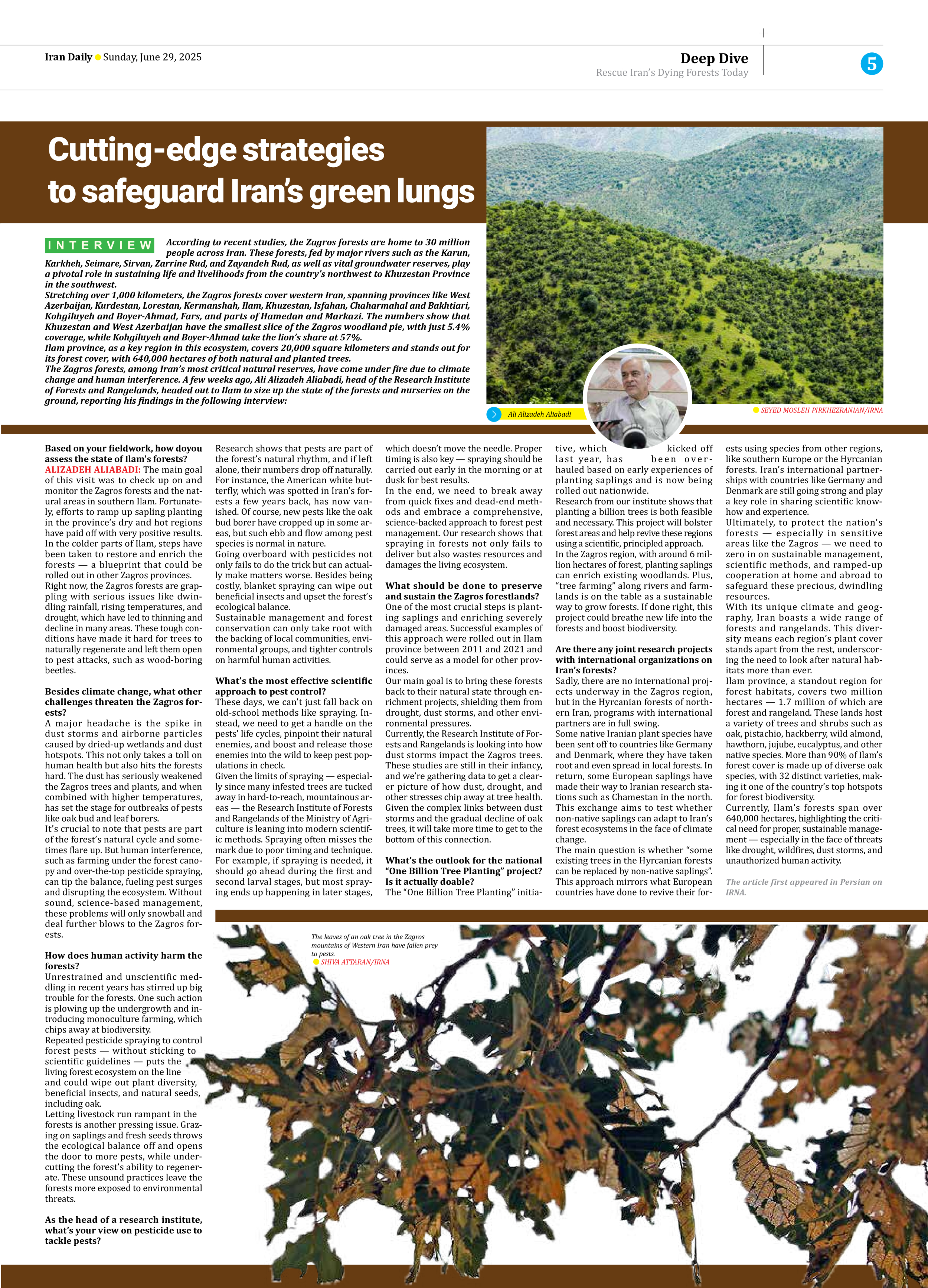
According to recent studies, the Zagros forests are home to 30 million people across Iran. These forests, fed by major rivers such as the Karun, Karkheh, Seimare, Sirvan, Zarrine Rud, and Zayandeh Rud, as well as vital groundwater reserves, play a pivotal role in sustaining life and livelihoods from the country’s northwest to Khuzestan Province in the southwest. Stretching over 1,000 kilometers, the Zagros forests cover western Iran, spanning provinces like West Azerbaijan, Kurdestan, Lorestan, Kermanshah, Ilam, Khuzestan, Isfahan, Chaharmahal and Bakhtiari, Kohgiluyeh and Boyer-Ahmad, Fars, and parts of Hamedan and Markazi. The numbers show that Khuzestan and West Azerbaijan have the smallest slice of the Zagros woodland pie, with just 5.4% coverage, while Kohgiluyeh and Boyer-Ahmad take the lion’s share at 57%. Ilam province, as a key region in this ecosystem, covers 20,000 square kilometers and stands out for its forest cover, with 640,000 hectares of both natural and planted trees. The Zagros forests, among Iran’s most critical natural reserves, have come under fire due to climate change and human interference. A few weeks ago, Ali Alizadeh Aliabadi, head of the Research Institute of Forests and Rangelands, headed out to Ilam to size up the state of the forests and nurseries on the ground, reporting his findings in the following interview:
Ali Alizadeh Aliabadi
Based on your fieldwork, how doyou assess the state of Ilam’s forests?
ALIZADEH ALIABADI: The main goal of this visit was to check up on and monitor the Zagros forests and the natural areas in southern Ilam. Fortunately, efforts to ramp up sapling planting in the province’s dry and hot regions have paid off with very positive results. In the colder parts of Ilam, steps have been taken to restore and enrich the forests — a blueprint that could be rolled out in other Zagros provinces.
Right now, the Zagros forests are grappling with serious issues like dwindling rainfall, rising temperatures, and drought, which have led to thinning and decline in many areas. These tough conditions have made it hard for trees to naturally regenerate and left them open to pest attacks, such as wood-boring beetles.
Besides climate change, what other challenges threaten the Zagros forests?
A major headache is the spike in dust storms and airborne particles caused by dried-up wetlands and dust hotspots. This not only takes a toll on human health but also hits the forests hard. The dust has seriously weakened the Zagros trees and plants, and when combined with higher temperatures, has set the stage for outbreaks of pests like oak bud and leaf borers.
It’s crucial to note that pests are part of the forest’s natural cycle and sometimes flare up. But human interference, such as farming under the forest canopy and over-the-top pesticide spraying, can tip the balance, fueling pest surges and disrupting the ecosystem. Without sound, science-based management, these problems will only snowball and deal further blows to the Zagros forests.
How does human activity harm the forests?
Unrestrained and unscientific meddling in recent years has stirred up big trouble for the forests. One such action is plowing up the undergrowth and introducing monoculture farming, which chips away at biodiversity.
Repeated pesticide spraying to control forest pests — without sticking to scientific guidelines — puts the living forest ecosystem on the line and could wipe out plant diversity, beneficial insects, and natural seeds, including oak.
Letting livestock run rampant in the forests is another pressing issue. Grazing on saplings and fresh seeds throws the ecological balance off and opens the door to more pests, while undercutting the forest’s ability to regenerate. These unsound practices leave the forests more exposed to environmental threats.
As the head of a research institute, what’s your view on pesticide use to tackle pests?
Research shows that pests are part of the forest’s natural rhythm, and if left alone, their numbers drop off naturally.
For instance, the American white butterfly, which was spotted in Iran’s forests a few years back, has now vanished. Of course, new pests like the oak bud borer have cropped up in some areas, but such ebb and flow among pest species is normal in nature.
Going overboard with pesticides not only fails to do the trick but can actually make matters worse. Besides being costly, blanket spraying can wipe out beneficial insects and upset the forest’s ecological balance.
Sustainable management and forest conservation can only take root with the backing of local communities, environmental groups, and tighter controls on harmful human activities.
What’s the most effective scientific approach to pest control?
These days, we can’t just fall back on old-school methods like spraying. Instead, we need to get a handle on the pests’ life cycles, pinpoint their natural enemies, and boost and release those enemies into the wild to keep pest populations in check.
Given the limits of spraying — especially since many infested trees are tucked away in hard-to-reach, mountainous areas — the Research Institute of Forests and Rangelands of the Ministry of Agriculture is leaning into modern scientific methods. Spraying often misses the mark due to poor timing and technique.
For example, if spraying is needed, it should go ahead during the first and second larval stages, but most spraying ends up happening in later stages, which doesn’t move the needle. Proper timing is also key — spraying should be carried out early in the morning or at dusk for best results.
In the end, we need to break away from quick fixes and dead-end methods and embrace a comprehensive, science-backed approach to forest pest management. Our research shows that spraying in forests not only fails to deliver but also wastes resources and damages the living ecosystem.
What should be done to preserve and sustain the Zagros forestlands?
One of the most crucial steps is planting saplings and enriching severely damaged areas. Successful examples of this approach were rolled out in Ilam province between 2011 and 2021 and could serve as a model for other provinces.
Our main goal is to bring these forests back to their natural state through enrichment projects, shielding them from drought, dust storms, and other environmental pressures.
Currently, the Research Institute of Forests and Rangelands is looking into how dust storms impact the Zagros trees. These studies are still in their infancy, and we’re gathering data to get a clearer picture of how dust, drought, and other stresses chip away at tree health. Given the complex links between dust storms and the gradual decline of oak trees, it will take more time to get to the bottom of this connection.
What’s the outlook for the national “One Billion Tree Planting” project? Is it actually doable?
The “One Billion Tree Planting” initiative, which kicked off last year, has been overhauled based on early experiences of planting saplings and is now being rolled out nationwide.
Research from our institute shows that planting a billion trees is both feasible and necessary. This project will bolster forest areas and help revive these regions using a scientific, principled approach.
In the Zagros region, with around 6 million hectares of forest, planting saplings can enrich existing woodlands. Plus, “tree farming” along rivers and farmlands is on the table as a sustainable way to grow forests. If done right, this project could breathe new life into the forests and boost biodiversity.
Are there any joint research projects with international organizations on Iran’s forests?
Sadly, there are no international projects underway in the Zagros region, but in the Hyrcanian forests of northern Iran, programs with international partners are in full swing.
Some native Iranian plant species have been sent off to countries like Germany and Denmark, where they have taken root and even spread in local forests. In return, some European saplings have made their way to Iranian research stations such as Chamestan in the north. This exchange aims to test whether non-native saplings can adapt to Iran’s forest ecosystems in the face of climate change.
The main question is whether “some existing trees in the Hyrcanian forests can be replaced by non-native saplings”. This approach mirrors what European countries have done to revive their forests using species from other regions, like southern Europe or the Hyrcanian forests. Iran’s international partnerships with countries like Germany and Denmark are still going strong and play a key role in sharing scientific know-how and experience.
Ultimately, to protect the nation’s forests — especially in sensitive areas like the Zagros — we need to zero in on sustainable management, scientific methods, and ramped-up cooperation at home and abroad to safeguard these precious, dwindling resources.
With its unique climate and geography, Iran boasts a wide range of forests and rangelands. This diversity means each region’s plant cover stands apart from the rest, underscoring the need to look after natural habitats more than ever.
Ilam province, a standout region for forest habitats, covers two million hectares — 1.7 million of which are forest and rangeland. These lands host a variety of trees and shrubs such as oak, pistachio, hackberry, wild almond, hawthorn, jujube, eucalyptus, and other native species. More than 90% of Ilam’s forest cover is made up of diverse oak species, with 32 distinct varieties, making it one of the country’s top hotspots for forest biodiversity.
Currently, Ilam’s forests span over 640,000 hectares, highlighting the critical need for proper, sustainable management — especially in the face of threats like drought, wildfires, dust storms, and unauthorized human activity.
The article first appeared in Persian on IRNA.