







Zagros forests in peril
60 years of relentless damage
By Hamid Zahrabi
Deputy of Iran’s Department of Environment
The Zagros issue has been put on the front burner for the Department of Environment. We are currently gathering input from various segments of society. We have invited university experts and researchers to weigh in, hoping that together, we can break down the challenges. Any future action plan will be drawn up with the full participation of all stakeholders.
Iran holds a unique position in terms of biodiversity, sitting at the crossroads of several ecosystems and climates. The country boasts nine out of the world’s 11 ecosystems and harbors 41 out of 42 wetland types globally. These facts alone speak volumes about Iran’s extraordinary biodiversity.
Within our borders, two biodiversity hotspots — Hyrcanian and Zagros-Anatolian — overlap, making Iran one of only about 30 such regions worldwide to host more than one hotspot. To protect this wealth, we have set aside 327 protected areas, including 44 national natural monuments, 33 national parks, 55 wildlife refuges, and 195 protected zones, covering nearly 20 million hectares, or 12% of the country’s land. These areas were mapped out to take in multiple ecosystems and diverse plant regions, ensuring that a significant portion of our natural heritage falls under protection.
Iran is home to over 8,600 plant species, a third of which are endemic. Our knowledge of our animal species is also now broader, but we have fallen short on invertebrates — a gap that needs to be closed. The country hosts 209 mammal species, 23 amphibians, 274 reptiles, 302 fish, and 579 bird species, along with around 970 marine fish species. This drives home the point that Iran’s biodiversity is both significant and irreplaceable.
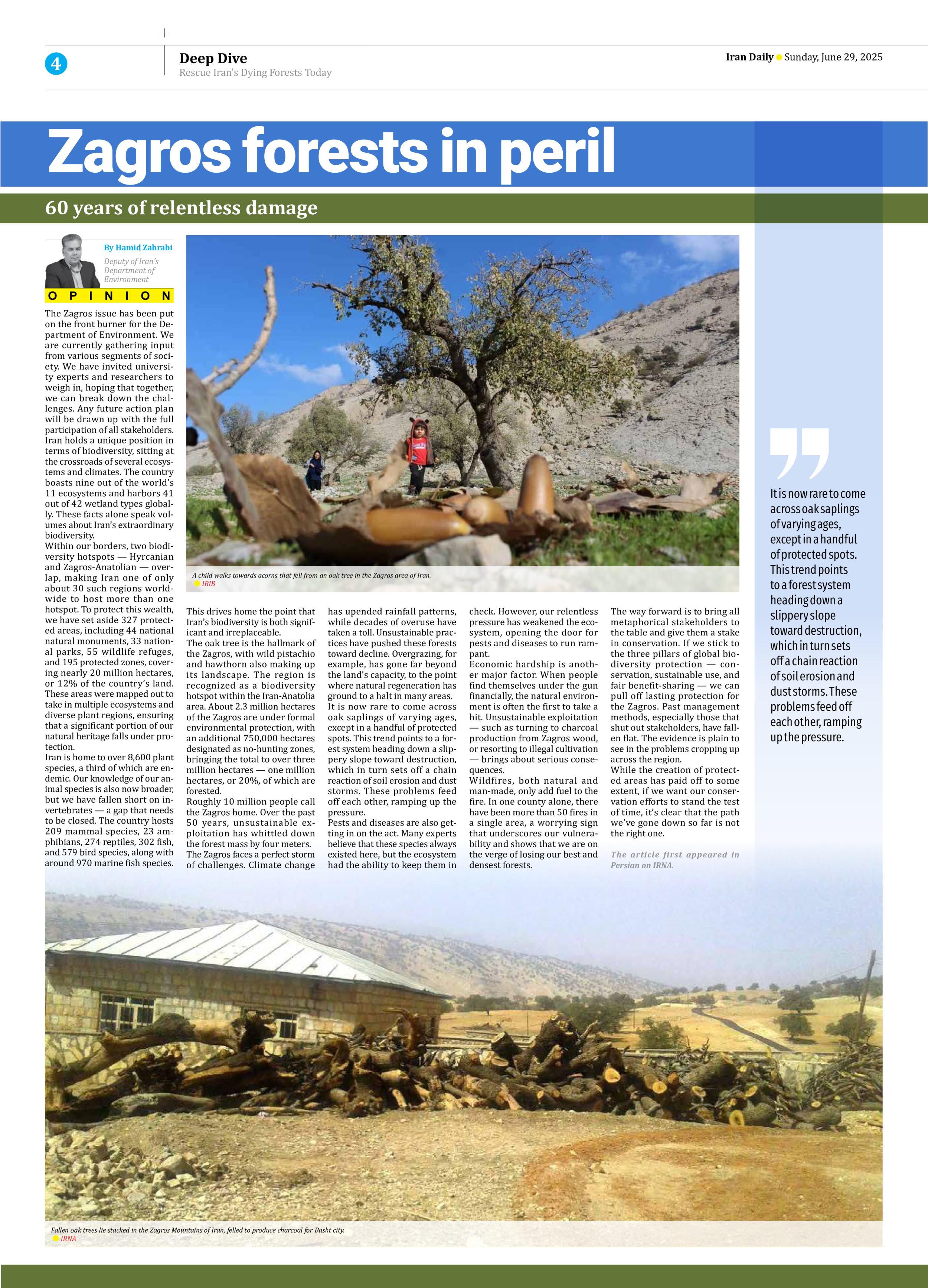
The oak tree is the hallmark of the Zagros, with wild pistachio and hawthorn also making up its landscape. The region is recognized as a biodiversity hotspot within the Iran-Anatolia area. About 2.3 million hectares of the Zagros are under formal environmental protection, with an additional 750,000 hectares designated as no-hunting zones, bringing the total to over three million hectares — one million hectares, or 20%, of which are forested.
Roughly 10 million people call the Zagros home. Over the past 50 years, unsustainable exploitation has whittled down the forest mass by four meters.
The Zagros faces a perfect storm of challenges. Climate change has upended rainfall patterns, while decades of overuse have taken a toll. Unsustainable practices have pushed these forests toward decline. Overgrazing, for example, has gone far beyond the land’s capacity, to the point where natural regeneration has ground to a halt in many areas.
It is now rare to come across oak saplings of varying ages, except in a handful of protected spots. This trend points to a forest system heading down a slippery slope toward destruction, which in turn sets off a chain reaction of soil erosion and dust storms. These problems feed off each other, ramping up the pressure.
Pests and diseases are also getting in on the act. Many experts believe that these species always existed here, but the ecosystem had the ability to keep them in check. However, our relentless pressure has weakened the ecosystem, opening the door for pests and diseases to run rampant.
Economic hardship is another major factor. When people find themselves under the gun financially, the natural environment is often the first to take a hit. Unsustainable exploitation — such as turning to charcoal production from Zagros wood, or resorting to illegal cultivation — brings about serious consequences.
Wildfires, both natural and man-made, only add fuel to the fire. In one county alone, there have been more than 50 fires in a single area, a worrying sign that underscores our vulnerability and shows that we are on the verge of losing our best and densest forests.
The way forward is to bring all metaphorical stakeholders to the table and give them a stake in conservation. If we stick to the three pillars of global biodiversity protection — conservation, sustainable use, and fair benefit-sharing — we can pull off lasting protection for the Zagros. Past management methods, especially those that shut out stakeholders, have fallen flat. The evidence is plain to see in the problems cropping up across the region.
While the creation of protected areas has paid off to some extent, if we want our conservation efforts to stand the test of time, it’s clear that the path we’ve gone down so far is not the right one.
The article first appeared in
Persian on IRNA.