





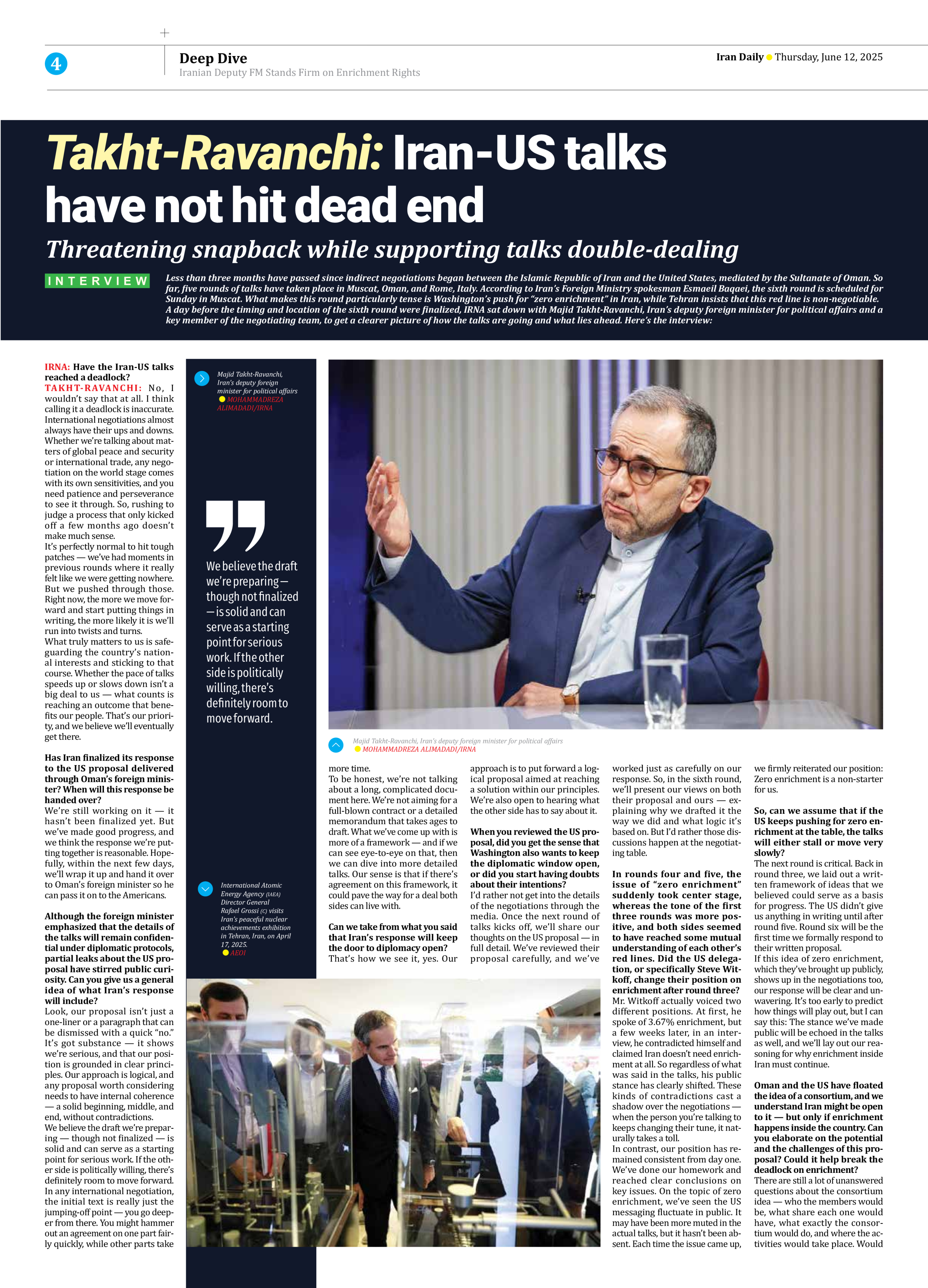


Takht-Ravanchi: Iran-US talks have not hit dead end
Threatening snapback while supporting talks double-dealing
Less than three months have passed since indirect negotiations began between the Islamic Republic of Iran and the United States, mediated by the Sultanate of Oman. So far, five rounds of talks have taken place in Muscat, Oman, and Rome, Italy. According to Iran’s Foreign Ministry spokesman Esmaeil Baqaei, the sixth round is scheduled for Sunday in Muscat. What makes this round particularly tense is Washington’s push for “zero enrichment” in Iran, while Tehran insists that this red line is non-negotiable. A day before the timing and location of the sixth round were finalized, IRNA sat down with Majid Takht-Ravanchi, Iran’s deputy foreign minister for political affairs and a key member of the negotiating team, to get a clearer picture of how the talks are going and what lies ahead. Here’s the interview:
IRNA: Have the Iran-US talks reached a deadlock?
TAKHT-RAVANCHI: No, I wouldn’t say that at all. I think calling it a deadlock is inaccurate. International negotiations almost always have their ups and downs. Whether we’re talking about matters of global peace and security or international trade, any negotiation on the world stage comes with its own sensitivities, and you need patience and perseverance to see it through. So, rushing to judge a process that only kicked off a few months ago doesn’t make much sense.
It’s perfectly normal to hit tough patches — we’ve had moments in previous rounds where it really felt like we were getting nowhere. But we pushed through those. Right now, the more we move forward and start putting things in writing, the more likely it is we’ll run into twists and turns.
What truly matters to us is safeguarding the country’s national interests and sticking to that course. Whether the pace of talks speeds up or slows down isn’t a big deal to us — what counts is reaching an outcome that benefits our people. That’s our priority, and we believe we’ll eventually get there.
Has Iran finalized its response to the US proposal delivered through Oman’s foreign minister? When will this response be handed over?
We’re still working on it — it hasn’t been finalized yet. But we’ve made good progress, and we think the response we’re putting together is reasonable. Hopefully, within the next few days, we’ll wrap it up and hand it over to Oman’s foreign minister so he can pass it on to the Americans.
Although the foreign minister emphasized that the details of the talks will remain confidential under diplomatic protocols, partial leaks about the US proposal have stirred public curiosity. Can you give us a general idea of what Iran’s response will include?
Look, our proposal isn’t just a one-liner or a paragraph that can be dismissed with a quick “no.” It’s got substance — it shows we’re serious, and that our position is grounded in clear principles. Our approach is logical, and any proposal worth considering needs to have internal coherence — a solid beginning, middle, and end, without contradictions.
We believe the draft we’re preparing — though not finalized — is solid and can serve as a starting point for serious work. If the other side is politically willing, there’s definitely room to move forward. In any international negotiation, the initial text is really just the jumping-off point — you go deeper from there. You might hammer out an agreement on one part fairly quickly, while other parts take more time.
To be honest, we’re not talking about a long, complicated document here. We’re not aiming for a full-blown contract or a detailed memorandum that takes ages to draft. What we’ve come up with is more of a framework — and if we can see eye-to-eye on that, then we can dive into more detailed talks. Our sense is that if there’s agreement on this framework, it could pave the way for a deal both sides can live with.
Can we take from what you said that Iran’s response will keep the door to diplomacy open?
That’s how we see it, yes. Our approach is to put forward a logical proposal aimed at reaching a solution within our principles. We’re also open to hearing what the other side has to say about it.
When you reviewed the US proposal, did you get the sense that Washington also wants to keep the diplomatic window open, or did you start having doubts about their intentions?
I’d rather not get into the details of the negotiations through the media. Once the next round of talks kicks off, we’ll share our thoughts on the US proposal — in full detail. We’ve reviewed their proposal carefully, and we’ve worked just as carefully on our response. So, in the sixth round, we’ll present our views on both their proposal and ours — explaining why we drafted it the way we did and what logic it’s based on. But I’d rather those discussions happen at the negotiating table.
In rounds four and five, the issue of “zero enrichment” suddenly took center stage, whereas the tone of the first three rounds was more positive, and both sides seemed to have reached some mutual understanding of each other’s red lines. Did the US delegation, or specifically Steve Witkoff, change their position on enrichment after round three?
Mr. Witkoff actually voiced two different positions. At first, he spoke of 3.67% enrichment, but a few weeks later, in an interview, he contradicted himself and claimed Iran doesn’t need enrichment at all. So regardless of what was said in the talks, his public stance has clearly shifted. These kinds of contradictions cast a shadow over the negotiations — when the person you’re talking to keeps changing their tune, it naturally takes a toll.
In contrast, our position has remained consistent from day one. We’ve done our homework and reached clear conclusions on key issues. On the topic of zero enrichment, we’ve seen the US messaging fluctuate in public. It may have been more muted in the actual talks, but it hasn’t been absent. Each time the issue came up, we firmly reiterated our position: Zero enrichment is a non-starter for us.
So, can we assume that if the US keeps pushing for zero enrichment at the table, the talks will either stall or move very slowly?
The next round is critical. Back in round three, we laid out a written framework of ideas that we believed could serve as a basis for progress. The US didn’t give us anything in writing until after round five. Round six will be the first time we formally respond to their written proposal.
If this idea of zero enrichment, which they’ve brought up publicly, shows up in the negotiations too, our response will be clear and unwavering. It’s too early to predict how things will play out, but I can say this: The stance we’ve made public will be echoed in the talks as well, and we’ll lay out our reasoning for why enrichment inside Iran must continue.
Oman and the US have floated the idea of a consortium, and we understand Iran might be open to it — but only if enrichment happens inside the country. Can you elaborate on the potential and the challenges of this proposal? Could it help break the deadlock on enrichment?
There are still a lot of unanswered questions about the consortium idea — who the members would be, what share each one would have, what exactly the consortium would do, and where the activities would take place. Would each country be responsible for a specific task, or would all work happen jointly? Would some countries just invest and stay out of the day-to-day operations? These are important details that we need clarity on before we can give a definite answer.
One thing we’re absolutely clear on: Enrichment must take place in Iran. If the consortium were set up in a way that enrichment happens elsewhere, or even if just that part of the process is moved outside Iran, while the rest stays here — that’s unacceptable to us. We’ve said this in the talks and made it clear in public, too.
If enrichment within Iran is built into the consortium model, then we can start addressing the other questions. It’s not like we’re waiting for a yes or no just based on the location of enrichment — we have a lot of concerns that still need answers before we can make a decision. The bottom line is, we haven’t reached a conclusion yet on the consortium idea, and we believe we’re entitled to get those answers first. But let me be clear: Enrichment inside Iran, even under a consortium, is one of our red lines.
What are Iran’s red lines regarding sanctions relief? What are Iran’s demands from the American side, and what strategies are being considered to ensure that, this time, the previous scenario with the JCPOA does not play out again?
We have been through this before. We had an experience during the JCPOA era: Under President Obama, the deal was signed, finalized, and implemented. Then, President Trump came along and pulled out of the JCPOA, which was a clear breach of commitment, and the consequences were plain for all to see. Under president Biden, we reached an understanding regarding our assets in Qatar that was never put into practice. So, we have these experiences with two American presidents, and these episodes have taught us a valuable lesson: We must always watch out for any move they might make to wriggle out of their commitments.
Of course, as you pointed out, getting guarantees is no walk in the park, but we have put this on the table from the outset and will keep pushing for it. There are some ideas on how to hammer out a guarantee, but as talks move forward, we will keep everyone posted as necessary.
At this stage, what we can say about sanctions is that we must see real, tangible benefits from their removal. We won’t settle for mere promises or statements on paper that certain sanctions have been lifted, only for the other side to wash their hands of the matter. This is a point we have raised in the talks and will continue to underscore: The mere lifting of sanctions is necessary but not enough. Our practical benefit from sanctions relief must be front and center. What they do internally is their own business; We won’t get involved in their internal affairs.
What matters to us is that, for example, when it comes to oil sales, if they need to amend congressional laws or issue executive orders to make it happen, that’s up to them. Whatever needs to be done on their side is their concern. What counts for us is that we can feel the effects of sanctions relief on the ground, which would give us some peace of mind that the sanctions have not just been lifted on paper but are playing out in practice and we can bank on this outcome.
Do you think that just lifting the nuclear-related sanctions — even if all our expectations in this area are met — will deliver the economic benefits and opening you have in mind for the country? Or should the sanctions allegedly imposed due to non-nuclear issues also be lifted?
From our perspective, all the sanctions imposed on us are illegal. Our legal position is that every sanction against us is baseless and unlawful. That is our main stance.
Of course, as you mentioned, we are negotiating within the nuclear framework, and naturally, any sanctions directly or indirectly related to the nuclear issue must be lifted. If these are fully removed, and if we see honesty in the implementation of this relief and there is no nitpicking or attempts to shirk their obligations, we believe we can reap the benefits of sanctions relief as I outlined.
An important point is that some sanctions initially imposed under the nuclear issue have, over time, been rebranded or shifted to other categories. These cannot be used as a pretext for further pressure. Directly or indirectly, anything linked to the nuclear file may now be dressed up in a different guise, or during negotiations, they may try to rename sanctions and claim they fall under a new heading. I don’t want to prejudge, but I can say that such changes in sanction labels are on our radar, and we will bring them up at the negotiating table when the time is right. When we reach the stage where sanctions relief is a serious topic, these matters will certainly be front and center for us.
In the coming days, it is expected that European countries, together with the US, will table a resolution, and it is likely to pass at the IAEA Board of Governors. Do you feel that alarm bells are ringing for our nuclear case at the Agency and the Board? What has the government done in recent months, both politically and technically, to head off a crisis that might be triggered by the Board of Governors?
We have been in touch with members of the Board of Governors and the Security Council, especially China and Russia, two friendly countries whose positions are closely aligned with ours and who play a key role both as permanent Security Council members and at the IAEA Board. We have also been in talks with European countries, and we have been very clear with them: “The Agency is a technical body and must not be used as a political tool.”
We know that in the past, the Agency has been used as a political football, and it may happen again in the future. But we see it as our duty to sound the alarm to those who might try to drag the Agency into a space where it is used to pile pressure on Iran. We have said that if they go down this road, we will not sit on our hands; We will respond. What kind of response we will give depends on the nature and content of the resolution. As you noted, a draft resolution is on the table and may be put to a vote in the coming days. Whether it passes or not is still up in the air, but we have braced ourselves for the worst-case scenario. The content of the resolution is secondary in importance — though not irrelevant, as it will shape our response. First and foremost, we will certainly respond.
Are the European Troika looking to trigger the snapback mechanism (automatic reimposition of UN Security Council resolutions)?
Yes, that’s exactly the case, and as you know, our stance on the snapback issue is crystal clear. I’d like to point out that countries trying to play politics with the Agency are laying their cards on the table. On the one hand, they claim to support ongoing talks — including those between Iran and the US, where their positions are well known — but on the other, they’ve kicked off activities against us at the Agency. What does this double-dealing mean? Isn’t it obvious they have other motives up their sleeves?
They might have all sorts of intentions; Perhaps they want to turn up the heat on Iran to reach their goals and, for instance, hold back on concessions. Over the past twenty-odd years, they’ve put us to the test — from the very first talks with the three European countries, then the 5+1, and later the JCPOA negotiations. Throughout these years, we’ve stood our ground and our positions haven’t changed. From day one, we’ve insisted on enrichment taking place in Iran, stating that unless this is recognized, the talks simply won’t get off the ground. That principle still holds. So, if they think they can box Iran into a deal that doesn’t really suit them, they’re barking up the wrong tree.
What’s happening at the Board of Governors and the Agency is just one part of our differences with Europe. You’re involved in Iran-Europe talks. Where’s the sticking point that’s holding up progress? Is it the Ukraine war and the claim about Iran helping Russia, or are there other issues at play?
We’ve been holding talks with the Europeans for years, and it’s always on our agenda. Wherever we are, we spell out clearly that the Agency could be open to abuse. Our positions are communicated to them in no uncertain terms. If snapback comes up or is about to, we make our view plain and lay out our actions.
At the same time, our nuclear issue and peaceful program are so transparent that we have no qualms about discussing them. As you mentioned, the Agency’s inspections of Iran are unprecedented. If you get the actual figures and make a comparison, you’ll see what kind of inspections have been carried out here — proof of our transparency.
We want to show our program is peaceful, and in exchange for this openness, we expect the unjust sanctions to be lifted. Europeans may bring up non-nuclear issues; Those are their own concerns. If they try to drag unrelated matters into the nuclear talks, we have our answers ready. Their motives for doing so should be clear — why mix in unrelated issues? Our position is straightforward: We stick to the nuclear issue within a defined framework, and our argument is logical. If you’re worried about the peaceful nature of our nuclear program, there’s a simple way forward. We’re not after nuclear weapons. We’ve said it time and again, the Leader has emphasized it, and officials have confirmed it: It’s not part of our doctrine or plans. Reaching an agreement is straightforward, though it takes time. But if they have hidden agendas, we’ll push back, because we know the further they go, the less satisfied they’ll be — their demands would be never-ending.
As for our dispute with the Agency, I’ve said before: if the Agency’s technical questions aren’t resolved politically, it’ll never end — every time a new question will pop up. The same goes for nuclear negotiations: If the goal is to build confidence in our peaceful program, the solution is easy. If it’s something else, that’s a different story altogether.
Is mending ties with Europe a top priority for the Foreign Ministry?
If we’re ranking priorities, our neighbors come first. We have 15 neighboring countries — like Russia, the Persian Gulf states, and others — and we’re working to build the best possible relations with them. The record of President Pezeshkian’s government on neighborly cooperation is strong, and under the late president Raisi, we also had good ties with our neighbors.
Our relations with China are also solid; While not a direct neighbor, it’s in our neighborhood, and we have excellent ties. President Pezeshkian will soon visit China. We have ongoing political exchanges, economic agreements, and diverse cultural cooperation, all of which shore up our relationship.
That said, it’s not just about neighbors. If the basic principles of relations are observed — like non-interference and equal footing — we’re open to working with others, including Europeans. But our main focus is on our neighbors, and while talks with the Europeans are ongoing and we’re eager to work together in various fields, they’re not our top priority at the moment.
Regarding the threats by the Zionist regime about attacking Iran, and the media hype claiming the US has blocked such actions — do you consider any military strike by this regime on Iran’s nuclear facilities or any part of Iranian territory as a deal-breaker for indirect talks between Iran and the US? It’s often said the Islamic Republic sees any attack on its soil by this regime as coordinated with the US.
First, before getting into this, I should say all this media hype and talk that if nothing happens, the Zionist regime will launch a military strike, is mostly bluster and an attempt to sway the talks. They think this kind of posturing can shake our resolve, but this analysis is off the mark. They know our capabilities — both defensive and offensive — and are well aware that any move on their part won’t go unanswered. So, you can be sure they’ll think twice before making any move.
As for US-Israeli cooperation, their military ties have always been out in the open — they’ve admitted as much themselves. Their joint military actions in the region are well documented. So, if any miscalculation happens, it will definitely be with US and Israeli involvement, and our position on this is absolutely clear.
The full article first appeared in
Persian on IRNA.