







Economies of Iran, Japan complement each other: Businessman
The track record of economic ties between Iran and Japan shows that once sanctions are lifted, Japan can once again step into the spotlight as a major economic, commercial, and industrial partner for Iran. Diplomatic and trade relations between Iran and Japan date back over a century. Throughout this time, especially in the last 50 years, the two countries have maintained good relations. Trade volume between Iran and Japan saw a sharp increase starting in 1973, coinciding with the rise in crude oil prices. In 1967, trade volume was only $605.8 million, but by 1977 it had shot up to over $6 billion — a tenfold increase. After the 1979 Islamic Revolution in Iran, trade exchanges expanded further, reaching over $12 billion by 2006. Japan remained one of Iran’s major industrial and commercial partners for years after the Revolution because it sourced a significant portion of its crude oil from Iran. Meanwhile, Iran relied on Japan for industrial and technological goods. Japan can still play a significant role in enhancing Iran’s technological level and securing its industrial supply chain, just as it did in the past. Iran’s main non-oil exports to Japan included carpets, dried fruits, gas condensates, handicrafts, shrimp, caviar, and foodstuffs, while Japan exported equipment, machinery, and technical and engineering services to Iran. However, the upward trend in trade and economic exchanges hit a snag after sanctions against Iran intensified, causing trade volume to fall to its lowest point in 50 years. Japan, being a key trade partner of the United States, naturally fell in line with US sanctions on Iran. At the same time, Japan still depends on Iranian oil, making the outcome of Iran-US negotiations a make-or-break factor for future trade relations between Iran and Japan. Iran Daily spoke with Babak Abedin, a board member of the Iran-Japan Joint Chamber of Commerce and a board member of the Iran Export Confederation, about the current state and future outlook of Iran-Japan economic relations. Below is the full interview.
By Sadeq Dehqan
Staff writer
IRAN DAILY: Could you please explain the role of the Iran-Japan Joint Chamber of Commerce and the current status of trade and economic exchanges between the two countries?
ABEDIN: The Iran-Japan Joint Chamber of Commerce was established to broaden economic markets and cultural and social ties between Iran and Japan. Its vision is to bring back the level of relations between the two countries to what it was by 2029. Unfortunately, trade volume has taken a nosedive in recent years due to sanctions. The Japanese have been among the countries that strictly toe the line on US sanctions against Iran, making direct trade difficult and causing a sharp decline in bilateral trade.
As you know, in the past, parts of Iran’s technology, technical services, engineering, and industrial machinery capacities were built up through cooperation with Japan. Now, we are forced to bring in those Japanese industrial and technological supply chains through third countries.
What is the importance of economic and trade cooperation between Iran and Japan, and in which areas can the two countries collaborate?
There are many opportunities for cooperation. Some of these have already taken shape, especially in energy, oil, gas, and petrochemicals. Currently, the two countries can expand their energy cooperation because the economies of Iran and Japan fit like a glove: Japan needs Iran’s energy resources, and Iran needs Japanese technology in this sector.
There has also been good cooperation in the printing and packaging industries, especially since Japan is one of the world’s two leading producers of professional printing and packaging machinery. Furthermore, there has been fruitful collaboration in cellulose industries.
Japan is a global leader in electrical, electronic, and IT industries, and these are fields where cooperation can be ramped up. As one of the world’s top five economies and a pioneer in technology, Japan’s capabilities can be leveraged to develop Iran’s industries and production capacities.
Given the sanctions imposed by Western and European countries, which create hurdles for economic, trade, and industrial cooperation, Iran must branch out beyond one- or two-dimensional relationships with Europe or even China. In this context, Japan is one of the best options for developing industrial and technological cooperation. If we shift our focus away from Europe, Japan stands out as a very promising partner in East Asia.
Japanese investors are known for making strong investments in their target markets, and we can build on this to boost industrial cooperation with Japan.
In tourism, Japan is also a very good partner. The Japanese people are keen travelers with a high per capita income, spending significantly on tourism annually. Iran, with its rich natural and historical attractions, can be very appealing to Japanese tourists. Conversely, Iranians are also interested in visiting Japan’s tourist sites.
What needs to be done to realize and develop cooperation in these areas?
Currently, one of the biggest obstacles to expanding cooperation is the sanctions on Iran. I believe that if the nuclear negotiations bear fruit and a good agreement is reached between Iran and the US, Japan will be one of the first markets to open up economically to Iran.
Today, many industrial machines and production lines worldwide rely on Japanese technology. Many important economic and industrial countries use Japanese equipment in their production centers. Therefore, Iran, as a country eager to develop its industry and increase production, can tap into Japan’s capacities in this regard.
Does the Iran-Japan Joint Chamber of Commerce have plans to foster relations between traders and economic activists of the two countries?
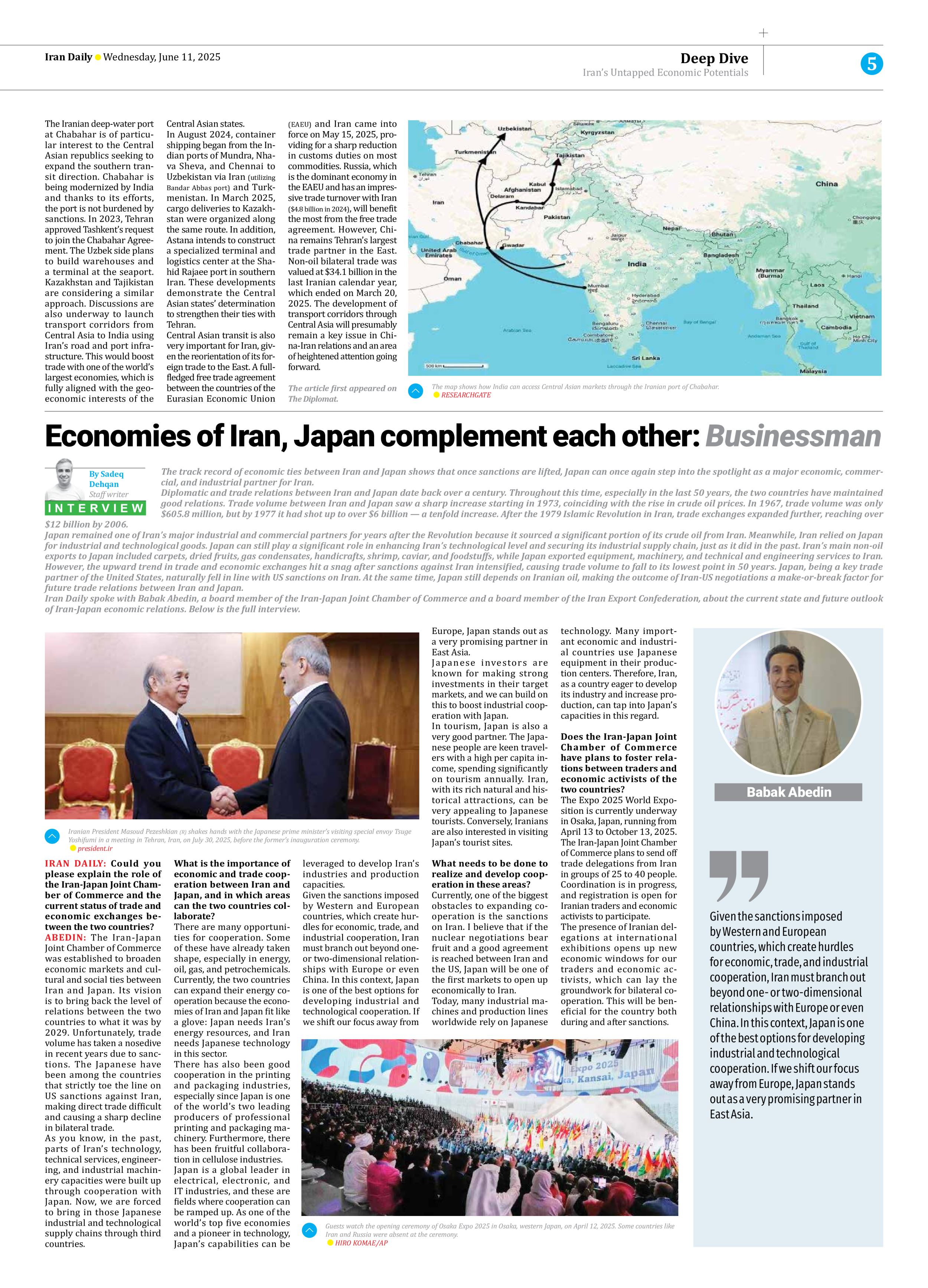
The Expo 2025 World Exposition is currently underway in Osaka, Japan, running from April 13 to October 13, 2025. The Iran-Japan Joint Chamber of Commerce plans to send off trade delegations from Iran in groups of 25 to 40 people. Coordination is in progress, and registration is open for Iranian traders and economic activists to participate.
The presence of Iranian delegations at international exhibitions opens up new economic windows for our traders and economic activists, which can lay the groundwork for bilateral cooperation. This will be beneficial for the country both during and after sanctions.