







Role of renewables in redefining Mideast energy diplomacy
The global energy order is in transition, and once again, the Middle East finds itself at the epicenter. This time, however, it is not the resources buried beneath the ground but the forces above the horizon — sunlight, wind, and innovation — that will shape regional influence. National prominence will no longer be solely measured by the volume of oil reserves but by the agility with which nations build smart grids, deploy clean infrastructure, and collaborate across borders.
By Kamran Yeganegi
Foreign policy expert
For much of the 20th century, the politics and economics of the Middle East were forged in the crucible of oil. Concepts such as energy geopolitics and petro-diplomacy became synonymous with the region — from the oil shocks of the 1970s to the strategic disputes over subterranean reserves. Today, however, signs of a deeper structural shift are emerging: a transition from the geopolitics of fossil fuels to the geo-economics of renewables.
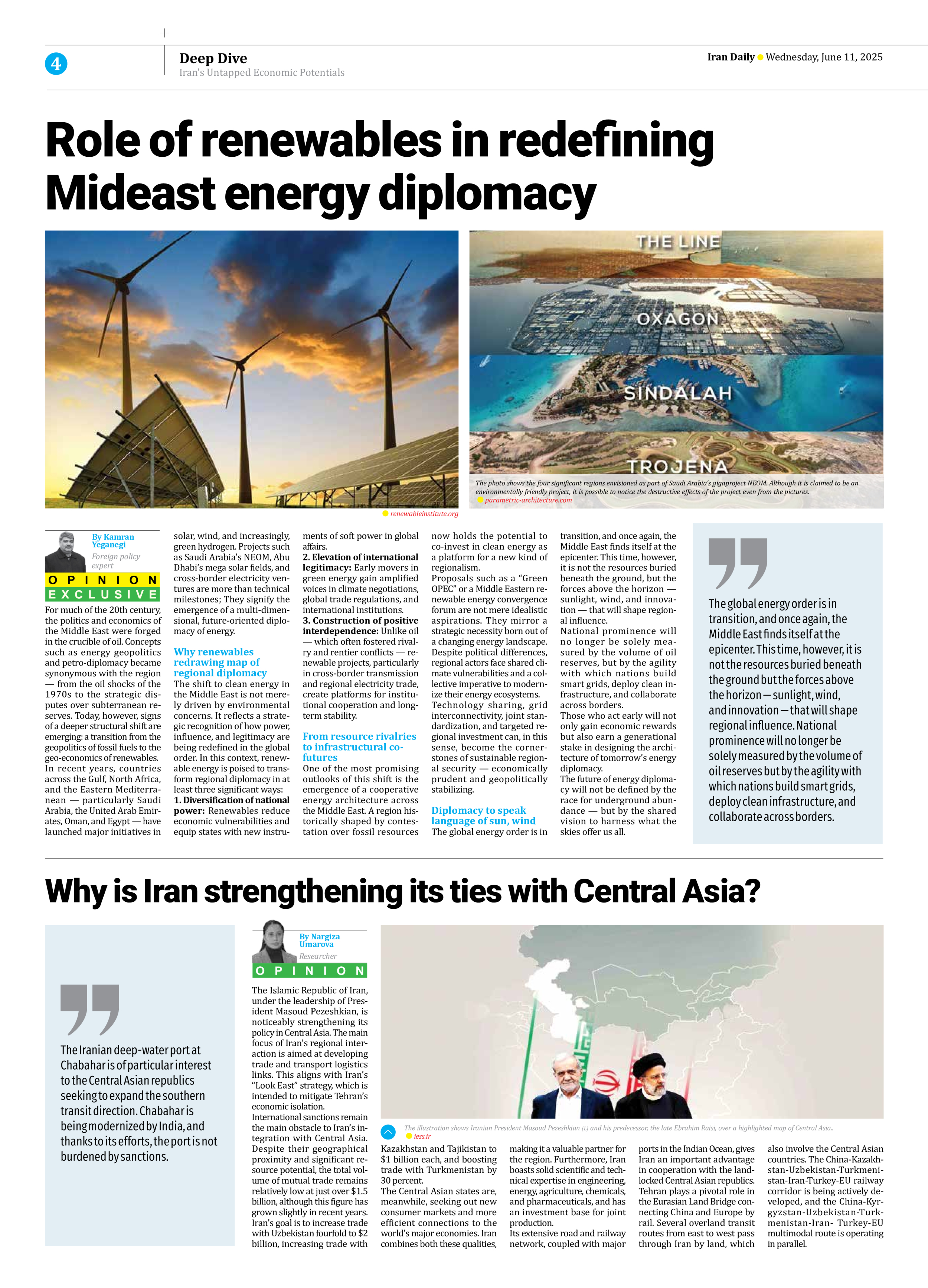
In recent years, countries across the Gulf, North Africa, and the Eastern Mediterranean — particularly Saudi Arabia, the United Arab Emirates, Oman, and Egypt — have launched major initiatives in solar, wind, and increasingly, green hydrogen. Projects such as Saudi Arabia’s NEOM, Abu Dhabi’s mega solar fields, and cross-border electricity ventures are more than technical milestones; They signify the emergence of a multi-dimensional, future-oriented diplomacy of energy.
Why renewables redrawing map of regional diplomacy
The shift to clean energy in the Middle East is not merely driven by environmental concerns. It reflects a strategic recognition of how power, influence, and legitimacy are being redefined in the global order. In this context, renewable energy is poised to transform regional diplomacy in at least three significant ways:
1. Diversification of national power: Renewables reduce economic vulnerabilities and equip states with new instruments of soft power in global affairs.
2. Elevation of international legitimacy: Early movers in green energy gain amplified voices in climate negotiations, global trade regulations, and international institutions.
3. Construction of positive interdependence: Unlike oil — which often fostered rivalry and rentier conflicts — renewable projects, particularly in cross-border transmission and regional electricity trade, create platforms for institutional cooperation and long-term stability.
From resource rivalries to infrastructural co-futures
One of the most promising outlooks of this shift is the emergence of a cooperative energy architecture across the Middle East. A region historically shaped by contestation over fossil resources now holds the potential to co-invest in clean energy as a platform for a new kind of regionalism.
Proposals such as a “Green OPEC” or a Middle Eastern renewable energy convergence forum are not mere idealistic aspirations. They mirror a strategic necessity born out of a changing energy landscape. Despite political differences, regional actors face shared climate vulnerabilities and a collective imperative to modernize their energy ecosystems.
Technology sharing, grid interconnectivity, joint standardization, and targeted regional investment can, in this sense, become the cornerstones of sustainable regional security — economically prudent and geopolitically stabilizing.
Diplomacy to speak language of sun, wind
The global energy order is in transition, and once again, the Middle East finds itself at the epicenter. This time, however, it is not the resources buried beneath the ground, but the forces above the horizon — sunlight, wind, and innovation — that will shape regional influence.
National prominence will no longer be solely measured by the volume of oil reserves, but by the agility with which nations build smart grids, deploy clean infrastructure, and collaborate across borders.
Those who act early will not only gain economic rewards but also earn a generational stake in designing the architecture of tomorrow’s energy diplomacy.
The future of energy diplomacy will not be defined by the race for underground abundance — but by the shared vision to harness what the skies offer us all.