





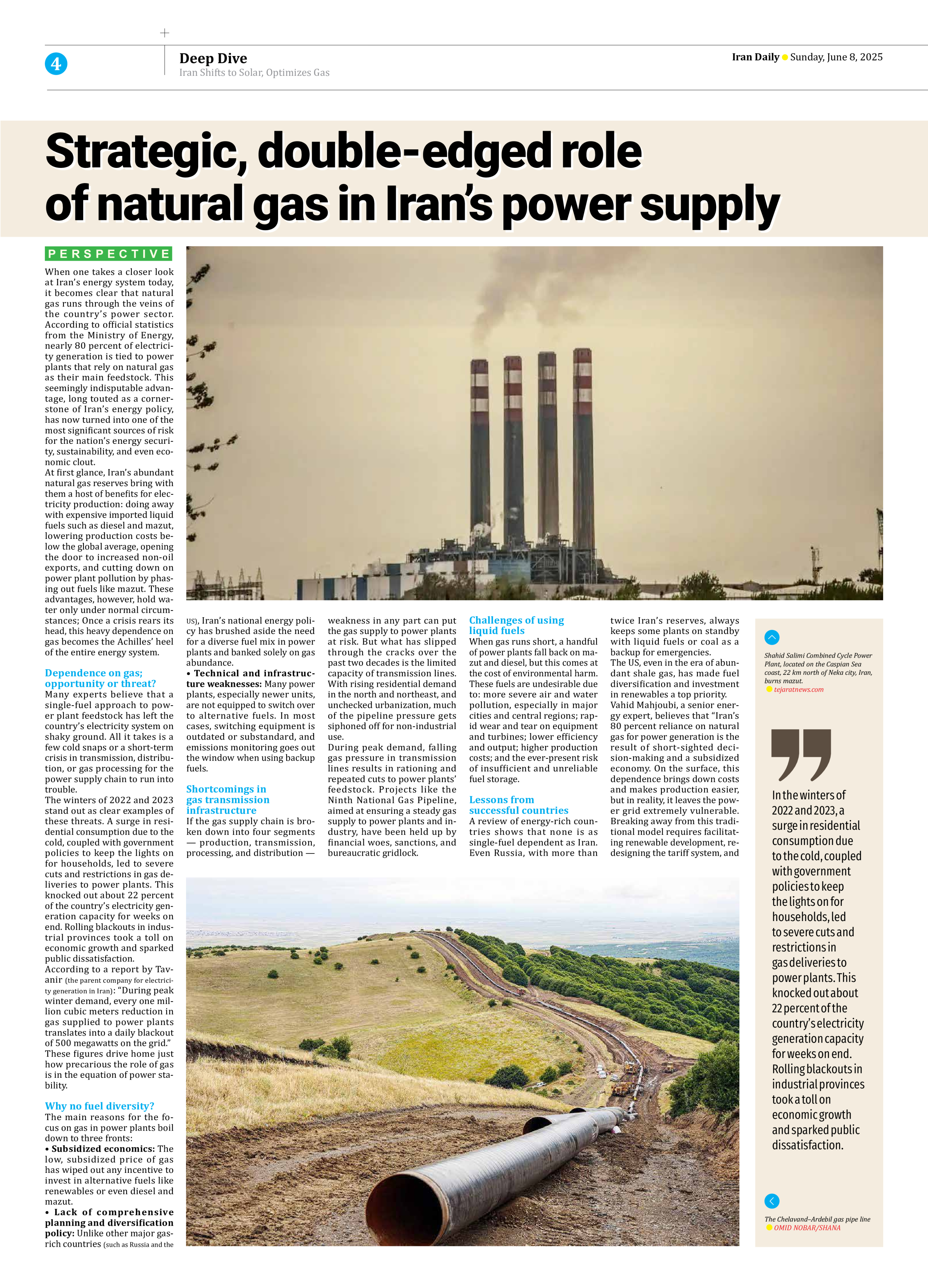


Strategic, double-edged role of natural gas in Iran’s power supply
When one takes a closer look at Iran’s energy system today, it becomes clear that natural gas runs through the veins of the country’s power sector. According to official statistics from the Ministry of Energy, nearly 80 percent of electricity generation is tied to power plants that rely on natural gas as their main feedstock. This seemingly indisputable advantage, long touted as a cornerstone of Iran’s energy policy, has now turned into one of the most significant sources of risk for the nation’s energy security, sustainability, and even economic clout.
At first glance, Iran’s abundant natural gas reserves bring with them a host of benefits for electricity production: doing away with expensive imported liquid fuels such as diesel and mazut, lowering production costs below the global average, opening the door to increased non-oil exports, and cutting down on power plant pollution by phasing out fuels like mazut. These advantages, however, hold water only under normal circumstances; Once a crisis rears its head, this heavy dependence on gas becomes the Achilles’ heel of the entire energy system.
Dependence on gas; opportunity or threat?
Many experts believe that a single-fuel approach to power plant feedstock has left the country’s electricity system on shaky ground. All it takes is a few cold snaps or a short-term crisis in transmission, distribution, or gas processing for the power supply chain to run into trouble.
The winters of 2022 and 2023 stand out as clear examples of these threats. A surge in residential consumption due to the cold, coupled with government policies to keep the lights on for households, led to severe cuts and restrictions in gas deliveries to power plants. This knocked out about 22 percent of the country’s electricity generation capacity for weeks on end. Rolling blackouts in industrial provinces took a toll on economic growth and sparked public dissatisfaction.
According to a report by Tavanir (the parent company for electricity generation in Iran): “During peak winter demand, every one million cubic meters reduction in gas supplied to power plants translates into a daily blackout of 500 megawatts on the grid.”
These figures drive home just how precarious the role of gas is in the equation of power stability.
Why no fuel diversity?
The main reasons for the focus on gas in power plants boil down to three fronts:
• Subsidized economics: The low, subsidized price of gas has wiped out any incentive to invest in alternative fuels like renewables or even diesel and mazut.
• Lack of comprehensive planning and diversification policy: Unlike other major gas-rich countries (such as Russia and the US), Iran’s national energy policy has brushed aside the need for a diverse fuel mix in power plants and banked solely on gas abundance.
• Technical and infrastructure weaknesses: Many power plants, especially newer units, are not equipped to switch over to alternative fuels. In most cases, switching equipment is outdated or substandard, and emissions monitoring goes out the window when using backup fuels.
Shortcomings in gas transmission infrastructure
If the gas supply chain is broken down into four segments — production, transmission, processing, and distribution — weakness in any part can put the gas supply to power plants at risk. But what has slipped through the cracks over the past two decades is the limited capacity of transmission lines. With rising residential demand in the north and northeast, and unchecked urbanization, much of the pipeline pressure gets siphoned off for non-industrial use.
During peak demand, falling gas pressure in transmission lines results in rationing and repeated cuts to power plants’ feedstock. Projects like the Ninth National Gas Pipeline, aimed at ensuring a steady gas supply to power plants and industry, have been held up by financial woes, sanctions, and bureaucratic gridlock.
Challenges of using
liquid fuels
When gas runs short, a handful of power plants fall back on mazut and diesel, but this comes at the cost of environmental harm. These fuels are undesirable due to: more severe air and water pollution, especially in major cities and central regions; rapid wear and tear on equipment and turbines; lower efficiency and output; higher production costs; and the ever-present risk of insufficient and unreliable fuel storage.
Lessons from
successful countries
A review of energy-rich countries shows that none is as single-fuel dependent as Iran. Even Russia, with more than twice Iran’s reserves, always keeps some plants on standby with liquid fuels or coal as a backup for emergencies.
The US, even in the era of abundant shale gas, has made fuel diversification and investment in renewables a top priority.
Vahid Mahjoubi, a senior energy expert, believes that “Iran’s 80 percent reliance on natural gas for power generation is the result of short-sighted decision-making and a subsidized economy. On the surface, this dependence brings down costs and makes production easier, but in reality, it leaves the power grid extremely vulnerable. Breaking away from this traditional model requires facilitating renewable development, redesigning the tariff system, and managing residential gas consumption. There is no guarantee that future winters will play out any better than the last — unless infrastructure and policy are overhauled quickly.”
Key requirements for power security
• Developing transmission infrastructure and reinforcing pipelines: Planning and completing projects like the Ninth National Gas Pipeline and the expansion of pumping and pressure-boosting equipment are vital.
• Revamping the power plant fuel mix: Strong incentives should be given for dual-fuel capability in new plants, old units should be upgraded, and renewables should be pursued not just for environmental reasons but as a matter of national security.
• Promoting public awareness and reforming household gas tariffs: Wasteful consumption habits must be reined in through precise tiered pricing and public education so that the grid is not put under extra strain during peak periods.
• Upgrading technology and reducing losses: Boosting plant efficiency and adopting cutting-edge technologies is needed, provided that technology transfer and international cooperation are brought into play.
• Secure storage of gas and liquid fuels: Establishing strategic reserves for gas and liquid fuels during critical seasons is essential for supply chain stability.
Natural gas is a colossal national asset and a unique opportunity for Iran’s economy. Yet, regrettably, with a one-track policy, it has morphed into a threat to energy security and even national strength. Deep reform of subsidy policies, a redesign of the fuel mix, and expansion of transmission infrastructure are now not just lofty recommendations, but the very conditions for the survival of Iran’s electricity stability. Sticking to the current approach — ignoring fuel diversity and doubling down on subsidy-driven speculation — will trap the country in a vicious cycle of winter blackouts, public discontent, and decaying infrastructure.
The article first appeared in
Persian on Mehr news agency.