







‘National Unity’ in political conduct of Imam Khomeini
Iranian President Masoud Pezeshkian has been insisting that he will be leading a government of “National Unity” and has shown it to be true, especially in picking his cabinet members. From the perspective of the founder of the Islamic Republic of Iran Ayatollah Ruhollah Khomeini as well, National Unity is not just a social necessity but a pivotal strategy for the continuity and stability of the Islamic Revolution. To explore the role of National Unity in Imam Khomeini’s political conduct, we sat down with Yahya Fozi, a political science professor and faculty member at the Institute for Humanities and Cultural Studies. He believes that Imam Khomeini, with a realistic view of Iran’s diverse social fabric, was convinced that without national consensus, cohesion and national strength simply cannot be built up. Therefore, from his viewpoint, National Unity is a rational and strategic necessity for Iran’s survival.
Yahya Fowzi
IRAN DAILY: What place does National Unity hold in Imam Khomeini’s thoughts?
Fowzi: Imam Khomeini never wrote off National Unity as a mere fantasy; rather, he regarded it as a religious, rational, and political necessity for the survival and power of the Islamic establishment — a necessity that still rings true and inspires today. In his political thought, National Unity was not only a political strategy during the Islamic Revolution but also the cornerstone for the Islamic establishment’s stability during its consolidation phase. With a realistic grasp of Iran’s ethnically, religiously, and intellectually diverse society, Imam Khomeini believed that only through collective agreement and acceptance of diversity could unity and integration be brought about.
How do democracy and unity relate to Imam Khomeini’s practical approach?
In practice, Imam Khomeini managed to bring together opposing political groups, diverse social classes, and even critics under slogans like “all together” and “be one hand”. This unity was not a short-term tactic but a religious, rational, and ethical imperative — a necessity that turned democracy into the backbone of National Unity. For him, without broad popular participation and respect for the people’s role, no unity could last.
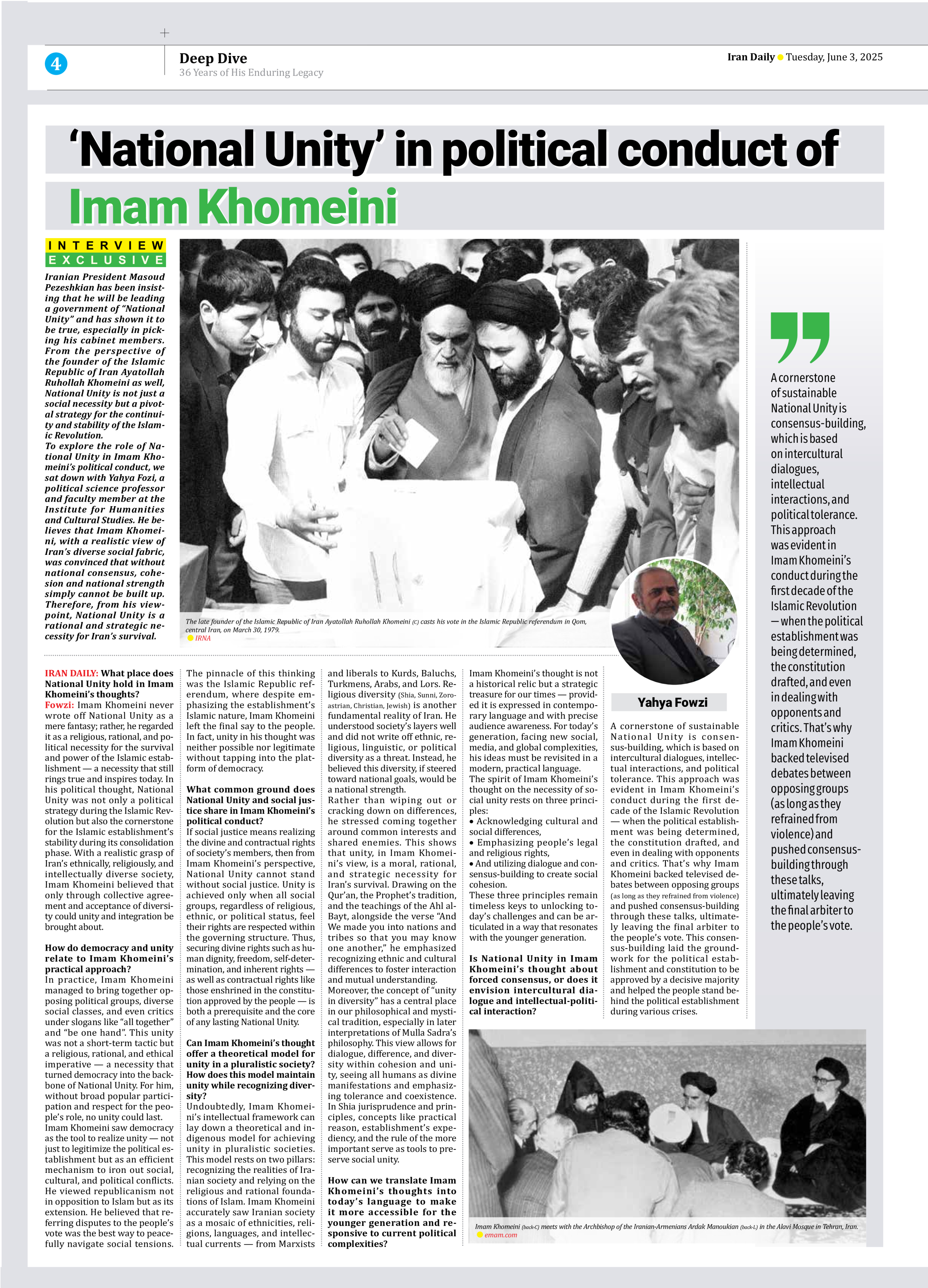
Imam Khomeini saw democracy as the tool to realize unity — not just to legitimize the political establishment but as an efficient mechanism to iron out social, cultural, and political conflicts. He viewed republicanism not in opposition to Islam but as its extension. He believed that referring disputes to the people’s vote was the best way to peacefully navigate social tensions. The pinnacle of this thinking was the Islamic Republic referendum, where despite emphasizing the establishment’s Islamic nature, Imam Khomeini left the final say to the people. In fact, unity in his thought was neither possible nor legitimate without tapping into the platform of democracy.
What common ground does National Unity and social justice share in Imam Khomeini’s political conduct?
If social justice means realizing the divine and contractual rights of society’s members, then from Imam Khomeini’s perspective, National Unity cannot stand without social justice. Unity is achieved only when all social groups, regardless of religious, ethnic, or political status, feel their rights are respected within the governing structure. Thus, securing divine rights such as human dignity, freedom, self-determination, and inherent rights — as well as contractual rights like those enshrined in the constitution approved by the people — is both a prerequisite and the core of any lasting National Unity.
Can Imam Khomeini’s thought offer a theoretical model for unity in a pluralistic society? How does this model maintain unity while recognizing diversity?
Undoubtedly, Imam Khomeini’s intellectual framework can lay down a theoretical and indigenous model for achieving unity in pluralistic societies. This model rests on two pillars: recognizing the realities of Iranian society and relying on the religious and rational foundations of Islam. Imam Khomeini accurately saw Iranian society as a mosaic of ethnicities, religions, languages, and intellectual currents — from Marxists and liberals to Kurds, Baluchs, Turkmens, Arabs, and Lors. Religious diversity (Shia, Sunni, Zoroastrian, Christian, Jewish) is another fundamental reality of Iran. He understood society’s layers well and did not write off ethnic, religious, linguistic, or political diversity as a threat. Instead, he believed this diversity, if steered toward national goals, would be a national strength.
Rather than wiping out or cracking down on differences, he stressed coming together around common interests and shared enemies. This shows that unity, in Imam Khomeini’s view, is a moral, rational, and strategic necessity for Iran’s survival. Drawing on the Qur’an, the Prophet’s tradition, and the teachings of the Ahl al-Bayt, alongside the verse “And We made you into nations and tribes so that you may know one another,” he emphasized recognizing ethnic and cultural differences to foster interaction and mutual understanding.
Moreover, the concept of “unity in diversity” has a central place in our philosophical and mystical tradition, especially in later interpretations of Mulla Sadra’s philosophy. This view allows for dialogue, difference, and diversity within cohesion and unity, seeing all humans as divine manifestations and emphasizing tolerance and coexistence. In Shia jurisprudence and principles, concepts like practical reason, establishment’s expediency, and the rule of the more important serve as tools to preserve social unity.
How can we translate Imam Khomeini’s thoughts into today’s language to make it more accessible for the younger generation and responsive to current political complexities?
Imam Khomeini’s thought is not a historical relic but a strategic treasure for our times — provided it is expressed in contemporary language and with precise audience awareness. For today’s generation, facing new social, media, and global complexities, his ideas must be revisited in a modern, practical language.
The spirit of Imam Khomeini’s thought on the necessity of social unity rests on three principles:
• Acknowledging cultural and social differences,
• Emphasizing people’s legal and religious rights,
• And utilizing dialogue and consensus-building to create social cohesion.
These three principles remain timeless keys to unlocking today’s challenges and can be articulated in a way that resonates with the younger generation.
Is National Unity in Imam Khomeini’s thought about forced consensus, or does it envision intercultural dialogue and intellectual-political interaction?
A cornerstone of sustainable National Unity is consensus-building, which is based on intercultural dialogues, intellectual interactions, and political tolerance. This approach was evident in Imam Khomeini’s conduct during the first decade of the Islamic Revolution — when the political establishment was being determined, the constitution drafted, and even in dealing with opponents and critics. That’s why Imam Khomeini backed televised debates between opposing groups (as long as they refrained from violence) and pushed consensus-building through these talks, ultimately leaving the final arbiter to the people’s vote. This consensus-building laid the groundwork for the political establishment and constitution to be approved by a decisive majority and helped the people stand behind the political establishment during various crises.