







Copy in clipboard...
Evolution of Qoli Darvish Hill from ancient to modern times
The archaeological excavations at Qoli Darvish began in 2003. These excavations revealed that both Qoli Darvish and Shadqoli Khan Hill, located within the urban fabric of Qom, date back roughly six to seven thousand years. It is noteworthy that after these ancient periods, the site of Qoli Darvish remained unoccupied for over a thousand years before experiencing a resurgence and regaining its historical significance, visitiran.ir wrote.
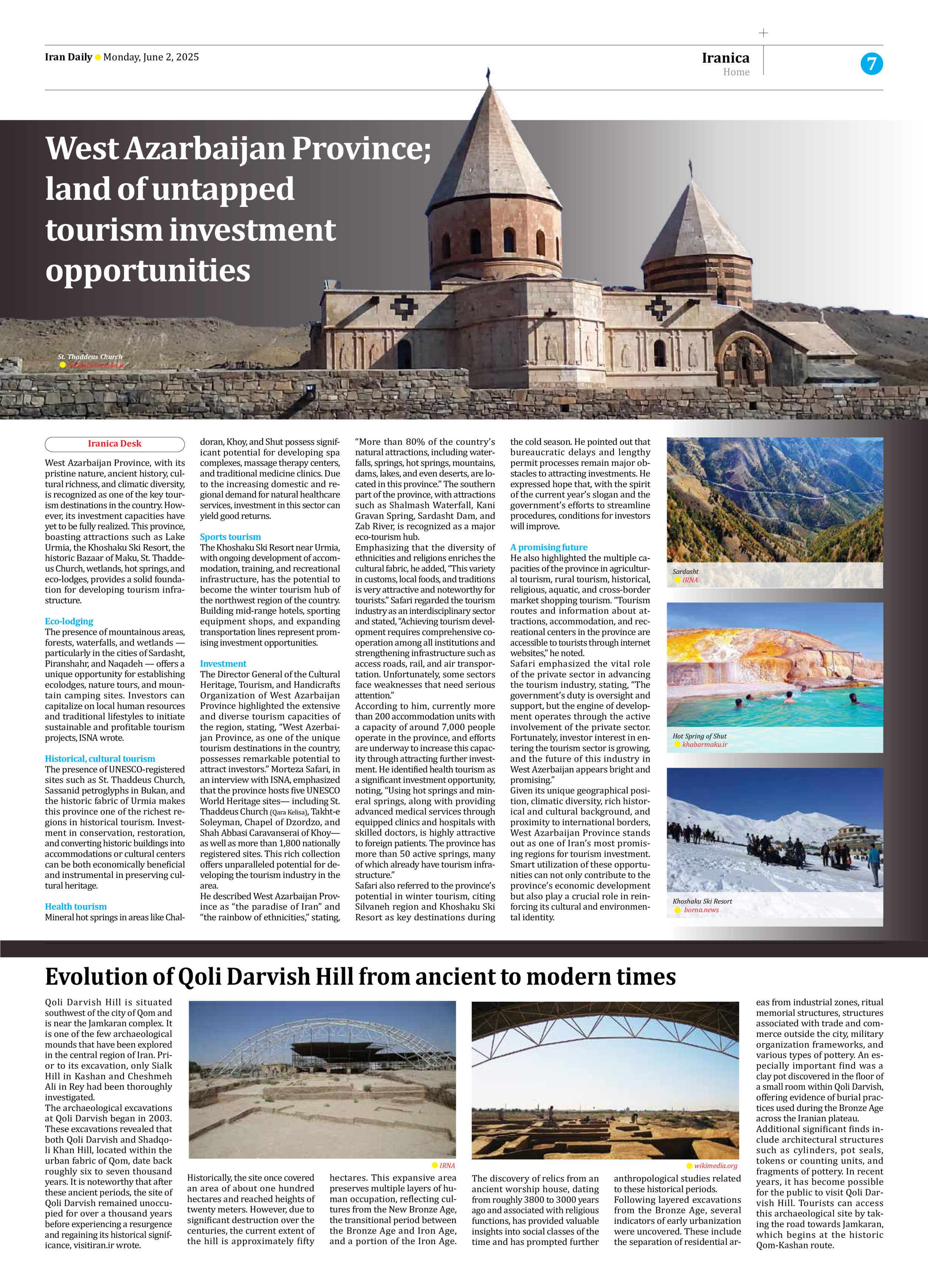
Historically, the site once covered an area of about one hundred hectares and reached heights of twenty meters. However, due to significant destruction over the centuries, the current extent of the hill is approximately fifty hectares. This expansive area preserves multiple layers of human occupation, reflecting cultures from the New Bronze Age, the transitional period between the Bronze Age and Iron Age, and a portion of the Iron Age. The discovery of relics from an ancient worship house, dating from roughly 3800 to 3000 years ago and associated with religious functions, has provided valuable insights into social classes of the time and has prompted further anthropological studies related to these historical periods.
Following layered excavations from the Bronze Age, several indicators of early urbanization were uncovered. These include the separation of residential areas from industrial zones, ritual memorial structures, structures associated with trade and commerce outside the city, military organization frameworks, and various types of pottery. An especially important find was a clay pot discovered in the floor of a small room within Qoli Darvish, offering evidence of burial practices used during the Bronze Age across the Iranian plateau.
Additional significant finds include architectural structures such as cylinders, pot seals, tokens or counting units, and fragments of pottery. In recent years, it has become possible for the public to visit Qoli Darvish Hill. Tourists can access this archaeological site by taking the road towards Jamkaran, which begins at the historic Qom-Kashan route.