





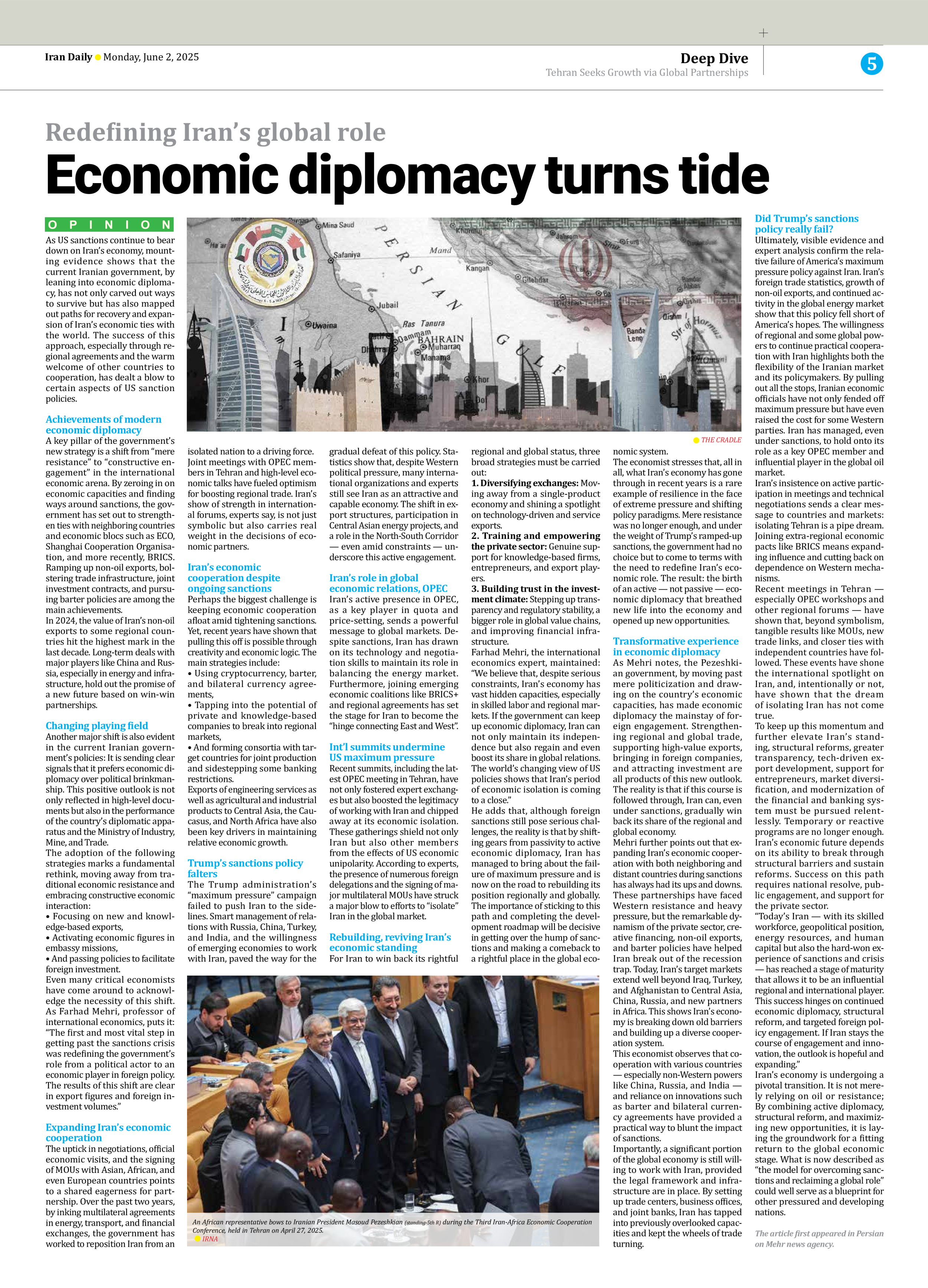


Redefining Iran’s global role
Economic diplomacy turns tide
As US sanctions continue to bear down on Iran’s economy, mounting evidence shows that the current Iranian government, by leaning into economic diplomacy, has not only carved out ways to survive but has also mapped out paths for recovery and expansion of Iran’s economic ties with the world. The success of this approach, especially through regional agreements and the warm welcome of other countries to cooperation, has dealt a blow to certain aspects of US sanction policies.
Achievements of modern economic diplomacy
A key pillar of the government’s new strategy is a shift from “mere resistance” to “constructive engagement” in the international economic arena. By zeroing in on economic capacities and finding ways around sanctions, the government has set out to strengthen ties with neighboring countries and economic blocs such as ECO, Shanghai Cooperation Organisation, and more recently, BRICS. Ramping up non-oil exports, bolstering trade infrastructure, joint investment contracts, and pursuing barter policies are among the main achievements.
In 2024, the value of Iran’s non-oil exports to some regional countries hit the highest mark in the last decade. Long-term deals with major players like China and Russia, especially in energy and infrastructure, hold out the promise of a new future based on win-win partnerships.
Changing playing field
Another major shift is also evident in the current Iranian government’s policies: It is sending clear signals that it prefers economic diplomacy over political brinkmanship. This positive outlook is not only reflected in high-level documents but also in the performance of the country’s diplomatic apparatus and the Ministry of Industry, Mine, and Trade.
The adoption of the following strategies marks a fundamental rethink, moving away from traditional economic resistance and embracing constructive economic interaction:
• Focusing on new and knowledge-based exports,
• Activating economic figures in embassy missions,
• And passing policies to facilitate foreign investment.
Even many critical economists have come around to acknowledge the necessity of this shift. As Farhad Mehri, professor of international economics, puts it: “The first and most vital step in getting past the sanctions crisis was redefining the government’s role from a political actor to an economic player in foreign policy. The results of this shift are clear in export figures and foreign investment volumes.”
Expanding Iran’s economic cooperation
The uptick in negotiations, official economic visits, and the signing of MOUs with Asian, African, and even European countries points to a shared eagerness for partnership. Over the past two years, by inking multilateral agreements in energy, transport, and financial exchanges, the government has worked to reposition Iran from an isolated nation to a driving force.
Joint meetings with OPEC members in Tehran and high-level economic talks have fueled optimism for boosting regional trade. Iran’s show of strength in international forums, experts say, is not just symbolic but also carries real weight in the decisions of economic partners.
Iran’s economic cooperation despite ongoing sanctions
Perhaps the biggest challenge is keeping economic cooperation afloat amid tightening sanctions. Yet, recent years have shown that pulling this off is possible through creativity and economic logic. The main strategies include:
• Using cryptocurrency, barter, and bilateral currency agreements,
• Tapping into the potential of private and knowledge-based companies to break into regional markets,
• And forming consortia with target countries for joint production and sidestepping some banking restrictions.
Exports of engineering services as well as agricultural and industrial products to Central Asia, the Caucasus, and North Africa have also been key drivers in maintaining relative economic growth.
Trump’s sanctions policy falters
The Trump administration’s “maximum pressure” campaign failed to push Iran to the sidelines. Smart management of relations with Russia, China, Turkey, and India, and the willingness of emerging economies to work with Iran, paved the way for the gradual defeat of this policy. Statistics show that, despite Western political pressure, many international organizations and experts still see Iran as an attractive and capable economy. The shift in export structures, participation in Central Asian energy projects, and a role in the North-South Corridor — even amid constraints — underscore this active engagement.
Iran’s role in global economic relations, OPEC
Iran’s active presence in OPEC, as a key player in quota and price-setting, sends a powerful message to global markets. Despite sanctions, Iran has drawn on its technology and negotiation skills to maintain its role in balancing the energy market. Furthermore, joining emerging economic coalitions like BRICS+ and regional agreements has set the stage for Iran to become the “hinge connecting East and West”.
Int’l summits undermine US maximum pressure
Recent summits, including the latest OPEC meeting in Tehran, have not only fostered expert exchanges but also boosted the legitimacy of working with Iran and chipped away at its economic isolation. These gatherings shield not only Iran but also other members from the effects of US economic unipolarity. According to experts, the presence of numerous foreign delegations and the signing of major multilateral MOUs have struck a major blow to efforts to “isolate” Iran in the global market.
Rebuilding, reviving Iran’s economic standing
For Iran to win back its rightful regional and global status, three broad strategies must be carried out:
1. Diversifying exchanges: Moving away from a single-product economy and shining a spotlight on technology-driven and service exports.
2. Training and empowering the private sector: Genuine support for knowledge-based firms, entrepreneurs, and export players.
3. Building trust in the investment climate: Stepping up transparency and regulatory stability, a bigger role in global value chains, and improving financial infrastructure.
Farhad Mehri, the international economics expert, maintained: “We believe that, despite serious constraints, Iran’s economy has vast hidden capacities, especially in skilled labor and regional markets. If the government can keep up economic diplomacy, Iran can not only maintain its independence but also regain and even boost its share in global relations. The world’s changing view of US policies shows that Iran’s period of economic isolation is coming to a close.”
He adds that, although foreign sanctions still pose serious challenges, the reality is that by shifting gears from passivity to active economic diplomacy, Iran has managed to bring about the failure of maximum pressure and is now on the road to rebuilding its position regionally and globally. The importance of sticking to this path and completing the development roadmap will be decisive in getting over the hump of sanctions and making a comeback to a rightful place in the global economic system.
The economist stresses that, all in all, what Iran’s economy has gone through in recent years is a rare example of resilience in the face of extreme pressure and shifting policy paradigms. Mere resistance was no longer enough, and under the weight of Trump’s ramped-up sanctions, the government had no choice but to come to terms with the need to redefine Iran’s economic role. The result: the birth of an active — not passive — economic diplomacy that breathed new life into the economy and opened up new opportunities.
Transformative experience in economic diplomacy
As Mehri notes, the Pezeshkian government, by moving past mere politicization and drawing on the country’s economic capacities, has made economic diplomacy the mainstay of foreign engagement. Strengthening regional and global trade, supporting high-value exports, bringing in foreign companies, and attracting investment are all products of this new outlook. The reality is that if this course is followed through, Iran can, even under sanctions, gradually win back its share of the regional and global economy.
Mehri further points out that expanding Iran’s economic cooperation with both neighboring and distant countries during sanctions has always had its ups and downs. These partnerships have faced Western resistance and heavy pressure, but the remarkable dynamism of the private sector, creative financing, non-oil exports, and barter policies have helped Iran break out of the recession trap. Today, Iran’s target markets extend well beyond Iraq, Turkey, and Afghanistan to Central Asia, China, Russia, and new partners in Africa. This shows Iran’s economy is breaking down old barriers and building up a diverse cooperation system.
This economist observes that cooperation with various countries — especially non-Western powers like China, Russia, and India — and reliance on innovations such as barter and bilateral currency agreements have provided a practical way to blunt the impact of sanctions.
Importantly, a significant portion of the global economy is still willing to work with Iran, provided the legal framework and infrastructure are in place. By setting up trade centers, business offices, and joint banks, Iran has tapped into previously overlooked capacities and kept the wheels of trade turning.
Did Trump’s sanctions policy really fail?
Ultimately, visible evidence and expert analysis confirm the relative failure of America’s maximum pressure policy against Iran. Iran’s foreign trade statistics, growth of non-oil exports, and continued activity in the global energy market show that this policy fell short of America’s hopes. The willingness of regional and some global powers to continue practical cooperation with Iran highlights both the flexibility of the Iranian market and its policymakers. By pulling out all the stops, Iranian economic officials have not only fended off maximum pressure but have even raised the cost for some Western parties. Iran has managed, even under sanctions, to hold onto its role as a key OPEC member and influential player in the global oil market.
Iran’s insistence on active participation in meetings and technical negotiations sends a clear message to countries and markets: isolating Tehran is a pipe dream. Joining extra-regional economic pacts like BRICS means expanding influence and cutting back on dependence on Western mechanisms.
Recent meetings in Tehran — especially OPEC workshops and other regional forums — have shown that, beyond symbolism, tangible results like MOUs, new trade links, and closer ties with independent countries have followed. These events have shone the international spotlight on Iran, and, intentionally or not, have shown that the dream of isolating Iran has not come true.
To keep up this momentum and further elevate Iran’s standing, structural reforms, greater transparency, tech-driven export development, support for entrepreneurs, market diversification, and modernization of the financial and banking system must be pursued relentlessly. Temporary or reactive programs are no longer enough. Iran’s economic future depends on its ability to break through structural barriers and sustain reforms. Success on this path requires national resolve, public engagement, and support for the private sector.
“Today’s Iran — with its skilled workforce, geopolitical position, energy resources, and human capital but also the hard-won experience of sanctions and crisis — has reached a stage of maturity that allows it to be an influential regional and international player. This success hinges on continued economic diplomacy, structural reform, and targeted foreign policy engagement. If Iran stays the course of engagement and innovation, the outlook is hopeful and expanding.”
Iran’s economy is undergoing a pivotal transition. It is not merely relying on oil or resistance; By combining active diplomacy, structural reform, and maximizing new opportunities, it is laying the groundwork for a fitting return to the global economic stage. What is now described as “the model for overcoming sanctions and reclaiming a global role” could well serve as a blueprint for other pressured and developing nations.
The article first appeared in Persian on Mehr news agency.