





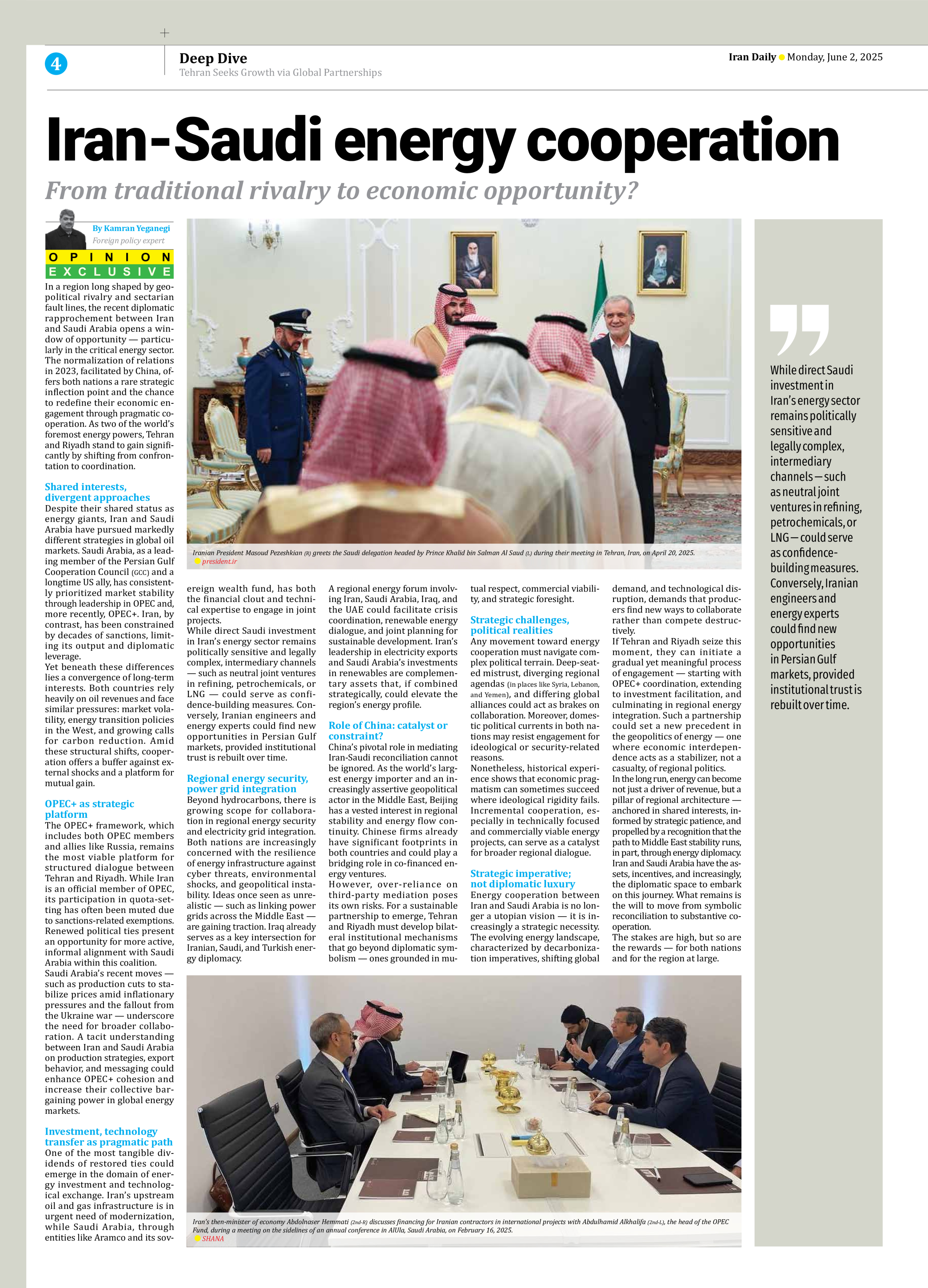


Iran-Saudi energy cooperation
From traditional rivalry to economic opportunity?
By Kamran Yeganegi
Foreign policy expert
In a region long shaped by geopolitical rivalry and sectarian fault lines, the recent diplomatic rapprochement between Iran and Saudi Arabia opens a window of opportunity — particularly in the critical energy sector. The normalization of relations in 2023, facilitated by China, offers both nations a rare strategic inflection point and the chance to redefine their economic engagement through pragmatic cooperation. As two of the world’s foremost energy powers, Tehran and Riyadh stand to gain significantly by shifting from confrontation to coordination.
Shared interests, divergent approaches
Despite their shared status as energy giants, Iran and Saudi Arabia have pursued markedly different strategies in global oil markets. Saudi Arabia, as a leading member of the Persian Gulf Cooperation Council (GCC) and a longtime US ally, has consistently prioritized market stability through leadership in OPEC and, more recently, OPEC+. Iran, by contrast, has been constrained by decades of sanctions, limiting its output and diplomatic leverage.
Yet beneath these differences lies a convergence of long-term interests. Both countries rely heavily on oil revenues and face similar pressures: market volatility, energy transition policies in the West, and growing calls for carbon reduction. Amid these structural shifts, cooperation offers a buffer against external shocks and a platform for mutual gain.
OPEC+ as strategic platform
The OPEC+ framework, which includes both OPEC members and allies like Russia, remains the most viable platform for structured dialogue between Tehran and Riyadh. While Iran is an official member of OPEC, its participation in quota-setting has often been muted due to sanctions-related exemptions. Renewed political ties present an opportunity for more active, informal alignment with Saudi Arabia within this coalition.
Saudi Arabia’s recent moves — such as production cuts to stabilize prices amid inflationary pressures and the fallout from the Ukraine war — underscore the need for broader collaboration. A tacit understanding between Iran and Saudi Arabia on production strategies, export behavior, and messaging could enhance OPEC+ cohesion and increase their collective bargaining power in global energy markets.
Investment, technology transfer as pragmatic path
One of the most tangible dividends of restored ties could emerge in the domain of energy investment and technological exchange. Iran’s upstream oil and gas infrastructure is in urgent need of modernization, while Saudi Arabia, through entities like Aramco and its sovereign wealth fund, has both the financial clout and technical expertise to engage in joint projects.
While direct Saudi investment in Iran’s energy sector remains politically sensitive and legally complex, intermediary channels — such as neutral joint ventures in refining, petrochemicals, or LNG — could serve as confidence-building measures. Conversely, Iranian engineers and energy experts could find new opportunities in Persian Gulf markets, provided institutional trust is rebuilt over time.
Regional energy security, power grid integration
Beyond hydrocarbons, there is growing scope for collaboration in regional energy security and electricity grid integration. Both nations are increasingly concerned with the resilience of energy infrastructure against cyber threats, environmental shocks, and geopolitical instability. Ideas once seen as unrealistic — such as linking power grids across the Middle East — are gaining traction. Iraq already serves as a key intersection for Iranian, Saudi, and Turkish energy diplomacy.
A regional energy forum involving Iran, Saudi Arabia, Iraq, and the UAE could facilitate crisis coordination, renewable energy dialogue, and joint planning for sustainable development. Iran’s leadership in electricity exports and Saudi Arabia’s investments in renewables are complementary assets that, if combined strategically, could elevate the region’s energy profile.
Role of China: catalyst or constraint?
China’s pivotal role in mediating Iran-Saudi reconciliation cannot be ignored. As the world’s largest energy importer and an increasingly assertive geopolitical actor in the Middle East, Beijing has a vested interest in regional stability and energy flow continuity. Chinese firms already have significant footprints in both countries and could play a bridging role in co-financed energy ventures.
However, over-reliance on third-party mediation poses its own risks. For a sustainable partnership to emerge, Tehran and Riyadh must develop bilateral institutional mechanisms that go beyond diplomatic symbolism — ones grounded in mutual respect, commercial viability, and strategic foresight.
Strategic challenges, political realities
Any movement toward energy cooperation must navigate complex political terrain. Deep-seated mistrust, diverging regional agendas (in places like Syria, Lebanon, and Yemen), and differing global alliances could act as brakes on collaboration. Moreover, domestic political currents in both nations may resist engagement for ideological or security-related reasons.
Nonetheless, historical experience shows that economic pragmatism can sometimes succeed where ideological rigidity fails. Incremental cooperation, especially in technically focused and commercially viable energy projects, can serve as a catalyst for broader regional dialogue.
Strategic imperative;
not diplomatic luxury
Energy cooperation between Iran and Saudi Arabia is no longer a utopian vision — it is increasingly a strategic necessity. The evolving energy landscape, characterized by decarbonization imperatives, shifting global demand, and technological disruption, demands that producers find new ways to collaborate rather than compete destructively.
If Tehran and Riyadh seize this moment, they can initiate a gradual yet meaningful process of engagement — starting with OPEC+ coordination, extending to investment facilitation, and culminating in regional energy integration. Such a partnership could set a new precedent in the geopolitics of energy — one where economic interdependence acts as a stabilizer, not a casualty, of regional politics.
In the long run, energy can become not just a driver of revenue, but a pillar of regional architecture — anchored in shared interests, informed by strategic patience, and propelled by a recognition that the path to Middle East stability runs, in part, through energy diplomacy. Iran and Saudi Arabia have the assets, incentives, and increasingly, the diplomatic space to embark on this journey. What remains is the will to move from symbolic reconciliation to substantive cooperation.
The stakes are high, but so are the rewards — for both nations and for the region at large.