





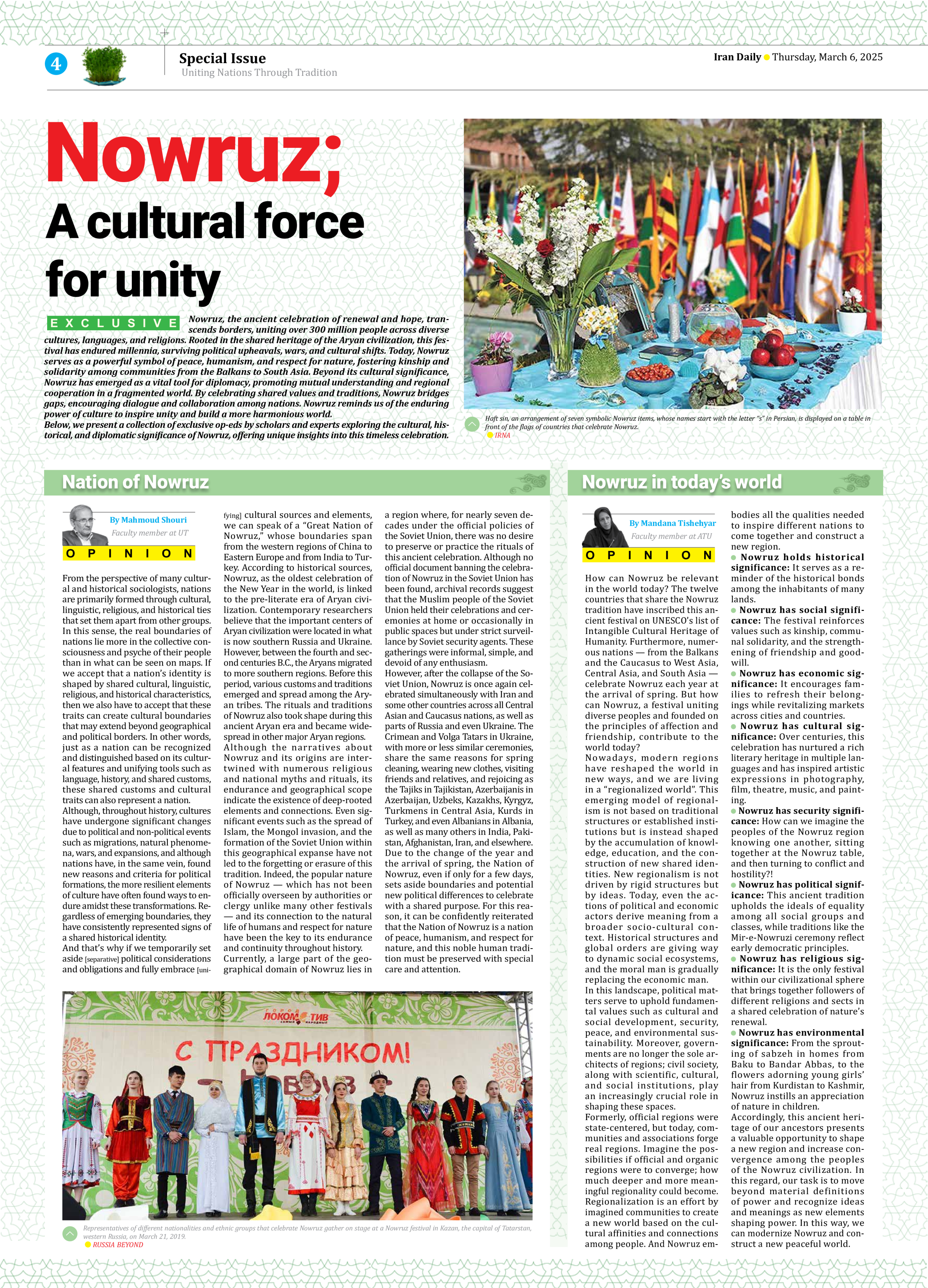


Nowruz; A cultural force for unity
Nowruz, the ancient celebration of renewal and hope, transcends borders, uniting over 300 million people across diverse cultures, languages, and religions. Rooted in the shared heritage of the Aryan civilization, this festival has endured millennia, surviving political upheavals, wars, and cultural shifts. Today, Nowruz serves as a powerful symbol of peace, humanism, and respect for nature, fostering kinship and solidarity among communities from the Balkans to South Asia. Beyond its cultural significance, Nowruz has emerged as a vital tool for diplomacy, promoting mutual understanding and regional cooperation in a fragmented world. By celebrating shared values and traditions, Nowruz bridges gaps, encouraging dialogue and collaboration among nations. Nowruz reminds us of the enduring power of culture to inspire unity and build a more harmonious world. Below, we present a collection of exclusive op-eds by scholars and experts exploring the cultural, historical, and diplomatic significance of Nowruz, offering unique insights into this timeless celebration.
Nation of Nowruz
By Mahmoud Shouri
Faculty member at UT
From the perspective of many cultural and historical sociologists, nations are primarily formed through cultural, linguistic, religious, and historical ties that set them apart from other groups. In this sense, the real boundaries of nations lie more in the collective consciousness and psyche of their people than in what can be seen on maps. If we accept that a nation’s identity is shaped by shared cultural, linguistic, religious, and historical characteristics, then we also have to accept that these traits can create cultural boundaries that may extend beyond geographical and political borders. In other words, just as a nation can be recognized and distinguished based on its cultural features and unifying tools such as language, history, and shared customs, these shared customs and cultural traits can also represent a nation.
Although, throughout history, cultures have undergone significant changes due to political and non-political events such as migrations, natural phenomena, wars, and expansions, and although nations have, in the same vein, found new reasons and criteria for political formations, the more resilient elements of culture have often found ways to endure amidst these transformations. Regardless of emerging boundaries, they have consistently represented signs of a shared historical identity.
And that’s why if we temporarily set aside [separative] political considerations and obligations and fully embrace [unifying] cultural sources and elements, we can speak of a “Great Nation of Nowruz,” whose boundaries span from the western regions of China to Eastern Europe and from India to Turkey. According to historical sources, Nowruz, as the oldest celebration of the New Year in the world, is linked to the pre-literate era of Aryan civilization. Contemporary researchers believe that the important centers of Aryan civilization were located in what is now southern Russia and Ukraine. However, between the fourth and second centuries B.C., the Aryans migrated to more southern regions. Before this period, various customs and traditions emerged and spread among the Aryan tribes. The rituals and traditions of Nowruz also took shape during this ancient Aryan era and became widespread in other major Aryan regions.
Although the narratives about Nowruz and its origins are intertwined with numerous religious and national myths and rituals, its endurance and geographical scope indicate the existence of deep-rooted elements and connections. Even significant events such as the spread of Islam, the Mongol invasion, and the formation of the Soviet Union within this geographical expanse have not led to the forgetting or erasure of this tradition. Indeed, the popular nature of Nowruz — which has not been officially overseen by authorities or clergy unlike many other festivals — and its connection to the natural life of humans and respect for nature have been the key to its endurance and continuity throughout history.
Currently, a large part of the geographical domain of Nowruz lies in a region where, for nearly seven decades under the official policies of the Soviet Union, there was no desire to preserve or practice the rituals of this ancient celebration. Although no official document banning the celebration of Nowruz in the Soviet Union has been found, archival records suggest that the Muslim people of the Soviet Union held their celebrations and ceremonies at home or occasionally in public spaces but under strict surveillance by Soviet security agents. These gatherings were informal, simple, and devoid of any enthusiasm.
However, after the collapse of the Soviet Union, Nowruz is once again celebrated simultaneously with Iran and some other countries across all Central Asian and Caucasus nations, as well as parts of Russia and even Ukraine. The Crimean and Volga Tatars in Ukraine, with more or less similar ceremonies, share the same reasons for spring cleaning, wearing new clothes, visiting friends and relatives, and rejoicing as the Tajiks in Tajikistan, Azerbaijanis in Azerbaijan, Uzbeks, Kazakhs, Kyrgyz, Turkmens in Central Asia, Kurds in Turkey, and even Albanians in Albania, as well as many others in India, Pakistan, Afghanistan, Iran, and elsewhere.
Due to the change of the year and the arrival of spring, the Nation of Nowruz, even if only for a few days, sets aside boundaries and potential new political differences to celebrate with a shared purpose. For this reason, it can be confidently reiterated that the Nation of Nowruz is a nation of peace, humanism, and respect for nature, and this noble human tradition must be preserved with special care and attention.
Nowruz in today’s world
By Mandana Tishehyar
Faculty member at ATU
How can Nowruz be relevant in the world today? The twelve countries that share the Nowruz tradition have inscribed this ancient festival on UNESCO’s list of Intangible Cultural Heritage of Humanity. Furthermore, numerous nations — from the Balkans and the Caucasus to West Asia, Central Asia, and South Asia — celebrate Nowruz each year at the arrival of spring. But how can Nowruz, a festival uniting diverse peoples and founded on the principles of affection and friendship, contribute to the world today?
Nowadays, modern regions have reshaped the world in new ways, and we are living in a “regionalized world”. This emerging model of regionalism is not based on traditional structures or established institutions but is instead shaped by the accumulation of knowledge, education, and the construction of new shared identities. New regionalism is not driven by rigid structures but by ideas. Today, even the actions of political and economic actors derive meaning from a broader socio-cultural context. Historical structures and global orders are giving way to dynamic social ecosystems, and the moral man is gradually replacing the economic man.
In this landscape, political matters serve to uphold fundamental values such as cultural and social development, security, peace, and environmental sustainability. Moreover, governments are no longer the sole architects of regions; civil society, along with scientific, cultural, and social institutions, play an increasingly crucial role in shaping these spaces.
Formerly, official regions were state-centered, but today, communities and associations forge real regions. Imagine the possibilities if official and organic regions were to converge; how much deeper and more meaningful regionality could become.
Regionalization is an effort by imagined communities to create a new world based on the cultural affinities and connections among people. And Nowruz embodies all the qualities needed to inspire different nations to come together and construct a new region.
Nowruz holds historical significance: It serves as a reminder of the historical bonds among the inhabitants of many lands.
Nowruz has social significance: The festival reinforces values such as kinship, communal solidarity, and the strengthening of friendship and goodwill.
Nowruz has economic significance: It encourages families to refresh their belongings while revitalizing markets across cities and countries.
Nowruz has cultural significance: Over centuries, this celebration has nurtured a rich literary heritage in multiple languages and has inspired artistic expressions in photography, film, theatre, music, and painting.
Nowruz has security significance: How can we imagine the peoples of the Nowruz region knowing one another, sitting together at the Nowruz table, and then turning to conflict and hostility?!
Nowruz has political significance: This ancient tradition upholds the ideals of equality among all social groups and classes, while traditions like the Mir-e-Nowruzi ceremony reflect early democratic principles.
Nowruz has religious significance: It is the only festival within our civilizational sphere that brings together followers of different religions and sects in a shared celebration of nature’s renewal.
Nowruz has environmental significance: From the sprouting of sabzeh in homes from Baku to Bandar Abbas, to the flowers adorning young girls’ hair from Kurdistan to Kashmir, Nowruz instills an appreciation of nature in children.
Accordingly, this ancient heritage of our ancestors presents a valuable opportunity to shape a new region and increase convergence among the peoples of the Nowruz civilization. In this regard, our task is to move beyond material definitions of power and recognize ideas and meanings as new elements shaping power. In this way, we can modernize Nowruz and construct a new peaceful world.
‘Nowruz moment’
in regional politics
By Mehdi
Mirmohammadi
Foreign affairs expert
Donald Trump’s meeting with Volodymyr Zelensky at the White House was a glaring sign that the world had once again drifted back into an era dominated by great-power politics. To put it more bluntly, Trump and his vice president’s condescending exchange with Zelensky laid bare what can only be described as a “great-power moment in global affairs.”
This ominous shift had already been set in motion long before: with the Iran nuclear deal being thrown under the bus following Trump’s withdrawal and Europe’s backtracking; with Ukraine becoming collateral damage in the geopolitical tug-of-war between the US and Russia; with Palestinian human rights trampled underfoot in the Gaza conflict; and with Syria and its people paying the price in the post-Assad era. It is bitter to admit, but the world is once again witnessing the fate of nations being determined by the powerful. We have rolled back to a time when great powers divided up weaker nations as they saw fit, cutting deals in their own interest and that of their allies. The “great-power moment” has always been a perilous one for our region and beyond. It was in such moments that the Ottoman Empire was torn apart, the illegitimate state of Israel was brought into being, Germany was split in two, Poland was nearly wiped off the map, and Eastern Europe was swallowed whole. Time and again, these powers have chipped away at the cultural unity and peace of our region — stoking divisions between neighbors, stirring up rivalries among key players, launching military interventions, and resorting to all manner of soft-power tactics to keep nations in check.
Contrary to the dominant narrative in political discourse, which paints our region as one rife with division, this is one of the most cohesive regions in the world. On the one hand, Islam has provided a shared cultural and intellectual foundation that stretches from the Indian subcontinent to Eurasia, Anatolia, the Levant, the Arab world, and the Persian Gulf. On the other, Iranian culture has acted as a unifying force — a belt binding together Anatolia, the Caucasus, the Iranian plateau, Central Asia, and the subcontinent. This Islamic foundation and Iranian cultural bond have historically fostered peace and cooperation among nations.
But here is the harsh truth: the “great-power moment” has repeatedly stood in the way of this natural course. If we are to break free from the vicious cycle of great-power politics, we must carve out alternative regional moments — ones that belong to us, not to external forces. Islam offers the framework for what we can call a “unity moment” — a moment rooted in shared history, despite ethnic, linguistic, and cultural diversity. However, diversity alone is not enough. If it is not reinforced by a unifying structure, it can be easily exploited by great powers and turned into a tool for their own interests.
This is where Nowruz comes into play. Nowruz, with its deep roots across the region, provides that very Islamic unifying structure. By fostering and sustaining a “Nowruz moment” in regional affairs, we can push back against the return of the “great-power moment” and the instability it brings. The Nowruz moment calls for new thoughts and actions, offering fresh perspectives for understanding, tolerance, renewal, and unity while preventing the re-emergence of the “ominous moment of great powers.”
From the Indian subcontinent to Central Asia, from Eurasia to the Caucasus, the Iranian plateau, and Anatolia — these are the lands where the Nowruz moment can rise. Unlike the great-power moment, the Nowruz moment is a people’s moment. It signals a time when the nations of the region, within the blessed framework of Islam, can forge stronger bonds, accept differences, build bridges across divides, and achieve unity in diversity.
In the Nowruz moment, nations take center stage and political affairs do not unfold in their absence. No one is belittled; rather, each nation’s presence is recognized and honored as a vital part of the political landscape. The Nowruz moment does not belong to any single nation — it arises from the harmonious movement of these nations in their quest for truth, goodness, and renewal.
Nowruz heralds peace, human rights
By Anahita Seifi
Faculty member at ATU
The world today is in dire need of a peace that fosters respect for human rights and fundamental freedoms. The international community, in its pursuit of global peace and security, has come to the conclusion that the most effective way to uphold peace is through human rights mechanisms. The recognition of values such as peace and human rights is nothing new in history. However, it should not be overlooked that reaching this point — where peace and human rights are acknowledged as interdependent values — was no easy feat. One cannot fully realize peace without ensuring human rights, and vice versa. The establishment of peace is only possible through a “culture of peace,” which aims to instill the defense of peace in the minds of individuals through education and communication.
Cultural diplomacy plays a key role in fostering and expanding this culture. It paves the way for cooperation, cultural understanding, and the exchange of cultural values, thereby strengthening amicable relations among nations. By focusing on cultural interaction, cultural diplomacy lays the groundwork for a society built on security, human rights, democracy, and peacebuilding. At its core, cultural diplomacy revolves around the exchange of ideas, information, art, and other aspects of culture to enhance mutual understanding. It is about engaging with and influencing other societies through culture.
Iranian culture and civilization have long embodied principles of altruism, human dignity, and peace among different nations, with Nowruz standing out as its most prominent symbol. Nowruz promotes dialogue, reconciliation, and a culture of peace, reinforcing unity, human rights, and human dignity. For centuries, vast regions of Asia have celebrated Nowruz in grand fashion. The festival serves as a reminder of monotheism, gratitude, mutual respect, and an opportunity to cleanse societies of impurities. Thus, Nowruz holds the potential to bring different ethnicities and nations together, fostering peace and friendship. UNESCO officially registered Nowruz as an intangible cultural heritage on September 30, 2009. Among the most influential cultural assets, Nowruz stands as a deeply symbolic tradition filled with cultural emblems and spiritual messages. Understanding how to leverage Nowruz as a diplomatic tool is key to achieving both regional and transregional peace. Beyond its historical roots in Iranian civilization, Nowruz serves as an avenue for cross-cultural dialogue and the promotion of peace and stability. At its core, Nowruz and its associated traditions carry profound messages of solidarity, hope, and the pursuit of a better future.
The Middle East, for instance, has long been a cradle of diverse civilizations, resulting in an unparalleled ethnic, religious, and cultural mosaic. However, in the absence of coexistence policies, this diversity has, at times, created a fertile ground for security challenges.
Therefore, within the strategic framework of national security, aimed at preserving and promoting peace and stability and preventing threats, festivals and rituals can be established that are attractive and respected by all societies and cultures. Such celebrations and rituals emphasize the shared values among all societies and cultures, ensuring that no culture or society has confronted or rejected them over the years but has embraced them instead.
Among the most significant examples of such traditions is Nowruz, a festival shared across ethnic groups shaped by Iranian civilization. It has the power to reinforce both regional identity and solidarity while fostering a peaceful environment through cultural values such as human dignity, forgiveness, and mutual respect.
Revitalizing and expanding this ancient tradition through modern forms like cultural and public diplomacy can serve as a preventive measure against conflicts across culturally connected nations. More precisely, Nowruz, as a common heritage among various nations, provides a fertile ground for cultural exchange and mutual understanding. Shared customs, culinary traditions, music, and other cultural elements tied to Nowruz can bridge gaps between societies, deepening cross-cultural appreciation. This intrinsic connection between Nowruz and diplomacy underscores its significance.
For centuries, Nowruz has remained a focal point for cultural and human interactions across Eurasia, retaining its role as a fundamental element of national identity for many nations in the region. Recognized by UNESCO as an intangible cultural heritage of humanity, Nowruz is widely regarded by regional states as an integral part of their civilizational identity. Nowruz and its importance to national identities in the region, coupled with its image as a ceremony promoting a culture of peace, make it an ideal candidate for successful cultural diplomacy. Successfully leveraging this shared tradition with other Nowruz-celebrating nations can extend its influence beyond cultural diplomacy, creating new avenues in broader foreign policy strategies and offering new horizons for cooperation in various aspects of foreign policy.
As a shared cultural tradition in Eurasia, Nowruz offers a diplomatic and cultural mechanism to strengthen regional relations. From an anthropological perspective, traditions like Nowruz — rooted in unity, harmony, and respect for human rights and the environment — underscore one key insight: the deep connection between Nowruz and the pursuit of lasting peace. A peace that is thoughtful and stems from the pure thoughts embedded within the human spirit. Thus, the commemoration of Nowruz is a direct manifestation of a higher goal: strengthening global peace through the respect and preservation of national cultures, world heritage, and cultural diversity.
By celebrating Nowruz, societies honor their roots, history, and the values that have shaped civilizations for centuries.
The United Nations General Assembly adopted the resolution “International Day of Nowruz” on February 13, 2010 as a symbol of a culture of peace. For the first time in the UN’s history, “Iranian Nowruz” was granted official international recognition. Nowruz represents a shared identity that fosters convergence among nations. It embodies a discourse that naturally gives rise to peace — a peace that the region and the world desperately need now more than ever.
Nowruz diplomacy; A cultural bridge
By Elham Abedini
Internation relations expert
Nowruz, the Persian New Year, is celebrated by more than 300 million people globally, mainly in neighboring countries. This festival brings together millions of individuals from various backgrounds and traditions, all united by a shared belief in joy, renewal, and hope that is embodied in the celebration of Nowruz.
Beyond its cultural significance, Nowruz acts as a potent diplomatic instrument. It presents a distinctive opportunity to foster peace, unity, and mutual understanding among nations in a world frequently characterized by political tensions and conflicts. As an ancient festival recognized by UNESCO as part of the Representative List of the Intangible Cultural Heritage of Humanity, Nowruz carries a message of renewal that resonates across cultures and borders, presenting an opportunity for cooperation. Understanding how to fully leverage Nowruz diplomacy is crucial, and the key to this lies in the media’s role. The media serves as a bridge, connecting people and promoting appreciation for cultural diversity. By raising awareness about Nowruz and its significance, the media can present this beautiful festival to a regional audience and encourage governments to acknowledge its potential as a diplomatic tool.
Covering Nowruz celebrations is crucial for highlighting the festival’s historical and cultural importance through documentaries, news reports, and feature articles. The traditions, rituals, and values associated with Nowruz resonate with everyone who celebrates it, regardless of their background or nationality. By showcasing the festival’s role in promoting peace and unity, the media can inspire individuals to value the importance of cultural diplomacy.
At the Second Tehran Dialogue Forum, held on March 16, 2021, Iran’s then Minister of Foreign Affairs, Mohammad Javad Zarif, emphasized the significance of Nowruz in fostering a sense of shared destiny. Zarif stated, “Nowruz is a celebration of renewal and hope, a time when we come together to reflect on our shared values and common destiny. It serves as a powerful reminder of the importance of cultural diplomacy in promoting peace and unity.” These remarks highlight the potential of Nowruz diplomacy to unite people and address regional challenges.
Nowruz diplomacy is not merely about celebrating a festival; it is about using the cultural significance of Nowruz to encourage regional cooperation, foster cultural understanding, and promote peace and stability in the region.
By covering diplomatic initiatives related to Nowruz, the media can highlight the festival’s potential to address regional challenges. This media attention can encourage other countries to participate in similar efforts, fostering a sense of global unity.
Furthermore, media coverage of Nowruz diplomacy can encourage governments to acknowledge the festival’s value as a diplomatic tool. By highlighting successful diplomatic initiatives and the positive effects of cultural exchanges, the media can motivate policymakers to support and invest in Nowruz-related diplomatic efforts. Governments can draw lessons from Nowruz diplomacy to strengthen regional cooperation and address pressing global challenges. By recognizing the cultural and diplomatic importance of the festival, they can strive to promote peace and unity on a larger scale.
Additionally, Nowruz has a significant economic impact. The Nowruz holiday season generates substantial economic activity, contributing billions of dollars to the economies of the countries where it is celebrated through increased tourism, retail sales, and cultural events. This economic aspect further underscores the importance of Nowruz as a valuable cultural and diplomatic asset.
Overall, Nowruz diplomacy offers a distinctive opportunity to foster peace, unity, and mutual understanding among nations by leveraging the cultural and historical significance of the Persian New Year. As UNESCO stated, “Nowruz promotes the values of peace and solidarity between generations and within families, as well as reconciliation and neighborliness, thus contributing to cultural diversity and friendship among peoples.” By covering diplomatic initiatives related to Nowruz, the media can emphasize the festival’s potential to tackle regional challenges. This media focus can inspire other countries to engage in similar efforts, nurturing a sense of global unity.