





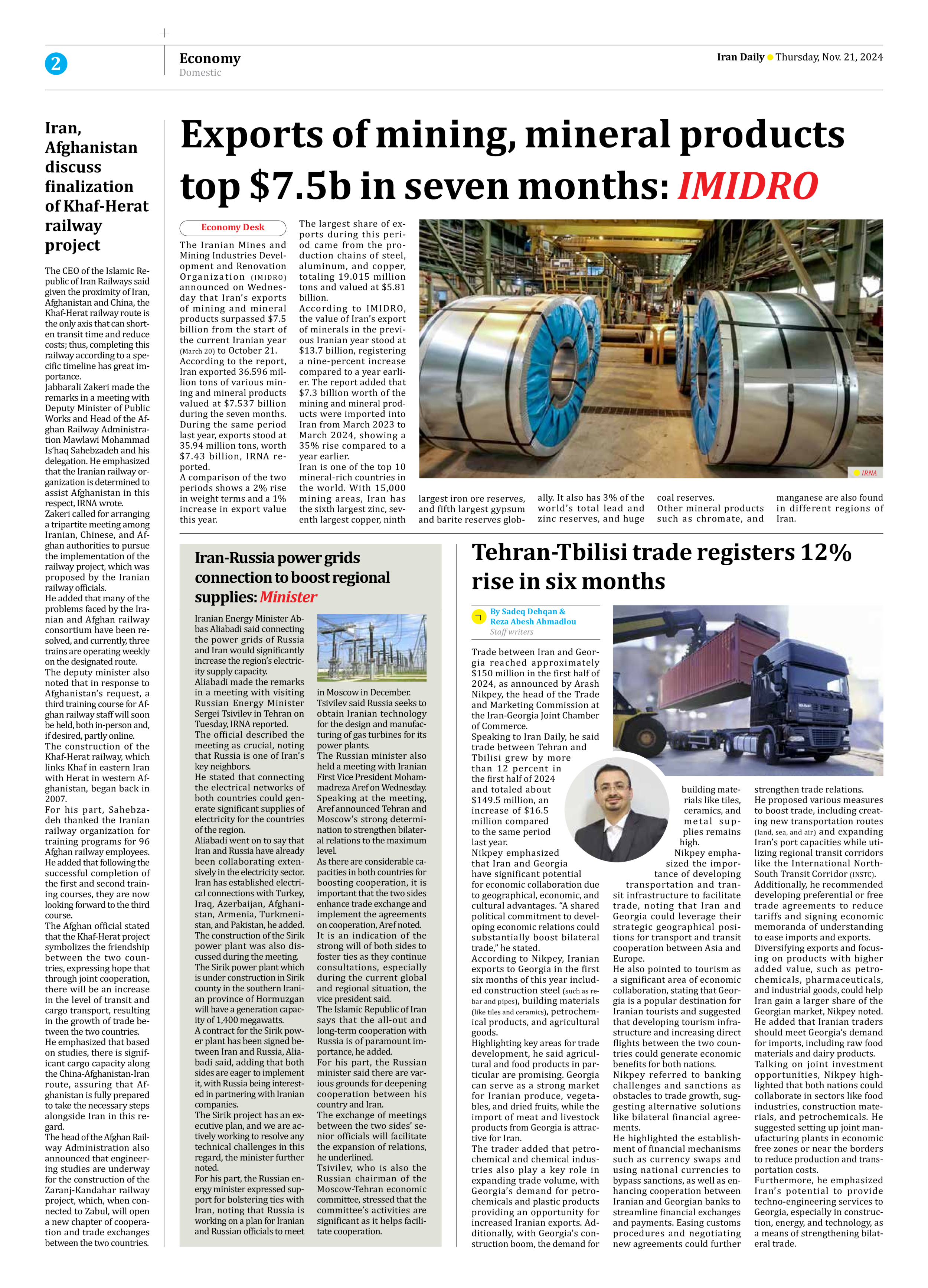


Tehran-Tbilisi trade registers 12% rise in six months
By Sadeq Dehqan &
Reza Abesh Ahmadlou
Staff writers
Trade between Iran and Georgia reached approximately $150 million in the first half of 2024, as announced by Arash Nikpey, the head of the Trade and Marketing Commission at the Iran-Georgia Joint Chamber of Commerce.
Speaking to Iran Daily, he said trade between Tehran and Tbilisi grew by more than 12 percent in the first half of 2024 and totaled about $149.5 million, an increase of $16.5 million compared to the same period last year.
Nikpey emphasized that Iran and Georgia have significant potential for economic collaboration due to geographical, economic, and cultural advantages. “A shared political commitment to developing economic relations could substantially boost bilateral trade,” he stated.
According to Nikpey, Iranian exports to Georgia in the first six months of this year included construction steel (such as rebar and pipes), building materials (like tiles and ceramics), petrochemical products, and agricultural goods.
Highlighting key areas for trade development, he said agricultural and food products in particular are promising. Georgia can serve as a strong market for Iranian produce, vegetables, and dried fruits, while the import of meat and livestock products from Georgia is attractive for Iran.
The trader added that petrochemical and chemical industries also play a key role in expanding trade volume, with Georgia’s demand for petrochemicals and plastic products providing an opportunity for increased Iranian exports. Additionally, with Georgia’s construction boom, the demand for building materials like tiles, ceramics, and metal supplies remains high.
Nikpey emphasized the importance of developing transportation and transit infrastructure to facilitate trade, noting that Iran and Georgia could leverage their strategic geographical positions for transport and transit cooperation between Asia and Europe.
He also pointed to tourism as a significant area of economic collaboration, stating that Georgia is a popular destination for Iranian tourists and suggested that developing tourism infrastructure and increasing direct flights between the two countries could generate economic benefits for both nations.
Nikpey referred to banking challenges and sanctions as obstacles to trade growth, suggesting alternative solutions like bilateral financial agreements.
He highlighted the establishment of financial mechanisms such as currency swaps and using national currencies to bypass sanctions, as well as enhancing cooperation between Iranian and Georgian banks to streamline financial exchanges and payments. Easing customs procedures and negotiating new agreements could further strengthen trade relations.
He proposed various measures to boost trade, including creating new transportation routes (land, sea, and air) and expanding Iran’s port capacities while utilizing regional transit corridors like the International North-South Transit Corridor (INSTC).
Additionally, he recommended developing preferential or free trade agreements to reduce tariffs and signing economic memoranda of understanding to ease imports and exports.
Diversifying exports and focusing on products with higher added value, such as petrochemicals, pharmaceuticals, and industrial goods, could help Iran gain a larger share of the Georgian market, Nikpey noted.
He added that Iranian traders should meet Georgia’s demand for imports, including raw food materials and dairy products.
Talking on joint investment opportunities, Nikpey highlighted that both nations could collaborate in sectors like food industries, construction materials, and petrochemicals. He suggested setting up joint manufacturing plants in economic free zones or near the borders to reduce production and transportation costs.
Furthermore, he emphasized Iran’s potential to provide techno-engineering services to Georgia, especially in construction, energy, and technology, as a means of strengthening bilateral trade.